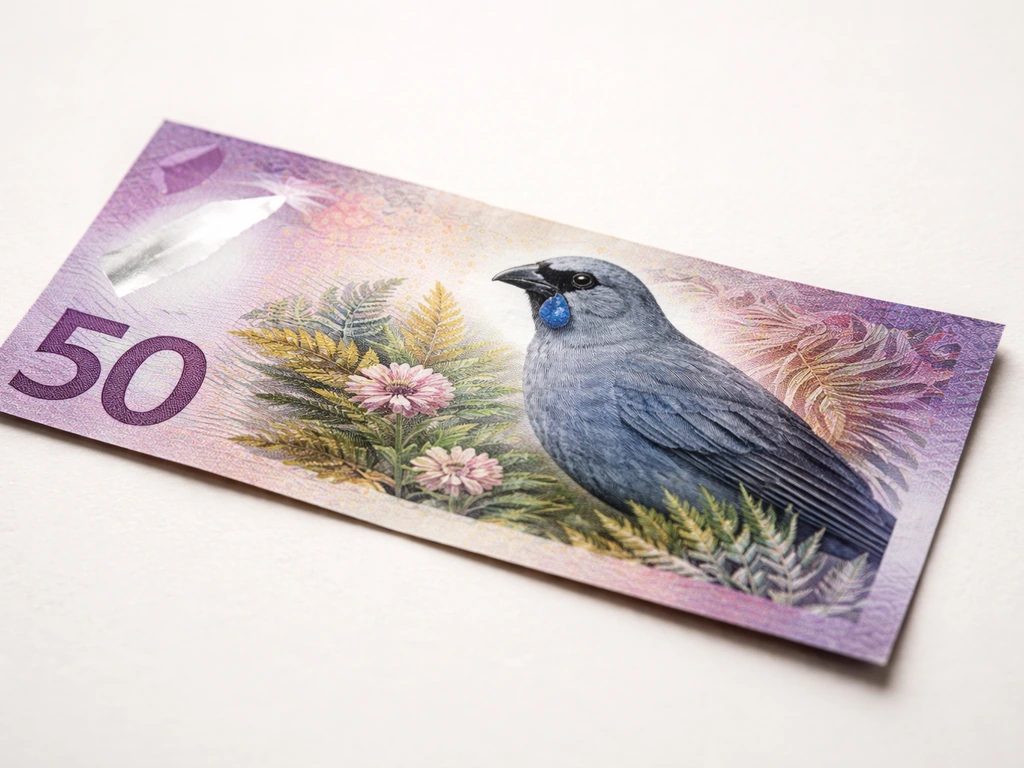
The bird on the NZ $50 note is the kōkako, a native New Zealand forest bird also known as the blue wattled crow. It appears on the back of the purple $50 banknote, while the front features the portrait of Sir Apirana Ngata, the prominent Māori leader and politician. The Reserve Bank of New Zealand describes the NZ$50 banknote as featuring Sir Apirana Ngata on the front and kōkako on the back.
What Bird Is on the NZ 50 Dollar Note? Identify It

Marcus Chen
15 May 2026
Exactly where to find the kōkako on the note
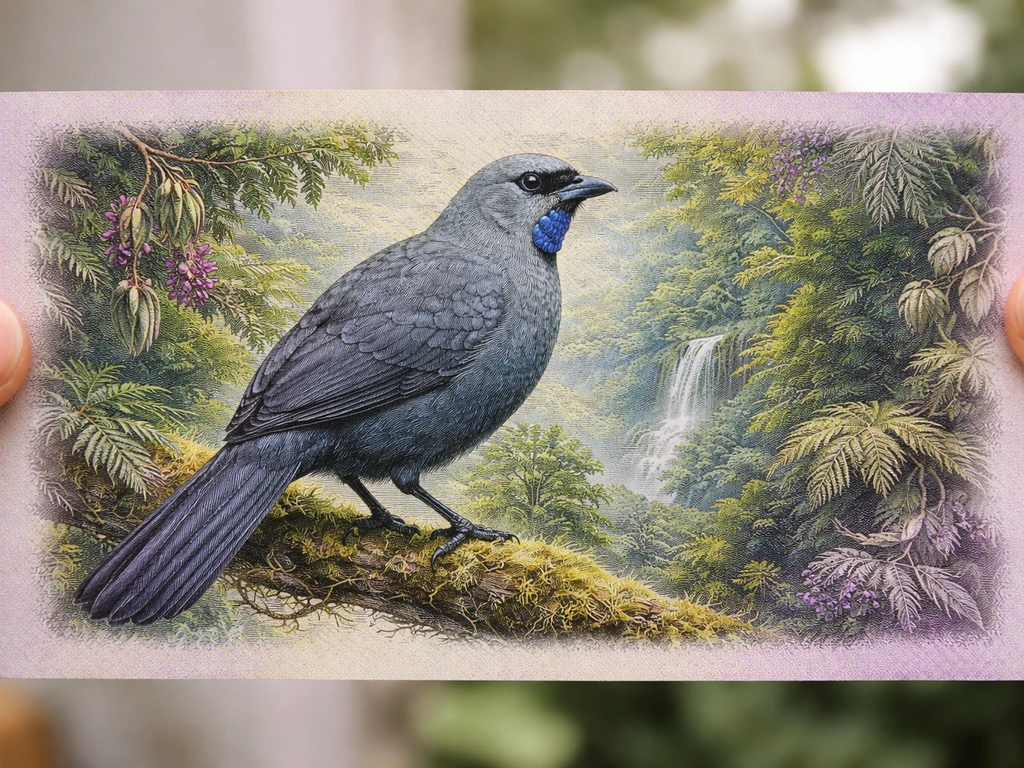
Flip the $50 note over to the back and you will see the kōkako depicted in the main artwork, surrounded by native New Zealand forest imagery. The bird is shown in enough detail to pick out its key features: a rounded body, a short curved beak, and the distinctive fleshy wattles at the base of the bill. On the North Island kōkako, those wattles are blue, which is also how you will often see it described.
If you are holding a Series 7 note (circulated from 16 May 2016 onwards, which is what most people have today), there is also a holographic window near one edge of the note. Tilt the note under a light and you will see the kōkako's silhouette in that window, with a colour-changing bar rolling across it as the angle changes. This is one of the Reserve Bank of New Zealand's built-in security features, and it doubles as a quick visual confirmation of exactly which bird the note is celebrating.
Key visual cues to confirm it is a kōkako
- Blue fleshy wattles at the base of the beak (the defining feature of the North Island kōkako)
- Slate-grey plumage with a black mask across the face
- Compact, rounded body with a relatively long tail
- Short, arched beak (not a long wading-bird bill)
- Holographic window silhouette on Series 7 notes shows a distinct rounded body outline consistent with a kōkako
What the kōkako means for New Zealand
The kōkako (Callaeas wilsoni on the North Island, Callaeas cinereus on the South Island) is endemic to New Zealand, meaning it exists nowhere else on Earth. It belongs to the wattlebird family Callaeidae, a group unique to the islands. That exclusivity is a big part of why the bird carries so much cultural weight.
The kōkako is especially known for its haunting, organ-like call that carries through native bush. The Beehive says kōkako is iconic, highlighting the bird’s song and how it evokes New Zealand native forests, linking it to cultural recognition beyond biology iconic status and highlights its song and role evoking native forests. For many New Zealanders, hearing that call is synonymous with deep, healthy forest. The New Zealand government has highlighted this connection explicitly, with conservation milestones for kōkako reported as national news because recovering the bird's population is seen as recovering something fundamentally New Zealand.
It is worth noting that the kōkako is not New Zealand's official national bird (that title belongs to the kiwi). But the kōkako has a strong claim as an emblem of the country's unique ecological heritage, and its appearance on the $50 note is a deliberate choice to celebrate native fauna alongside prominent New Zealanders. The Series 5 redesign and subsequent Series 7 update both reinforced this theme of pairing distinguished people on the front with iconic native birds on the back.
Why New Zealand puts birds on its banknotes
The Reserve Bank of New Zealand has consistently used banknote design to reflect national identity. The broad framework across multiple series has been to feature significant New Zealanders on the front and native flora and fauna on the back. Birds feature prominently because New Zealand's avian biodiversity is one of the most remarkable in the world, and many of the country's native birds exist nowhere else.
The Series 7 'Brighter Money' banknotes introduced in 2016 continued this tradition with updated imagery and sharper print reproduction. Each denomination carries a different bird: for example, the $10 note and $20 note each feature their own native species, and if you are curious about those, the pattern of pairing an important New Zealander with a native bird is consistent across the range.
The $20 note features a different native bird, so knowing the specific denomination helps you confirm which species you are looking at. If you are wondering what bird is on the NZ $10 dollar note, it is another native species chosen to highlight New Zealand’s avian life the $10 note. On the 10 cent coin, the bird design is different, so it is worth checking the coin's specific engraving or official descriptions $10 note.
The $50 purple note with the kōkako fits squarely within that design philosophy.
Placing the kōkako on the $50 also serves an indirect conservation purpose. When a threatened or recovering species appears on currency, it raises public awareness. The kōkako has been the subject of significant conservation effort in New Zealand, and its profile on everyday currency keeps it in the public eye.
Can't quite make out the bird? Here's how to confirm it
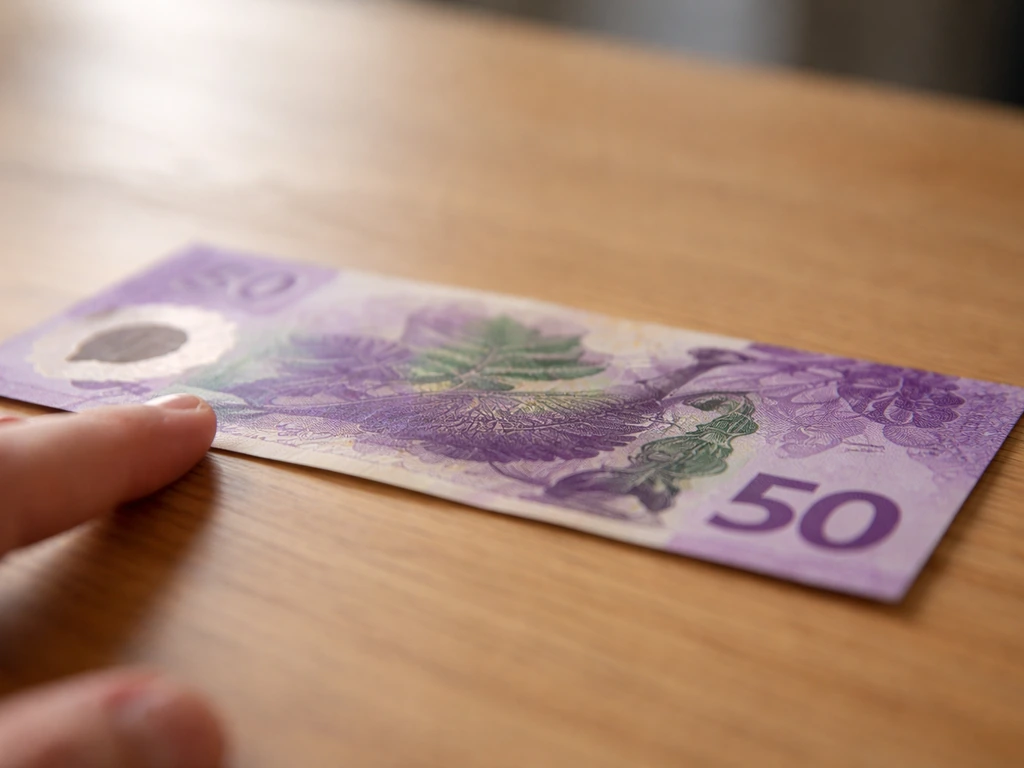
If you are looking at the note in a photo or under poor lighting and the bird isn't immediately clear, here are practical ways to confirm what you are seeing.
- Check the note colour first: the $50 note is purple. If the note in front of you is a different colour, you have a different denomination.
- Flip to the back: the bird is on the reverse, not the portrait side. The front shows Sir Apirana Ngata.
- Look for the holographic window on Series 7 notes: tilt the note and a bright bar rolls across a bird silhouette. The rounded, compact shape of the silhouette is distinctly kōkako.
- Zoom in on a photo or use good directional light: look for the blue wattles at the base of the beak and the black facial mask. These two features together are unmistakably kōkako.
- Compare against a reference: the Reserve Bank of New Zealand's website (rbnz.govt.nz) has a denomination-by-denomination breakdown confirming kōkako on the $50.
- Watch for series differences: older Series 5 notes also featured the kōkako but with a different artistic style. The bird is the same; the rendering is more stylised on older notes versus more naturalistically detailed on Series 7.
Common look-alikes to rule out
The kōkako could be confused with a few other native birds if you are only seeing a silhouette or a blurry photo. The tūī also has throat ornaments and a curved beak but is more slender and has white throat feathers. The kererū (native pigeon) is rounder and heavier-looking. Neither of these appears on the $50. If the bird has a compact, rounded body, a black mask, and those telltale blue wattles, it is the kōkako and you have the right note.
| Feature | Kōkako ($50) | Tūī | Kererū |
|---|---|---|---|
| Body shape | Compact, rounded | Slender, upright | Heavy, pigeon-like |
| Beak | Short, arched | Long, curved | Short, straight |
| Distinctive marking | Blue wattles, black mask | White throat feathers | White breast, iridescent wings |
| On NZ currency? | Yes, $50 note back | No | No |
Once you know to look for the blue wattles and the black mask, the kōkako is instantly recognisable on the note. The kōkako is also the bird featured on the reverse of New Zealand's $50 purple banknote. It is a bird that rewards a second look, which is fitting for a species with such a rich place in New Zealand's natural and cultural history.
FAQ
How can I tell if I have the NZ $50 note showing the kōkako, or a different version of the design?
Check the back artwork first. On the $50, the kōkako appears on the back, not the front, and the bird should have blue wattles at the base of the bill. Series 7 specifically adds a holographic window that shows a silhouette when tilted, which helps confirm you are viewing the intended security-and-design layout.
What if the wattles on my $50 note look unclear, or the print is faded?
Look at the combination of features rather than only the wattles. The kōkako on the note is depicted with a compact, rounded body and a short, curved beak. Even if the wattles are less vivid due to wear, the overall shape and the head area typically still match the kōkako style used on the note.
Do North Island and South Island kōkako look different on the $50 note?
Yes in general, North Island kōkako are commonly described with blue wattles, while South Island kōkako are associated with different wattle colouring. The $50 note artwork is designed so the bird is recognizable by its wattles and overall likeness, and the visual cues people typically notice are the blue wattles on the note.
Is the bird on the NZ $50 note definitely the kōkako, even if I only see a silhouette in a shadowy photo?
Usually, yes if the note is the NZ $50. The most reliable check is the back-of-note placement and the recognizable head cues once the photo is clearer. If it is truly only a silhouette, rely on the note’s other elements too, especially the Series 7 holographic window on circulated notes (from 16 May 2016 onwards).
Could the bird be mistaken for a tūī or kererū when looking at the note quickly?
It can be confused in a blurred image. The tūī is more slender and has different throat markings, and the kererū has a heavier, rounder pigeon look. On the $50, the kōkako is the bird with a compact rounded body plus the distinctive blue wattle area near the bill.
What should I look for on the front of the $50 note if I am confirming authenticity as well as the bird?
The front portrait should be Sir Apirana Ngata. If your goal is both identification and a quick check, confirm the denomination, the front portrait, and, for Series 7, the tilt-sensitive holographic window on the back area where the security feature is placed.
Is the bird on the $50 note the same as any bird on other NZ banknotes?
No. In the Series 7 “Brighter Money” range, each denomination highlights a different native bird. So you cannot assume the same species from another note denomination, even though the overall design theme of native birds paired with prominent people is consistent.