Ghana's national bird is blank" rel="noopener noreferrer">the Tawny Eagle (Aquila rapax). You'll find it prominently displayed on the country's coat of arms as two golden Tawny Eagles, one on each side, and that heraldic role is the clearest official link between this bird and Ghanaian national identity.
What Is the National Bird of Ghana? Meaning and Facts

Marcus Chen
18 May 2026
What the Tawny Eagle Means to Ghana
Eagles have carried the same core message across cultures for thousands of years: strength, vision, and sovereignty. Ghana's choice of the Tawny Eagle is no different. The bird sits on the coat of arms as a supporter, flanking the shield, which in heraldic tradition means it literally holds the national symbol up. That positioning isn't decorative; it signals that the eagle is a guardian of the nation.
In Ghanaian symbolism, the Tawny Eagle represents courage and freedom, values that carried enormous weight for a country that gained independence from British colonial rule in 1957. The eagle's sharp vision is also read as a metaphor for national foresight and the ability to see clearly into the future, which resonated strongly in the early years of building a new sovereign state.
How the Tawny Eagle Became Ghana's Symbol
Ghana's coat of arms was introduced on 4 March 1957, the same year the country declared independence and became the first sub-Saharan African nation to do so. The coat of arms was designed as a complete national symbol package, and the two golden Tawny Eagles were incorporated as supporters from the very beginning. The Ghana Permanent Mission to the United Nations explains that the coat of arms’ supporters are “two golden Tawny eagles,” tying them directly to Ghana’s national symbolism. This means the bird's role as a national emblem is as old as the modern Ghanaian state itself.
The selection wasn't arbitrary. The Tawny Eagle is a real bird found across West Africa, including Ghana's region, so it wasn't an imported or purely imaginary heraldic creature. Choosing a bird with an actual local presence gave the symbol an authentic grounding in the natural landscape of the country.
It's worth noting that some sources describe the Tawny Eagle specifically as Ghana's 'national animal' rather than 'national bird.' The distinction matters a little: Ghana does not appear to have a separately designated national bird in the way some countries maintain distinct categories for national animal, national bird, national flower, and so on. The Tawny Eagle covers all of those roles in one, primarily through its place on the coat of arms.
What the Tawny Eagle Actually Looks Like
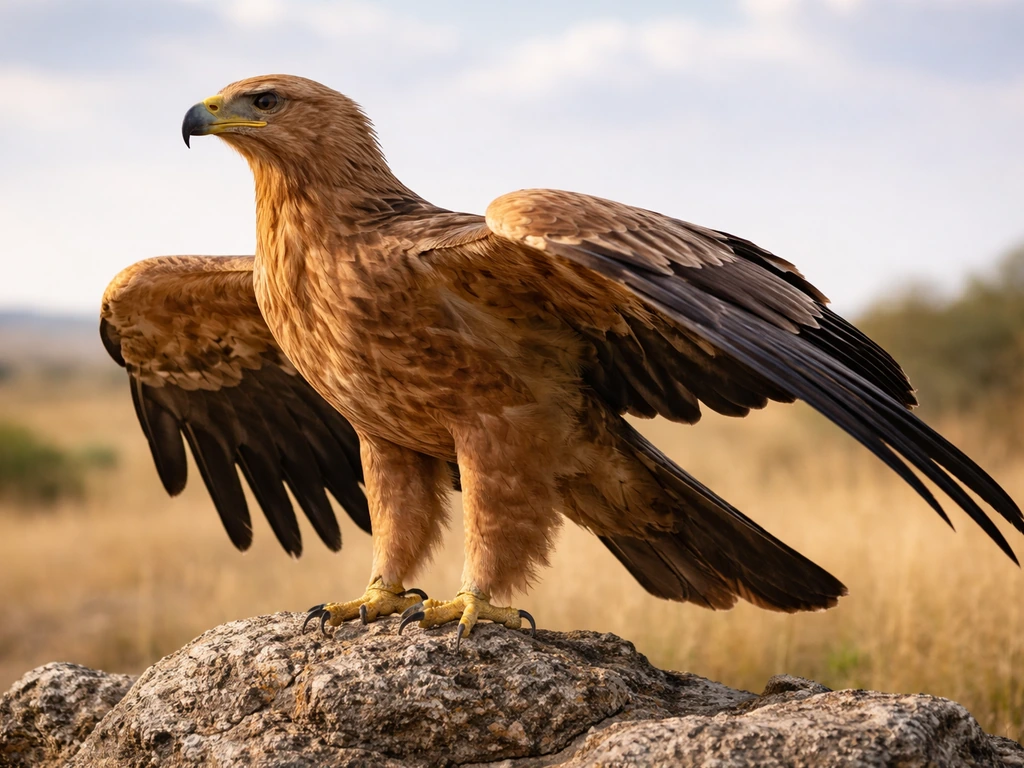
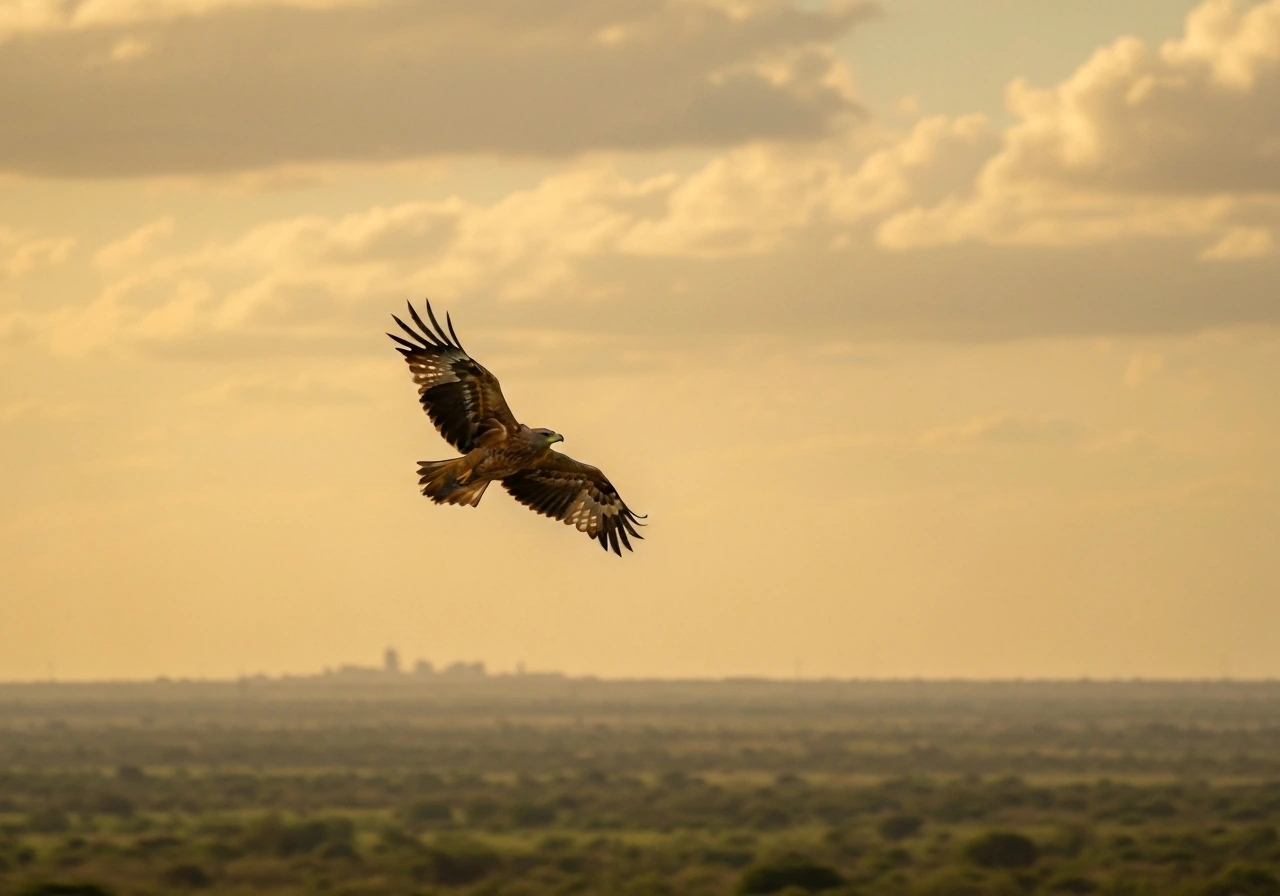
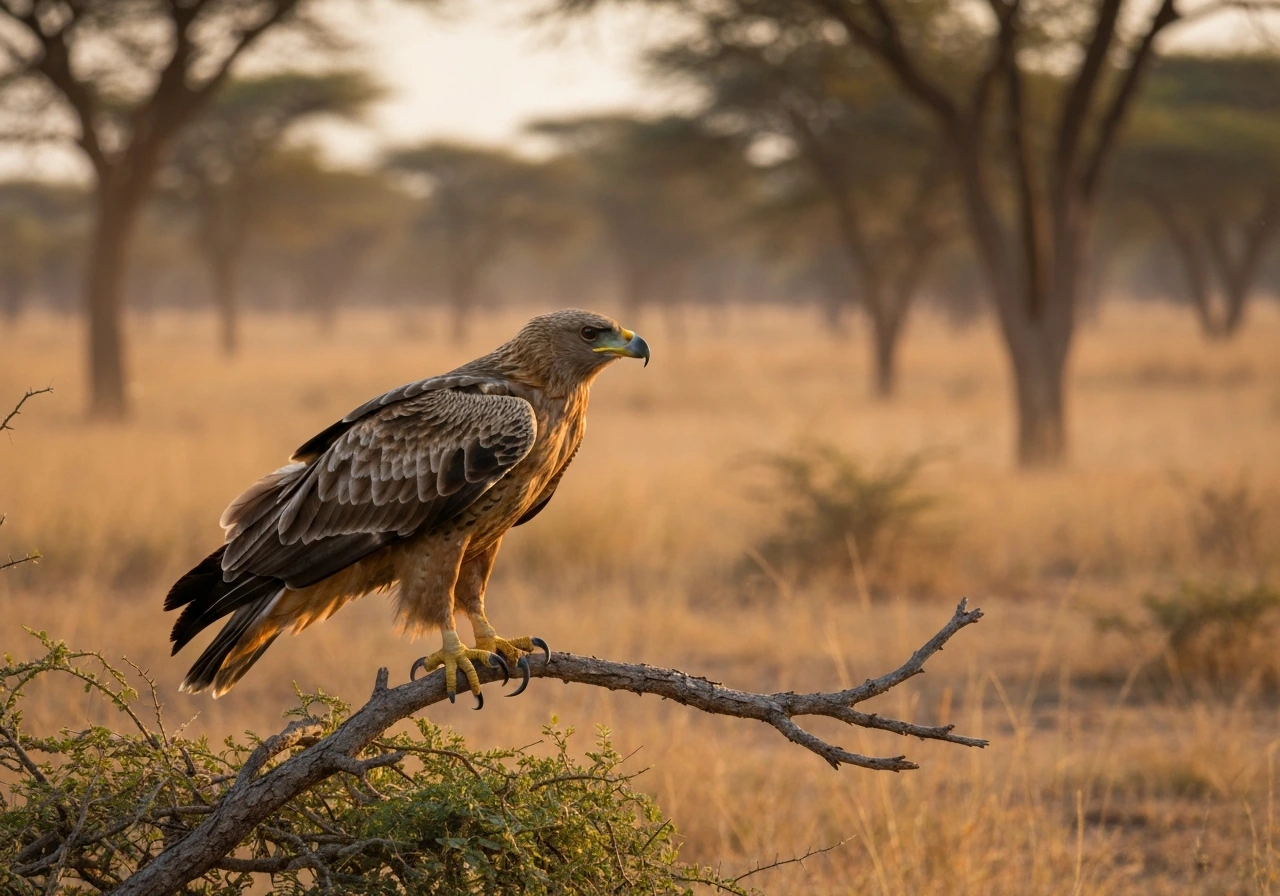
If you've never seen one, the Tawny Eagle is a medium-to-large raptor with a wingspan that can reach around 185 cm (roughly 6 feet). Adults are a warm brown color overall, which is where the 'tawny' name comes from, essentially a golden-brown tone that can vary from pale to quite dark depending on the individual and its age. Juveniles tend to be streakier and paler.
- Length: approximately 62 to 74 cm from bill to tail
- Wingspan: 159 to 190 cm
- Weight: roughly 1.6 to 2.4 kg
- Plumage: uniform warm brown with slightly paler underparts; yellow-orange gape (corner of the mouth) visible up close
- Flight profile: broad, relatively rounded wings held flat or slightly drooped when soaring
- Tail: medium length, slightly rounded
In the wild, Tawny Eagles favor open and semi-open habitats: savannas, grasslands, dry woodlands, and agricultural areas. Across West Africa they tend to be more common in the drier northern regions. In Ghana, that means you're more likely to spot one in the savanna zones of the north than in the dense forests of the south. They're opportunistic feeders, taking live prey, carrion, and even stealing meals from other birds.
Fun Facts and Cultural Stories
The Tawny Eagle is one of the more widespread eagle species in the world, ranging from Africa all the way through parts of South Asia. Despite that range, its populations have declined significantly and it is currently listed as Vulnerable on the IUCN Red List. That makes Ghana's choice a species with genuine conservation relevance, not just a symbolic one.
- The bird appears in gold on Ghana's coat of arms, which is significant: gold has been central to Ghana's identity for centuries, referenced even in the country's former colonial name, the Gold Coast.
- Tawny Eagles are known kleptoparasites, meaning they regularly steal food from other raptors. In some cultures, this behavioral trait is reframed as cunning and resourcefulness rather than dishonesty.
- The coat of arms the eagles support includes a black star (mirroring the Black Star of Ghana's flag), representing African freedom, which gives the eagles' guardian role extra symbolic weight.
- Ghana shares the eagle-as-national-symbol tradition with several African neighbors; Ethiopia and Sudan also feature eagles prominently in their national symbols, which reflects a broader continental tradition of associating eagles with state power and independence.
- The scientific name Aquila rapax translates roughly to 'rapacious eagle' or 'plundering eagle,' a reference to the bird's scavenging habits.
How to Verify Ghana's Official National Symbol
Online sources repeat 'national bird' claims constantly without always citing a real authority. If you want to confirm Ghana's national bird with confidence, here's how to do it properly.
- Check Ghana's coat of arms description: The Government of Ghana and the Ghana Permanent Mission to the United Nations both describe the coat of arms' supporters as 'two golden Tawny Eagles.' This is the most direct official documentation.
- Look at the 1957 date: The coat of arms was gazetted on 4 March 1957. Any credible source should tie the symbol to that specific date.
- Cross-reference scientific naming: The Tawny Eagle is Aquila rapax per CITES and major ornithological databases. If a source uses a different scientific name, treat it with skepticism.
- Be cautious with 'national animal' vs 'national bird' phrasing: Some sources say 'national animal' and some say 'national bird.' Ghana uses the eagle as its primary national animal symbol via the coat of arms; a separately declared 'national bird' category doesn't appear in well-documented official sources.
- Avoid relying solely on travel or quiz sites: These often copy each other without verification. Government sources, the UN mission's coat of arms description, and established encyclopedias are more reliable.
If you're doing research for academic or official purposes and need the most authoritative source, the Ghana High Commission or the Ghana Permanent Mission to the United Nations are the places to go. Their published coat of arms descriptions are the closest thing to a primary official source available publicly.
Ghana in the Broader Picture of African National Birds
Ghana's use of the Tawny Eagle fits a wider pattern across the continent. Many African countries have different national birds, and the specific answer can vary by country African national birds. Several African countries, including Ethiopia and Sudan, have also incorporated eagles into their national symbols as representations of strength and independence. You can also ask what is the national bird of ethiopia to see which species Ethiopia uses in its national symbolism. Many people also ask what is the national bird of Sudan, and the answer depends on Sudan's official national symbols. Tanzania goes a different route with the Grey Crowned Crane, a bird known for its elegance. Exploring those choices alongside Ghana's shows just how varied the reasoning behind national bird selection can be, from martial power to natural beauty to cultural tradition.
FAQ
So is the Tawny Eagle definitely Ghana’s national bird, or could it be considered the national animal instead?
It depends on the level of government documentation you are using. Ghana’s coat of arms is the clearest official place where the Tawny Eagle is explicitly used as a national symbol, and many references treat that as the effective national “bird” designation. However, Ghana is not commonly described as maintaining separate official categories like “national bird” versus “national animal,” so you should rely on the coat of arms description for the most defensible answer.
Where on Ghana’s symbols can I see the Tawny Eagle connected to the country?
Yes. The Tawny Eagle is shown as two golden supporters on either side of the shield on Ghana’s coat of arms. Those are not generic eagles, they are meant to represent the Tawny Eagle specifically, so visually matching the symbol to the correct species can help when you encounter inconsistent online claims.
How can I verify the claim if I find different answers on websites?
Common confusion happens when people read “national bird” articles that repeat the claim without citing an authority. If you need verification, look for official coat of arms descriptions from Ghanaian state institutions (for example, Ghana’s High Commission or Ghana’s Permanent Mission to the UN), since that is the closest publicly available primary-style reference.
Why doesn’t Ghana have a clearly separate national bird category like some other countries?
In Ghana’s case, there is no widely recognized separate “national bird” announcement in the way some countries publish a specific bird name for a standalone category. Because the Tawny Eagle is already embedded in the nation’s coat of arms from the state’s early independence period, it functions as the de facto national bird reference for most practical purposes.
In Ghana, where is the Tawny Eagle most likely to be seen?
The Tawny Eagle’s habitat patterns help explain why people more often notice it in the north than the south. It tends to be associated with savannas, grasslands, dry woodlands, and agricultural areas, so birdwatching expectations should be higher in Ghana’s drier regions.
What behavior should I expect from the Tawny Eagle that might help me locate it?
If you plan to spot one, remember they are opportunistic and may be detected around open landscapes rather than deep forest. Their feeding behavior can also involve carrion and sometimes taking opportunities near other birds, which affects where sightings occur.
Do Tawny Eagles look the same as juveniles, or is there a big difference?
Be careful with the word “tawny,” as it can vary a lot between individuals and across age groups. Adults tend to be warm brown to golden-brown overall, while juveniles are often paler and streakier, so you may not recognize the bird if you only know one color phase.
Is the Tawny Eagle only symbolic, or does it also have conservation significance?
Yes, conservation context matters. The Tawny Eagle is listed as Vulnerable, and that means Ghana’s national symbol choice is tied to a species with real conservation concerns, not just cultural symbolism. If you are using the information in a report, it is worth mentioning that status as an extra layer of meaning.
What wording should I use in a school or formal assignment to be accurate?
If your purpose is schoolwork or official documentation, you should cite the coat of arms association rather than a random webpage that repeats the claim. The safest phrasing is that Ghana uses the Tawny Eagle as a national symbol through the coat of arms, since that is the most concrete official linkage described in credible references.
Next Articles
What Is the National Bird of Zimbabwe? Symbolism and Facts
Discover Zimbabwe’s national bird, its distinctive traits, and the history and symbolism behind the emblematic choice.
What Is the National Bird of Botswana? Bird ID, Meaning
Answers Botswana national bird name with species ID, how to recognize it, where to spot it, and its cultural meaning
National Bird of South Africa Meaning: History and Symbolism
Learn the meaning, history, and symbolism of South Africa’s national bird, plus key traits, facts, and how to verify cla