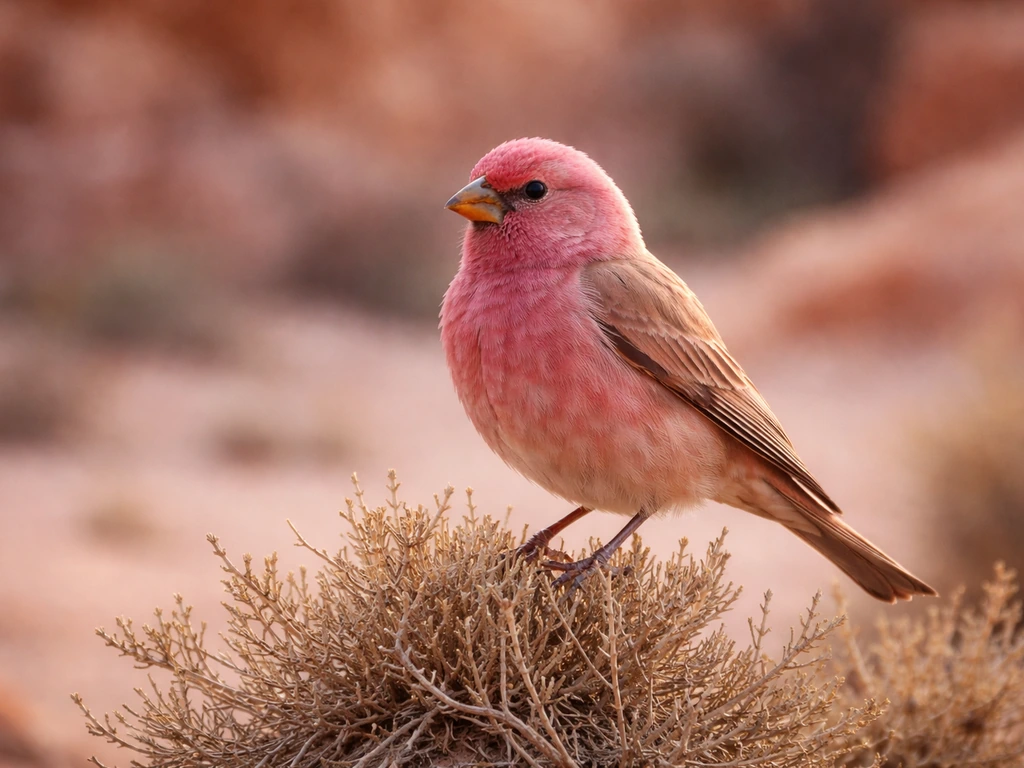
Jordan's national bird is the Sinai rosefinch (Carpodacus synoicus), known in Arabic as الطائر الوردي. It was chosen largely because its distinctive rosy-pink coloring mirrors the famous red sandstone of Petra, making it a natural symbol for a country whose most iconic landmark is literally carved from rose-red rock.
What Is the National Bird of Jordan? Meaning and Facts

Marcus Chen
6 May 2026
The bird itself: what is the Sinai rosefinch?
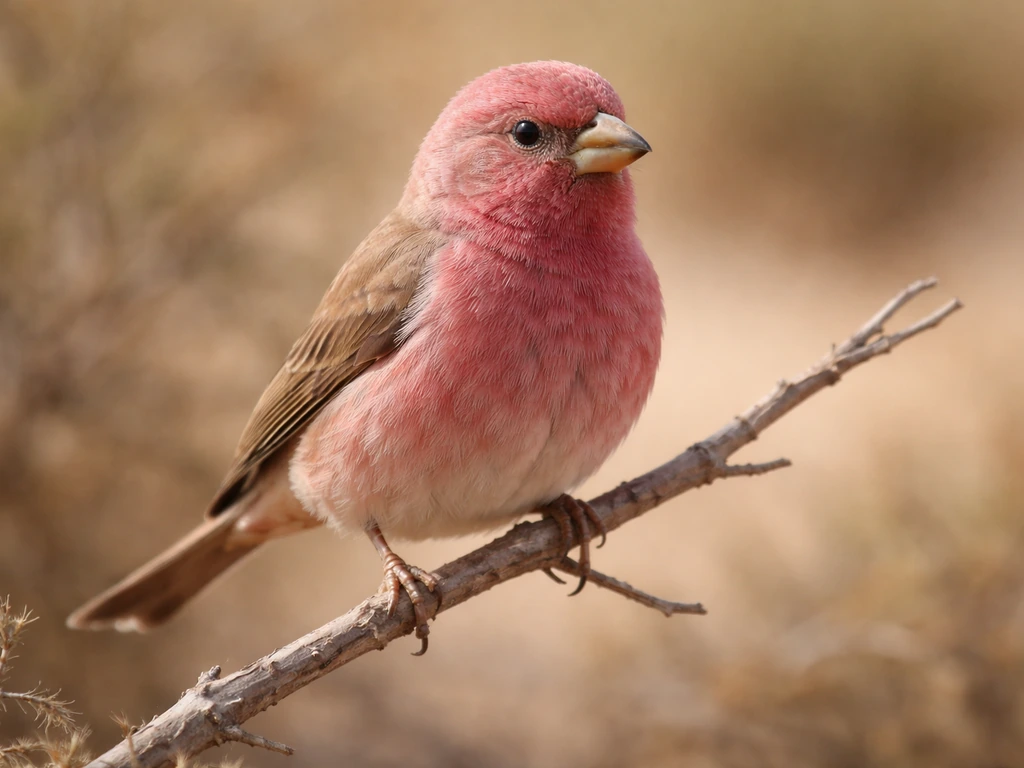
The Sinai rosefinch is a small finch in the family Fringillidae, classified under the genus Carpodacus with the scientific name Carpodacus synoicus. It's sometimes called the Pale Rosefinch, and you'll see both names used in ornithological databases. The male is the eye-catching one, wearing soft pink and rose plumage across its head and chest. Females are more muted, with brownish-gray tones. It's a desert-adapted bird that feels right at home in rocky, arid landscapes, which lines up perfectly with Jordan's terrain.
Its range spans several countries in the region, including Egypt, Israel, Jordan, and Saudi Arabia. Saudi Arabia also has its own national bird designation, which you can look up to compare with Jordan’s choice. In Jordan specifically, it lives in the desert regions and rocky wadis, which is why it turns up in ecological assessments of places like Petra and Wadi Rum.
Why Jordan chose this bird: the Petra connection
The cultural logic behind the choice is pretty straightforward and visually compelling. The Sinai rosefinch's rosy-pink feathers closely resemble the color of the red sandstone cliffs and carved facades of Petra, the ancient Nabataean city that is arguably Jordan's most recognizable landmark worldwide. Choosing this bird was a way of linking a living creature to an ancient landscape that defines Jordan's identity.
It also inhabits Jordanian desert areas, so the bird isn't just a symbolic color match. It actually lives in the same kinds of rocky, desert environments that Jordan is famous for. That overlap between habitat and heritage is what gives the symbol real weight. The Sinai rosefinch isn't an exotic bird imported as a metaphor. It's genuinely part of Jordan's natural world.
Where the symbol shows up officially (and what to avoid confusing it with)
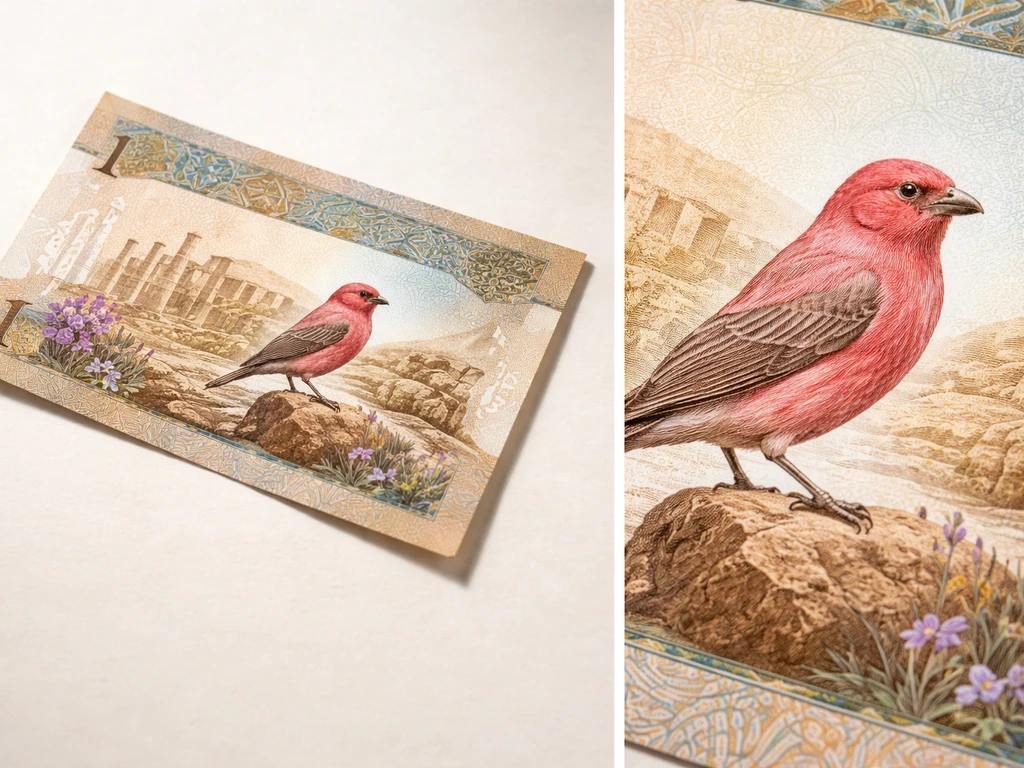
The clearest official appearance of the Sinai rosefinch as a national symbol is on Jordan's currency. The bird appears on the reverse of the 1 Jordanian dinar banknote, and when a new JD1 bill was introduced, news coverage specifically identified it as Jordan's national bird. ME Printer reports that Jordan’s Central Bank issued a new JD1 banknote starting circulation on 26 December 2022 featuring the Sinai rosefinch (Carpodacus synoicus) described as Jordan’s national bird news coverage specifically identified it as Jordan's national bird. That's about as official as it gets for public use of the symbol.
You'll also find it referenced in tourism materials. The Jordan Pass website's Eco Jordan Map PDF explicitly labels the Sinai rosefinch as Jordan's national bird, and Arabic-language tourism content uses the term العصفور الوردي السينائي in the same way. It comes up in ecological surveys too, including assessments for Petra as a key biodiversity site and in UNESCO documentation related to the Wadi Rum Protected Area.
One thing worth clarifying: Jordan's national bird is separate from Jordan's national emblem or coat of arms. In the UAE, the national bird is the houbara bustard what is the national bird of dubai. The state emblem is a heraldic symbol officially declared by blank" rel="noopener noreferrer">a Council of Ministers decision dated August 25, 1934, and it includes an eagle as part of the heraldic design. That eagle is part of the coat of arms, not the designated national bird. The two are distinct symbols. Jordan's Ministry of Foreign Affairs covers the coat of arms on its own page, and national symbols lists treat the national bird as a separate entry entirely. If you've seen references to an eagle in the context of Jordan's symbols, that's the heraldic emblem, not the national bird designation.
Quick facts about the Sinai rosefinch
| Detail | Information |
|---|---|
| Scientific name | Carpodacus synoicus |
| Family | Fringillidae (finches) |
| Other common name | Pale Rosefinch |
| Arabic name | الطائر الوردي / العصفور الوردي السينائي |
| Male plumage | Rosy pink on head, chest, and back |
| Female plumage | Muted brownish-gray |
| Natural range | Egypt, Israel, Jordan, Saudi Arabia |
| Preferred habitat | Rocky desert areas, wadis, arid terrain |
| Notable appearance | Reverse of the 1 Jordanian dinar banknote |
| Why chosen | Color resembles Petra's red sandstone; inhabits Jordanian deserts |
How to verify this and dig deeper
If you want to confirm the national bird designation, the most reliable starting points are Wikipedia's National Symbols of Jordan article and the corresponding Wikimedia Commons page, both of which list the Sinai rosefinch explicitly as Jordan's official national bird, separate from the coat of arms entry. For the bird's taxonomy, range, and ecology, eBird maintains a dedicated species page for Carpodacus synoicus where you can check distribution maps and sighting data. BirdLife International's DataZone has a factsheet for the Sinai rosefinch as well, useful if you want conservation status and range details from a widely respected ornithological source.
For the currency connection, Jordan News has covered the 1 dinar banknote and its national bird imagery directly. And if you want the government's own perspective on Jordan's state emblem (as distinct from the national bird), Jordan's Ministry of Foreign Affairs hosts the official coat-of-arms page.
Jordan's bird in regional context
Jordan sits in a part of the world where birds carry serious cultural weight. Neighboring countries have made similarly symbolic choices: the falcon is a national emblem across much of the Arabian Peninsula, celebrated for its role in the ancient tradition of falconry. The falcon is widely associated with the national identity of the UAE, which is why people often ask why it is the national bird the falcon is a national emblem. Saudi Arabia, the UAE, Qatar, Kuwait, Bahrain, and Oman all have their own bird designations tied to regional history and identity. Qatar’s national bird is the falcon, which is also widely associated with the region’s falconry traditions. Bahrain also has its own national bird designation, which is different from Jordan's Sinai rosefinch Bahrain's national bird. Oman, for example, has a different national bird than Jordan, reflecting the country’s own regional identity Oman all have their own bird designations. Kuwait's national bird is the rosered finch (also known as the Kuwait rosefinch), a distinct species recognized in national symbolism. Iraq has its own national bird story too. Iraq's national bird is the hawk-eyed eagle. Jordan's choice of the Sinai rosefinch stands out in this group because instead of reaching for a bird associated with power or hunting, Jordan went with a small, quietly beautiful finch whose greatest quality is its color, a living reflection of Petra carved in feathers.
FAQ
Is the Sinai rosefinch the national bird of Jordan, or is it just a symbol used in tourism?
It is designated as Jordan’s national bird. Tourism materials may reference it for branding, but the clearest public confirmation is that the bird is also used on Jordan’s currency, which is treated as official national symbolism for public-facing use.
What does “Jordan’s national bird” mean compared with the country’s coat of arms or emblem?
The national bird is a separate designation from heraldry. Jordan’s state emblem, which includes an eagle as part of the heraldic design, is an emblem-level symbol, while the national bird refers specifically to the Sinai rosefinch as a distinct national designation.
Are the male and female Sinai rosefinch easy to identify in the wild?
Often, no. Males show the rosy-pink coloration on the head and chest, while females are much more muted with brownish-gray tones, so sightings can look like a different bird species to someone who expects the pink look.
Why is the bird associated with Petra, is it only because of color?
Color is the main visual link, but the connection is reinforced by habitat overlap. The rosefinch is adapted to rocky, arid landscapes, so it fits both the look of Petra’s sandstone and the kind of environment where Jordan is known for having desert scenery.
Where in Jordan would you most likely see the Sinai rosefinch?
In Jordan, it is associated with desert regions and rocky wadis. If you are planning to see it, focus on arid, rocky terrain rather than greener valleys, since the species is described as desert-adapted.
Does Jordan’s national bird designation include the same species across the region?
Not necessarily. Neighboring countries can choose different birds even when the birds occur across shared ranges. The Sinai rosefinch occurs in multiple regional countries, but that does not automatically mean they use it as their national bird.
I saw an eagle mentioned in relation to Jordan’s national symbols. Is that Jordan’s national bird?
Usually not. An eagle reference is most often tied to Jordan’s heraldic coat of arms, not the national bird designation. The national bird, specifically, is the Sinai rosefinch.
What should I do if I want to double-check the national bird claim from a reliable source?
Use sources that list national symbols as formal entries and that distinguish the national bird from heraldic symbols. For species details, separate “national bird” confirmation from bird taxonomy and distribution checks, since those are handled by different kinds of references.
If I see a different name like “Pale Rosefinch,” is it still the same bird?
Yes, it can be. “Pale Rosefinch” is an alternate common name used alongside “Sinai rosefinch” for Carpodacus synoicus, so varying wording in different databases or articles does not automatically indicate a different national symbol.
Is the national bird appearance on the 1 Jordanian dinar banknote always the same across releases?
The bird appears on the reverse of the JD1 banknote, but imagery can vary in design details across printing eras or reissues. If you are verifying it in person, look for the rosefinch on the banknote face or reverse, then match the bird illustration rather than relying only on the year or print style.
Next Article
What Is the National Bird of Zimbabwe? Symbolism and Facts
Discover Zimbabwe’s national bird, its distinctive traits, and the history and symbolism behind the emblematic choice.