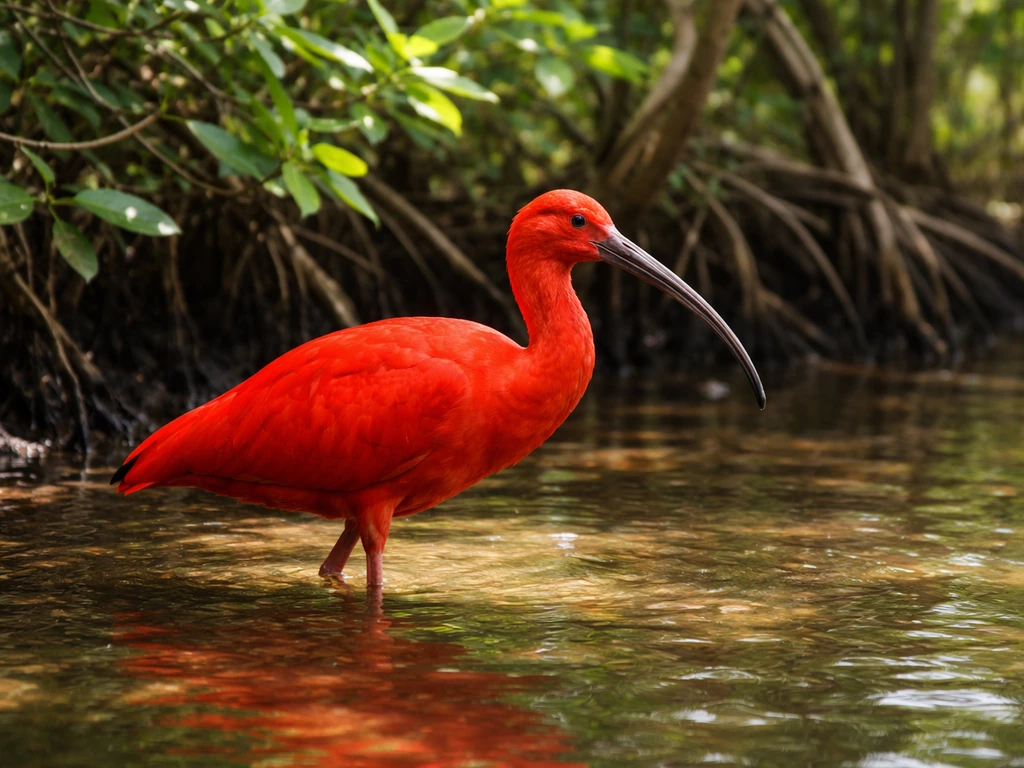
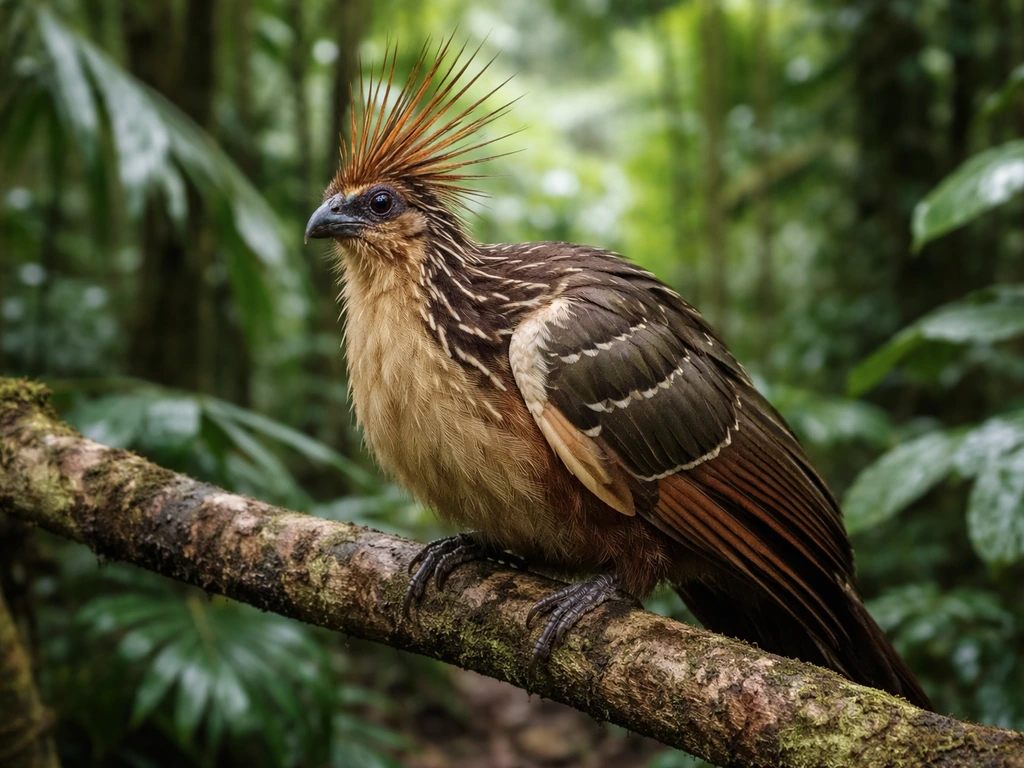
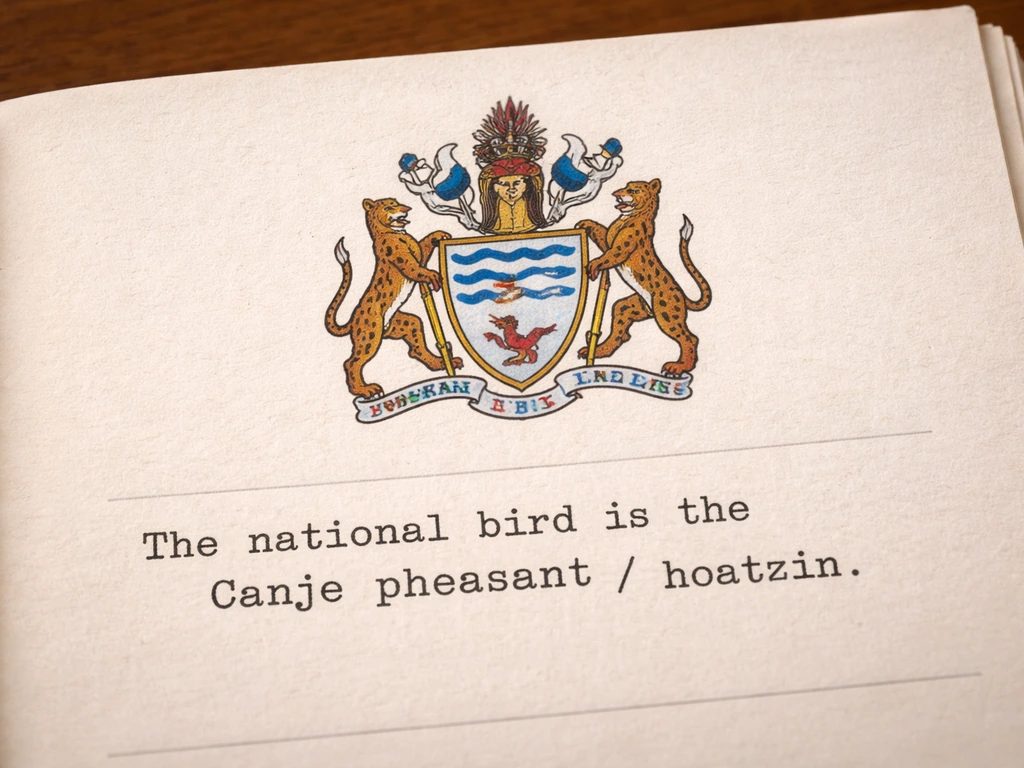
Guyana's national bird is the hoatzin, known locally as the Canje pheasant (scientific name: Opisthocomus hoazin). The hoatzin (Opisthocomus hoazin) is described as blank" rel="noopener noreferrer">Guyana’s national bird, where the local name is the Canje pheasant. This is not the same situation in Trinidad and Tobago, where people often ask whether the hummingbird is the national bird. To learn more about the national bird of Grenada, see what is the name of Grenada national bird. It's officially depicted on Guyana's national coat of arms, which was granted by the College of Arms on 25 February 1966, and the bird is labeled there by both names: 'Canje Pheasant (Opisthocomus hoazin).'
What Is the National Bird of Guyana? Meaning and Facts

Marcus Chen
26 Apr 2026
The official name, and why there are two of them
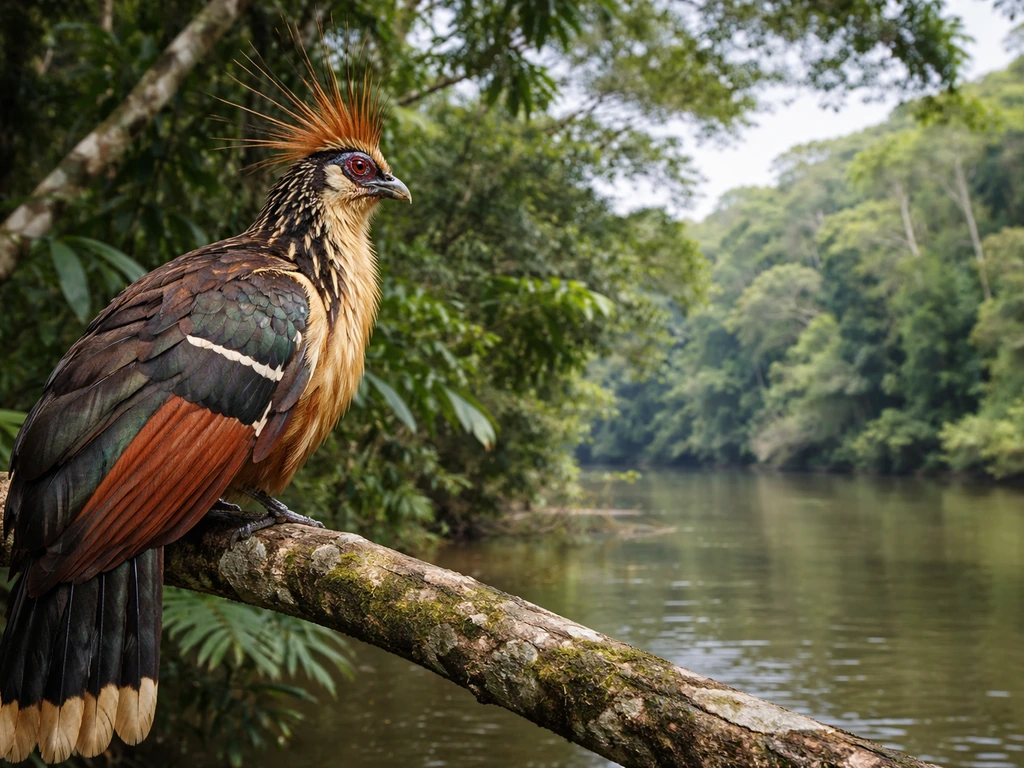
If you've seen sources call it the 'Canje pheasant' and others call it the 'hoatzin,' they're both referring to the same bird. 'Canje pheasant' is the local Guyanese name, named after the Canje River in the country's east. 'Hoatzin' is the widely used common name for the species across South America. Neither one is wrong, but it's worth knowing the distinction because online lists sometimes use one name and not the other, which creates confusion.
One thing to be clear about: despite the name 'pheasant,' the hoatzin is not actually a pheasant. It belongs to its own family entirely (Opisthocomidae) and is not closely related to true pheasants. The 'pheasant' label stuck historically because of a superficial resemblance in size and plumage, but taxonomically the two birds are quite different.
What the hoatzin means to Guyana
The hoatzin carries a strong sense of place for Guyana. It's a bird you find in the country's swamps, along riverbanks, and in riparian forests, which are exactly the kinds of landscapes that define Guyana's interior. Choosing it as a national emblem reflects the country's deep connection to its wetland ecosystems and biodiversity.
Guyana markets itself heavily around eco-tourism and its extraordinary wildlife, and the hoatzin fits that identity well. It's not just a government symbol on paper. Guyana Tourism highlights it as a notable wildlife encounter for visiting birders, and it shows up on both the national coat of arms and the presidential coat of arms. That dual placement on official state documents signals how seriously the bird is taken as a national identifier.
Compared to national birds in the Caribbean region, where countries like Trinidad and Tobago have chosen the scarlet ibis and the cocrico, Guyana's choice of the hoatzin reflects its South American geography and its vast Amazonian-style wilderness rather than a tropical island environment. In Trinidad and Tobago, the national bird is the scarlet ibis national bird of Trinidad and Tobago. You can compare this with what other Caribbean countries recognize, such as the national bird of St Lucia. It's a fitting distinction.
How and when it was officially chosen
The hoatzin's status as national bird is directly tied to Guyana's independence era. A government-appointed special committee selected the Canje pheasant as the national bird as part of the broader process of creating national symbols for the newly independent country. The coat of arms incorporating the bird was formally granted on 25 February 1966, just months before Guyana gained full independence from Britain on 26 May 1966.
The connection is documented in official and semi-official sources consistently. A 1990 National Insurance Scheme (NIS) annual report, for example, explicitly states 'National Bird of Guyana – the Canje Pheasant,' showing the designation was well established in government materials decades after independence. The Guyana Post Office Corporation also states directly that 'the Hoatzin is Guyana's national bird and is featured on the national and presidential coat of arms.'
What makes the hoatzin genuinely unusual
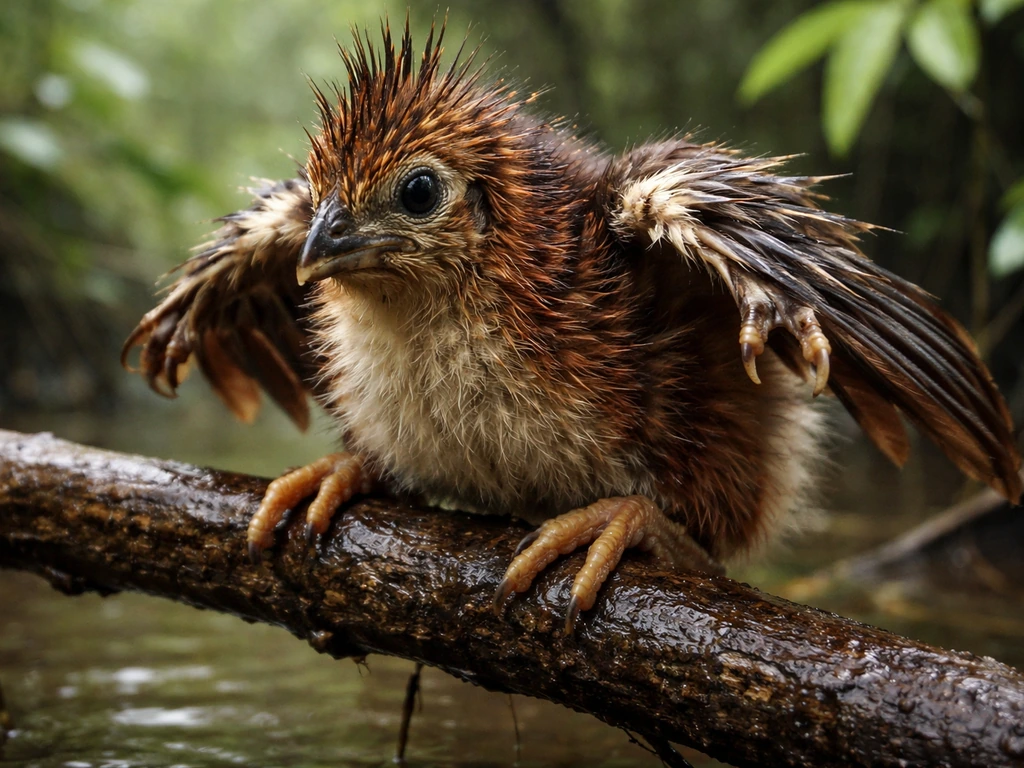
The hoatzin is one of the more fascinating birds in the world, not just South America. It's a chicken-sized bird found in the swamps, flooded forests, and mangroves of the Amazon and Orinoco river basins, which covers much of Guyana's lowland interior. Britannica describes the hoatzin as a chicken-sized South American bird found chiefly in the Amazon and Orinoco basins, and notes distinctive traits in young and its fermentation-based digestion chicken-sized bird found in the swamps, flooded forests, and mangroves of the Amazon and Orinoco river basins. Here's what makes it stand out:
- Hoatzin chicks are born with functional claws on their wings, which they use to grip branches and climb back to the nest if they fall into the water below. This is an extraordinary trait not seen in most modern birds.
- Adults feed almost entirely on leaves, which they ferment in a large crop (an enlarged part of the digestive tract). This gives them a notoriously strong, manure-like smell, earning them the nickname 'stinkbird' in some parts of South America.
- They are colonial nesters, building nests in trees overhanging water, which gives chicks the option of dropping into the water to escape predators and swimming to safety.
- Despite its unusual biology, the hoatzin's conservation status is currently Least Concern according to the IUCN, meaning the species is not under immediate threat.
- The hoatzin is considered a primitive bird lineage, and its exact evolutionary relationships have been debated by scientists for years. It has no close living relatives, sitting alone in its own taxonomic family.
A quick look at the hoatzin's key facts
| Attribute | Detail |
|---|---|
| Official common name (Guyana) | Canje pheasant |
| Widely used common name | Hoatzin |
| Scientific name | Opisthocomus hoazin |
| Family | Opisthocomidae (no close living relatives) |
| Size | Chicken-sized |
| Habitat | Swamps, riparian forests, mangroves |
| Range | Amazon and Orinoco river basins, including Guyana |
| IUCN conservation status | Least Concern |
| Notable trait | Wing claws on chicks; leaf-fermenting digestion |
| Appears on | National coat of arms and presidential coat of arms |
How to verify this and avoid bad sources
There's a fair amount of low-quality content online about national birds that gets species wrong or uses only one name without cross-referencing. Here's how to confirm you're looking at accurate information:
- Check the coat of arms: Guyana's national coat of arms documentation names the bird as 'Canje Pheasant (Opisthocomus hoazin).' Any credible source should match both names.
- Look for the scientific name: If a source only says 'Canje pheasant' or only says 'hoatzin' without cross-referencing, verify that both names refer to Opisthocomus hoazin before trusting the source.
- Use government-linked sources: The Guyana Post Office Corporation explicitly identifies the hoatzin as the national bird and links it to the coat of arms. Government or semi-official institutional publications are the most reliable references.
- Cross-check older government documents: The 1990 NIS Annual Report naming 'the Canje Pheasant' as the national bird is an example of an official institutional source that confirms the designation across decades.
- Be cautious with generic 'national birds of the world' lists: Many of these lists are scraped from each other and may omit the local name or use the wrong one. Always verify against a source that names both the common and scientific names.
The bottom line: if a source names Guyana's national bird as the hoatzin or the Canje pheasant and gives the scientific name Opisthocomus hoazin, it's correct. For comparison, Trinidad and Tobago has its own national bird that is officially designated for the country national bird of Trinidad and Tobago. If it gives a different bird entirely, it's wrong. The designation is well-documented in official Guyanese state materials going back to 1966, so there really isn't any legitimate ambiguity here.
FAQ
Is the hoatzin also Guyana’s national bird if a source calls it “Canje pheasant” only?
Yes. “Canje pheasant” is the local Guyanese name for the hoatzin, and both names refer to the same species when the source points to Opisthocomus hoazin. The names are interchangeable, but you can verify by checking for the scientific name.
What scientific name should I look for to confirm it’s the correct national bird?
Look for Opisthocomus hoazin. If the article or site mentions a different scientific name, it is likely referring to a different species even if it uses a similar common name.
Why do some websites get the “pheasant” part wrong?
Because the common name includes “pheasant” even though it is not closely related to true pheasants. If the site tries to classify it as a typical grouse or pheasant bird, that is a red flag, even if it still mentions the right species.
Does the hoatzin appear on both the national and presidential coat of arms?
Yes. It is featured on both, and that dual use is a strong indicator of the bird’s official status. If you see the bird on only one coat of arms, confirm whether the source is describing the correct Guyanese emblems.
Where in Guyana is the national bird most likely to be found?
You are most likely to encounter it in swamps, along riverbanks, and in riparian forests (wet, lowland habitats). If a guide claims it is common in dry savanna or upland forest, that habitat description is probably inaccurate.
Are there any official alternatives to the hoatzin as a national bird?
Not in the way countries sometimes list multiple birds for different purposes. Guyana’s national bird designation is tied specifically to the hoatzin, also labeled “Canje pheasant,” and supported by official state symbolism.
How can I quickly tell whether a claim about “Guyana’s national bird” is unreliable?
Check for two things at once: the common name match (hoatzin or Canje pheasant) and the scientific name Opisthocomus hoazin. If either is missing or a different bird is named, treat it as likely unreliable.
Do tourists commonly see the hoatzin during birding trips, and when is it easiest?
Birding success varies by locality and water level, but hoatzins tend to be associated with wetlands, flooded forests, and riverine areas. If your tour itinerary does not include swamp or river habitats, the chance of seeing one usually drops.
Next Article
What Is the National Bird of Trinidad and Tobago?
Discover Trinidad and Tobago’s national bird, the Scarlet Ibis, plus its symbolism, history, and cultural significance.