The U.S. Virgin Islands' official bird is the Yellow Breast, known scientifically as Coereba flaveola and more commonly called the Bananaquit. The British Virgin Islands uses a different bird entirely: the Turtle Dove. So the answer depends on which Virgin Islands you mean, and the two territories have made separate, official designations.
What Is the National Bird of the Virgin Islands?

Marcus Chen
21 May 2026
U.S. Virgin Islands or British Virgin Islands: Why It Matters
When someone searches for the national bird of the Virgin Islands, the ambiguity is real. The Virgin Islands is split between two distinct political entities. The U.S. Virgin Islands (USVI) is an unincorporated territory of the United States, while the British Virgin Islands (BVI) is a British Overseas Territory. They share the same island chain and a lot of history, but they operate under completely separate governments, laws, and official symbols.
Neither territory is an independent nation in the traditional sense, so the term 'national bird' gets applied loosely. What both have, officially, is a designated territorial bird. The USVI calls theirs the 'official bird' and has it written into law. The BVI government frames theirs as the 'Territorial Bird' on its national symbols page. Different birds, different governments, same island chain.
| Territory | Official/Territorial Bird | Common Name | Status |
|---|---|---|---|
| U.S. Virgin Islands | Coereba flaveola | Yellow Breast (Bananaquit) | Official bird, codified in law (1970) |
| British Virgin Islands | Turtle Dove | Turtle Dove | Territorial bird, listed on official government symbols page |
The Official Sources Behind Each Designation
For the USVI, the designation is not just a cultural tradition. It is written directly into U.S. Virgin Islands Code, Title 1, Section 105, which states plainly: 'The Yellow Breast (Coereba flaveola) is the official bird of the Virgin Islands.' That statute is publicly available through legal publishers and reflects the 2019 edition of the code. The U.S. Mint also references the Yellow Breast as the official bird in its description of the U.S. Virgin Islands quarter, which was approved by the Secretary of the Treasury on July 31, 2008.
For the BVI, the source is the Government of the Virgin Islands official website, which lists the Turtle Dove under both its 'Territorial Bird' entry and its broader 'National Symbols' page. Both pages are on the same government domain and corroborate each other, making the designation as official as it gets for the territory.
How the Yellow Breast Became the USVI's Official Bird

The Yellow Breast was formally adopted as the U.S. Virgin Islands' official bird on May 6, 1970, when the Virgin Islands Legislature passed Bill No. 4263. That single legislative act locked the Bananaquit into the islands' official identity, and it has been there ever since.
The cultural connection runs deeper than the legislation, though. The Yellow Breast has a long history in the islands tied to St. Croix's sugar economy. The bird was drawn to sugar workings, hovering around mills and cane operations, and became a familiar, almost domestic presence in island life. Over generations, it grew into a symbol of the local landscape in a way that imported or less visible species simply could not.
That familiarity matters when a territory chooses an emblem. The best national and territorial birds tend to be ones ordinary people actually recognize and associate with home, not just species that look impressive on paper. The Bananaquit fits that role in the USVI the same way the Doctor Bird fits it in Jamaica, where deep cultural roots explain why a specific bird gets elevated above all others.
Interesting Facts About the Bananaquit
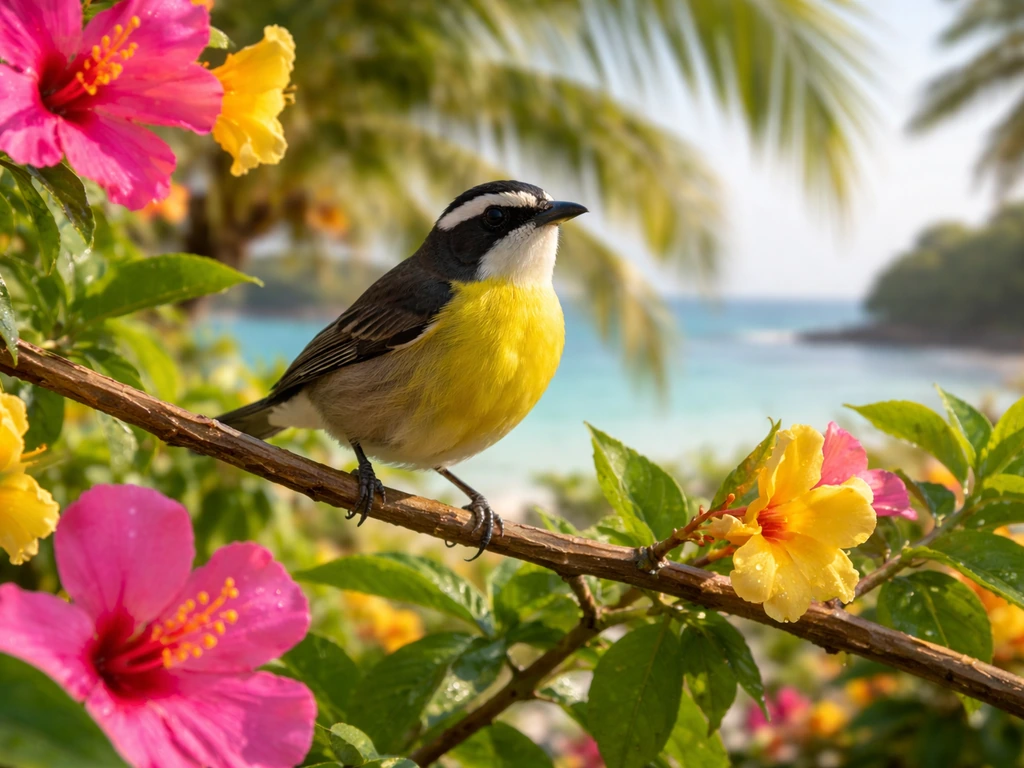
The Bananaquit is a small, energetic bird with a distinctive curved bill built for probing flowers and drinking nectar. It also eats insects and fruit depending on what is available, making it adaptable and widespread. It is one of the most abundant resident birds in the Caribbean, occurring across open to semi-open habitats like gardens, parks, and forest edges.
You are unlikely to mistake it for something else if you know what to look for. Adults typically show a bright yellow underside, a dark back and cap, and a bold white eyebrow stripe. The curved bill is the most distinctive structural feature. In the USVI, it is genuinely common in residential areas and is one of those birds you will notice almost immediately on any visit.
- Scientific name: Coereba flaveola
- Common names: Yellow Breast (USVI official name), Bananaquit (widely used across the Caribbean)
- Diet: Primarily nectar, supplemented by insects and fruit
- Bill shape: Short and sharply curved, adapted for nectar feeding
- Habitat: Gardens, parks, open woodland, and forest edges; avoids dense high-altitude forest
- Range: Abundant resident throughout the Caribbean region
- USVI adoption date: May 6, 1970, via the Virgin Islands Legislature (Bill No. 4263)
Where to Explore Further

If you want to verify the USVI designation yourself, look up U.S. Virgin Islands Code Title 1, Section 105 through a legal publisher like Justia. For the BVI, the government's official national symbols page is the primary source and is straightforward to find on the territory's government domain.
For the species itself, Cornell Lab of Ornithology's All About Birds has a solid Bananaquit profile covering range maps, photos, and behavior. Britannica also has a short entry on Coereba flaveola that covers the basics cleanly. If you are interested in the bird's evolutionary history across the Caribbean, there is peer-reviewed research available through open-access academic sources that tracks how the species spread and diversified across the region.
The Virgin Islands sit in a fascinating part of the Caribbean for bird symbolism. Other nearby territories like Aruba, Barbados, and Bermuda have each made their own official bird designations with their own histories and cultural logic. If you meant Bermuda specifically, the island has its own official national bird too. Barbados has its own official national bird as well, which is a different designation from the Bananaquit used in the Virgin Islands. Aruba’s national bird is the Adelaide’s Warbler what is the national bird of aruba. Comparing those stories side by side reveals a lot about how island communities relate to the natural world around them and what they choose to put on their seals, their coins, and their laws.
FAQ
Which one should I answer if I just search “the national bird of the Virgin Islands” without specifying USVI or BVI?
You should clarify the territory in your answer, because USVI and BVI officially use different birds. If you cannot confirm which one the reader means, the most accurate approach is to say USVI’s official bird is the Yellow Breast (Bananaquit), while BVI’s territorial bird is the Turtle Dove.
Why does the article say “national bird” even though these territories aren’t independent countries?
In this context, “national bird” is used informally for a government-designated emblem. The USVI uses “official bird” language in its legal code, and the BVI uses “territorial bird” on its official symbols pages, even though both serve a similar symbolic role.
Are there any differences between the terms “official bird” (USVI) and “territorial bird” (BVI) that affect how I should describe it?
Yes. For USVI, “official bird” is a statutory designation in the U.S. Virgin Islands Code. For BVI, the label is “territorial bird” as presented in the government’s symbols information, so it is safest to mirror the wording used by each government.
Does the USVI bird name “Yellow Breast” always refer to the Bananaquit, or is it different?
They refer to the same species, Coereba flaveola, with “Bananaquit” as the common name and “Yellow Breast” as the designation used in the USVI code text. If you need to avoid confusion, mention both names together.
What is the most common mix-up for travelers trying to spot the bird in the wrong place?
The common mix-up is assuming the same emblem applies across both territories. If you are in the U.S. Virgin Islands, look for the Bananaquit, while in the British Virgin Islands the emblem is the Turtle Dove, even though bird species you can see may vary by habitat and season.
If I’m trying to confirm the designation myself, what is the fastest reliable way for each territory?
For USVI, search the text of U.S. Virgin Islands Code, Title 1, Section 105 in a legal code database or publisher. For BVI, go directly to the Government of the Virgin Islands national symbols page, where the Turtle Dove is listed.
Do the birds appear as part of everyday symbols like coins or other government materials in the USVI?
Yes for the USVI. The Yellow Breast (Bananaquit) is referenced in the description of the U.S. Virgin Islands quarter, which helps corroborate the official emblem beyond the code itself.
Which physical feature should I use to identify the Bananaquit quickly in the USVI?
The curved bill is the most distinctive structural feature. Combined with the bright yellow underside, darker cap and back, and a white eyebrow stripe, it is usually hard to confuse with similar small nectar-feeding birds.
Is the Yellow Breast found only in a specific habitat on St. Croix or other islands?
No. While it has cultural ties to areas like sugar workings, the species is described as adaptable and widespread, using open to semi-open habitats such as gardens, parks, and forest edges, so you do not need to target a single type of landscape to see it.
Next Articles
What Is the Barbados National Bird? Symbolism and History
Learn what Barbados national bird is, why it was chosen, and how its traits and symbolism appear in culture.
Why Is the Doctor Bird Jamaica’s National Bird?
Learn why Jamaica chose the Doctor Bird national symbol, its species, nickname origins, and cultural historical meaning.
What Is the National Bird of Zimbabwe? Symbolism and Facts
Discover Zimbabwe’s national bird, its distinctive traits, and the history and symbolism behind the emblematic choice.