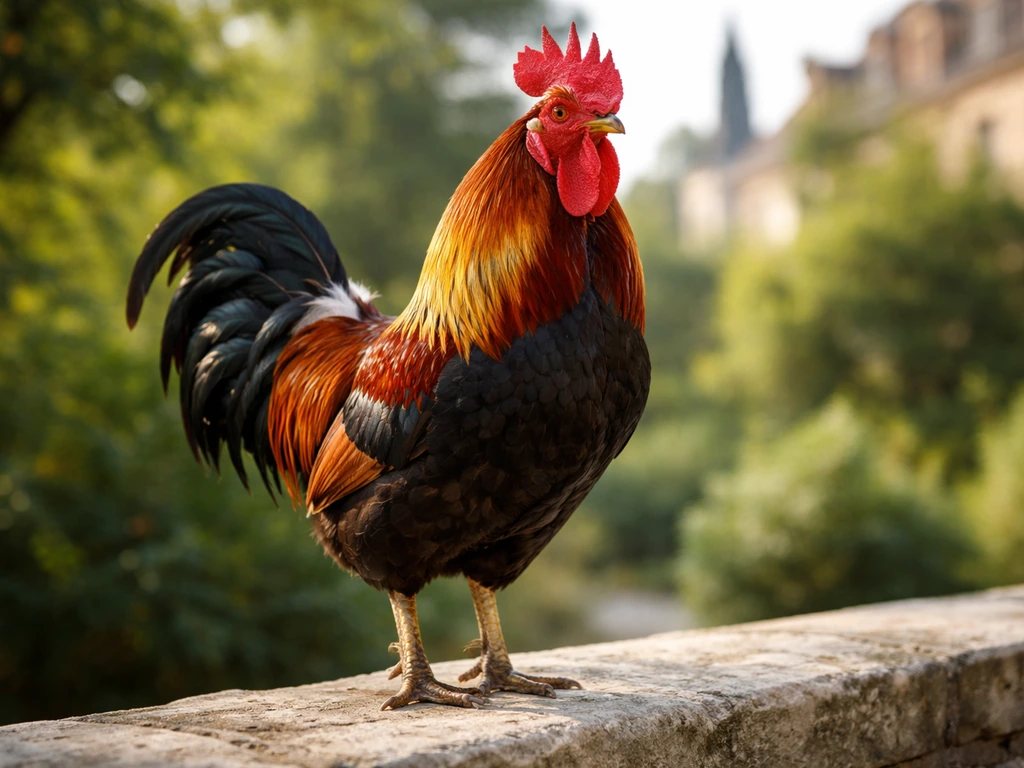
France's national bird: the Gallic rooster
France's national bird is the rooster, known in French as the "coq gaulois" or Gallic rooster. This isn't a random choice or a piece of trivia that varies by source. The Élysée Palace (the official residence of the French president) describes the rooster as "the emblem of France for everyone," and you'll see it on everything from coins and stamps to the famous grille at the entrance of the Élysée's park. If someone asks you what bird represents France, the coq gaulois is your answer.
Why it gets confusing: official vs. commonly cited
Here's where things get a little murky. France does not have a formally designated national bird enshrined by law or presidential decree the way some countries do. The rooster is widely treated as a national emblem, but it sits in an unofficial category. French discussions about national birds ("oiseau national") distinguish between birds that are officially established by decree and those that are simply recognized by popular and cultural convention. The domestic rooster (Gallus gallus domesticus) falls into the second camp: it's non-official as a state symbol in the strict sense, yet it functions as the most credible and broadly accepted emblematic bird of France.
There's also a historical wrinkle worth knowing. When a commission proposed the rooster to Napoleon I as the official emblem of France, he flatly rejected it. Napoleon reportedly argued that the rooster "has no strength" and could not adequately represent a great empire like France. So the bird was passed over for formal adoption at that moment, contributing to the ambiguity that still exists today. Despite that rejection, the rooster never really went away. It re-emerged and gradually became a quasi-official emblem of the nation (if not the state itself) by the early 20th century.
How the rooster became France's bird
The story goes back to a Latin pun. The Roman word "gallus" has a double meaning: it can refer to both a rooster and a Gaul (an inhabitant of ancient Gaul, the region that roughly corresponds to modern France). This wordplay is not a modern invention. Radio France's France Inter program on natural curiosities documented how this homonym became the root of the entire symbolic tradition. The Romans, possibly mockingly, associated the Gauls with roosters, and over time that association was reclaimed and worn with pride.
By the medieval and early modern periods, French kings were using the rooster in their imagery. The Valois and Bourbon monarchs were sometimes depicted accompanied by the bird in engravings, coins, letterheads, and paintings. The rooster's real political moment came during the French Revolution and the First Republic, when the bird became tied to the idea of the French people, as distinct from royal power. A key milestone was an order dated July 30, 1830, requiring the rooster's image to appear on the buttons of the National Guard uniform and at the top of its flags, giving the symbol a tangible official foothold.
World War I cemented the rooster's status. Propaganda imagery from 1914 to 1918 routinely depicted the Gallic rooster defeating the German eagle, turning the bird into a powerful wartime symbol of French resilience. The National Museum of Education holds allegorical engravings titled "Les forces morales de la France" from that period, showing exactly this rooster-over-eagle motif. By the start of the 20th century, the coq gaulois had become a quasi-official emblem of the French nation in the eyes of the public, even without a formal decree.
What the Gallic rooster actually looks like
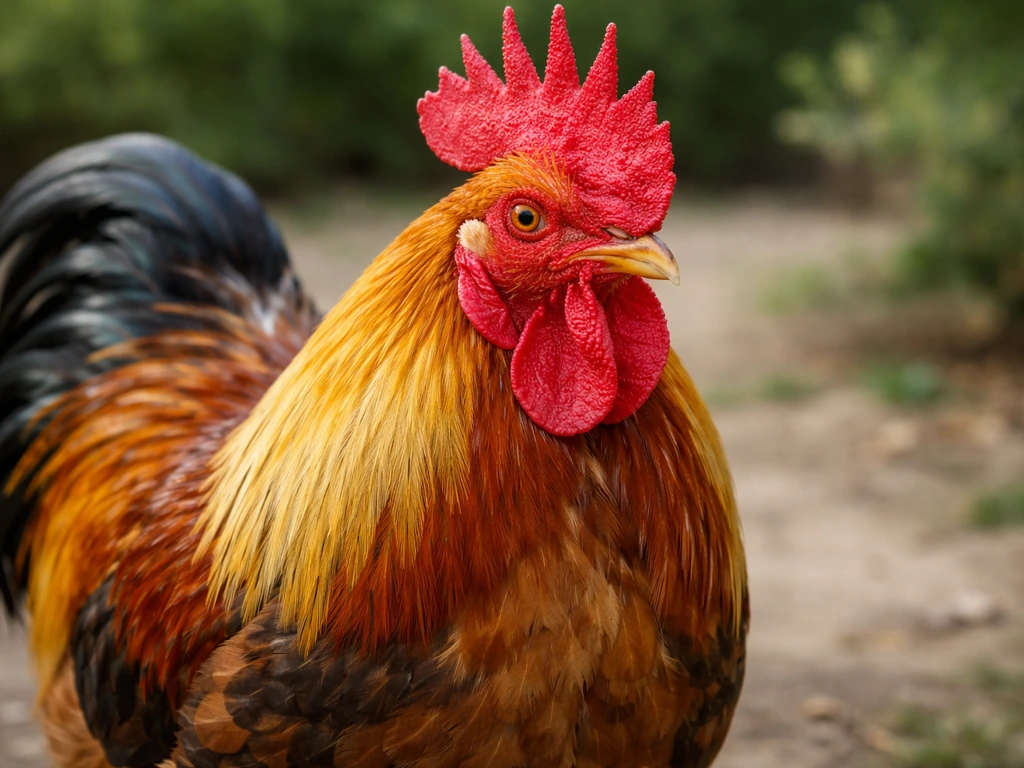
The rooster used in French symbolism is the domestic rooster, Gallus gallus domesticus, which is the domesticated form of the red junglefowl lineage. When you picture it, think of a large, upright bird with a bold red comb and wattles, glossy black and orange-red feathers, a full tail of curved plumes, and the kind of posture that reads as defiant and proud. That stance is part of why the bird works so well as a national symbol.
In terms of behavior, roosters are famously vocal (the crowing at dawn is universally recognized), territorial, and alert. They're also hierarchical within a flock, which historically gave them a reputation for courage. In France today, domestic chickens including roosters are found across mainland France and feral populations exist on several French overseas islands. The bird you see in French farmyards is the same species behind centuries of national imagery.
Where the rooster shows up in French culture and symbols
Once you start looking, the coq gaulois is everywhere in French public life. The Great Seal of the French Republic includes a ship's tiller topped with a rooster, explicitly representing the Gallic rooster as a symbol tied to the early French nation. The Third Republic featured a rooster design on the 20-franc gold coin (the "Pièce de 20 francs Coq"), one of the most recognizable French currency designs of the late 19th and early 20th centuries.
La Poste, the French postal service, has issued a philatelic stamp product explicitly called "Le Coq Gaulois" and describes it as "l'emblème de la France" (the emblem of France). The Élysée Palace has an ornate rooster gate, known as the "grille du coq," at the entrance to its park. And in sport, the French national football team's kits and equipment have featured the rooster for decades. As the Élysée itself puts it, while Marianne (the female allegorical figure) is preferred in modern political contexts, the rooster "remains the emblem of France, including at sporting events."
The Paris Musées collections include a well-known work titled "Le Coq Gaulois sur l'Aigle impérial allemand" (the Gallic Rooster on the German Imperial Eagle), which illustrates how deeply the bird was embedded in French national identity especially during the conflicts of the 19th and early 20th centuries.
France compared to its European neighbors
If you're curious how France's approach to a national bird compares with other European countries, the picture is varied. Some nations have formal, officially designated birds; others, like France, rely on cultural convention.
| Country | National Bird | Official Status |
|---|
| France | Gallic Rooster (Coq Gaulois) | Unofficial / cultural emblem |
| Spain | Spanish Imperial Eagle | Widely cited, not formally decreed |
| Sweden | Common Blackbird (Eurasian Blackbird) | Official |
| Norway | White-throated Dipper | Official |
| Netherlands | Black-tailed Godwit | Official |
| Portugal | Barcelos Rooster (symbol) / Barn Swallow (bird) | Varies by source |
| Finland | Whooper Swan | Official |
| Wales | Red Kite | Widely cited |
France is not alone in having a bird that is culturally embedded but not formally decreed. Spain's national bird sits in a similarly debated space, and the reasons behind each country's choice reveal a lot about how nations construct identity through symbolism. If you want a formally designated counterpart, Sweden's national bird, the Eurasian blackbird, was officially designated by public vote, making it one of the clearer examples in Europe.
How to verify this and dig deeper
If you want to confirm the rooster's status for yourself, the best primary source is the Élysée Palace's own website (elysee.fr), which has an English-language page dedicated to the rooster as an emblem of France. The Encyclopédie Universalis entry on "Coq Gaulois" provides the historical depth, and La Poste's stamp catalog explicitly uses the "emblem of France" language. These are institutional French sources, so they carry weight even in the absence of a formal decree.
For broader context on how European national birds are chosen and what they signify, exploring nearby countries is genuinely useful. Portugal's national bird story involves a famous rooster legend of its own, which makes for an interesting parallel to France. Norway's national bird, the white-throated dipper, offers a contrast: a small, unassuming bird chosen to represent a rugged Nordic nation. The Netherlands' national bird, the black-tailed godwit, reflects a country with strong wetland and polder traditions. And Wales' national bird, the red kite, tells a remarkable conservation story alongside its symbolic role.
If you're interested in the Nordic angle specifically, both Finland's national bird (the whooper swan) and the birds of its neighbors offer a window into how different cultures land on very different avian symbols. Each choice reflects something real about history, landscape, and identity, and France's rooster is one of the most historically layered examples of all.
The bottom line: when someone asks what France's national bird is, the answer is the Gallic rooster. It may not have a formal decree behind it, but it has centuries of cultural, political, and artistic weight. That's more than enough to make it the definitive answer.