May 4 is Bird Day, an annual observance founded in 1894 by Charles Almanzo Babcock in Oil City, Pennsylvania. It was designed to promote bird conservation through education, not to celebrate one country's national bird specifically. So if you searched 'National Bird Day May 4' hoping to find out which country's official bird emblem is being celebrated today, the answer is: Bird Day on May 4 is a general conservation awareness day, and you can use it as a perfect jumping-off point to explore the official national birds of countries all over the world.
National Bird Day May 4: Meaning and Global Bird Emblems Guide

Marcus Chen
3 Jun 2026
What 'National Bird Day May 4' actually means

Bird Day on May 4 has its roots in the early American conservation movement. Babcock, a school superintendent, believed birds deserved protection for moral, social, and aesthetic reasons, and he wanted schools to teach that message. Wikipedia summarizes that Babcock intended Bird Day to advance bird conservation as a moral value blank" rel="noopener noreferrer">Babcock intended it to advance bird conservation as a moral value. The Library of Congress recognizes May 4, 1894, as the first official Bird Day observance. Over time the date evolved into a broader celebration of birds worldwide, often tagged today with the phrase 'National Bird Day' even though the original observance didn't carry that exact label.
It's worth noting that a separate 'National Bird Day' appears in some observance calendars on January 5, which is specifically tied to advocacy for pet birds and captive bird welfare. The May 4 date is the older, conservation-rooted one with the deeper historical record. If you're seeing 'National Bird Day May 4' in a school curriculum or nature calendar, that's the Babcock tradition you're looking at.
How May 4 is used to celebrate birds today
In practice, May 4 is used by schools, nature centers, birdwatching clubs, and enthusiasts to highlight bird awareness in creative ways. Because it falls in early May, which is peak migration season in the Northern Hemisphere, birdwatching events and citizen science counts are common. People post photos of birds they've spotted, share fun facts about their favorite species, and many educators use the day specifically to teach about national birds as symbols of culture and identity.
That teaching angle is exactly where Bird Day and the concept of national birds connect most naturally. A national bird is a country's officially chosen avian emblem, often selected for reasons tied to history, ecology, or cultural identity. Using May 4 to dive into those stories is one of the most rewarding ways to observe the day.
How to find the national bird for any country

Not every country has an officially legislated national bird, but most have one that's widely recognized by government proclamation, cultural tradition, or popular consensus. Here's a simple approach to finding and learning about any country's national bird:
- Start with the country name. Pick a country you're curious about, whether it's one you're studying, visiting, or just drawn to.
- Look up its national bird emblem. A dedicated global reference guide covering every country's national bird is the fastest way to get a reliable answer with context, rather than piecing together scattered search results.
- Note the bird's common and scientific name. This helps you cross-reference with field guides, birding apps, or wildlife databases.
- Read the symbolism and selection story. Why was this bird chosen? Was it legislated by parliament, declared by a head of state, or settled by cultural tradition over centuries? That backstory is where things get interesting.
- Check when it was officially adopted. Some national birds have centuries-old roots; others were formalized only in the last few decades. The date can tell you a lot about a country's conservation priorities or post-independence identity building.
- Compare it to neighboring countries. Bird emblems often reflect regional ecosystems, so looking at nearby nations can reveal fascinating overlaps or deliberate distinctions.
A comprehensive global reference guide that documents the national bird of every country, alongside its symbolism, history, and selection context, is the most efficient tool for this kind of exploration. Instead of hunting across dozens of sites, you get the full picture in one place: the bird, the story, and the cultural weight behind the choice.
Why countries choose national birds (and why it matters)
National birds aren't chosen at random. They carry real symbolic weight, and the reasons behind each selection reveal something important about how a country sees itself. A few well-known examples make this concrete:
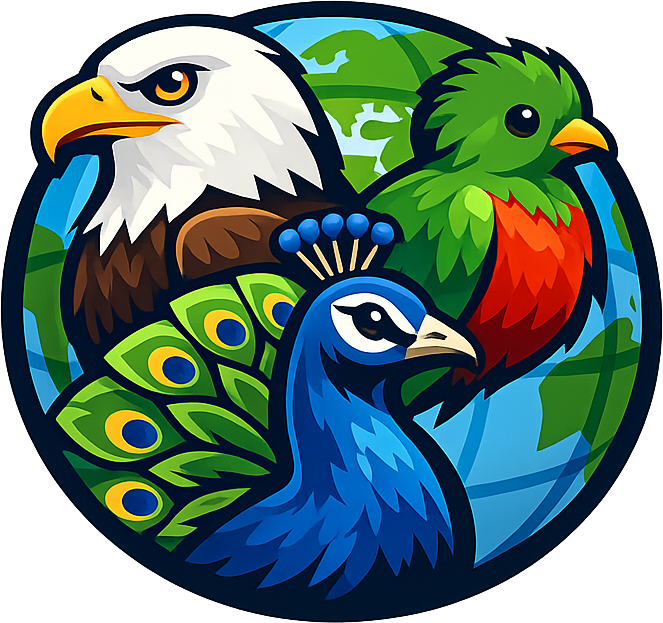
- The bald eagle of the United States was chosen in 1782 because it was seen as a symbol of strength, freedom, and long life, and it existed only in North America, making it a uniquely American emblem. The choice was controversial even then: Benjamin Franklin famously preferred the wild turkey.
- The peacock of India was officially designated in 1963. It appears throughout Hindu mythology, is associated with grace and beauty, and holds deep cultural meaning across the subcontinent. Its selection tied national identity to ancient tradition rather than political modernity.
- The resplendent quetzal of Guatemala is woven into the country's flag, its currency (the quetzal), and its national anthem. For the ancient Maya, the quetzal represented freedom and was considered so sacred that killing one was punishable by death. It became a symbol of liberty in the modern republic.
Those three examples show three very different rationales: geographic exclusivity, mythological heritage, and political symbolism. Across the roughly 200 countries and territories that have national birds, you find every variation of that logic: ecological significance, colonial-era selections, post-independence identity statements, and conservation-driven choices made in response to a species being endangered.
What to do today to participate in Bird Day

If you want to actually observe May 4 in a meaningful way, here are concrete things you can do right now:
- Pick one country and learn its national bird from scratch. Read the symbolism, the history, and why that specific bird was chosen. Five minutes of genuine reading beats an hour of skimming.
- Go outside for 15 minutes and watch whatever birds are in your area. You don't need a list or a target species. Just observe and notice behaviors.
- Share a national bird fact on social media. Something specific and surprising works better than generic. The quetzal's role in Mayan culture or Franklin's turkey preference tend to get real engagement.
- Use a birding app like Merlin or eBird to record a sighting today. Your observation becomes part of a larger citizen science dataset.
- Look up your own country's national bird and test whether you know the full story behind it. Most people know the bird but not the selection history.
- Ask a student or younger person what they think makes a good national bird. The conversation usually leads somewhere interesting.
Fun facts and prompts for curious bird enthusiasts
If you want to go deeper on Bird Day, these facts and prompts are worth sitting with:
- Charles Babcock was a school superintendent, not a scientist. He promoted Bird Day through the education system because he believed moral values, not just ecological facts, were the reason to protect birds. That ethical framing was unusual for 1894 and still holds up.
- Some countries have unofficial national birds that are more famous than their official ones. The robin is beloved as England's unofficial bird even though it was chosen by a public poll rather than any government declaration.
- The kiwi of New Zealand is flightless, nocturnal, and has nostrils at the tip of its beak. It's so deeply embedded in New Zealand identity that New Zealanders themselves are called 'Kiwis.'
- Several countries share the same national bird. The Andean condor appears as the national bird of Bolivia, Chile, Colombia, and Ecuador. How each country uses the symbol differs significantly.
- Prompt to explore: Which country chose its national bird most recently? Research suggests some smaller island nations and post-independence states formalized their choices only in the 21st century.
- Prompt to explore: Which national birds are currently endangered? The Philippines eagle and the kakapo of New Zealand are both critically at-risk emblems, making their national bird status a conservation tool as much as a cultural one.
Clearing up the confusion around 'National Bird Day'
A few misconceptions come up repeatedly when people search for National Bird Day on May 4, and it's worth addressing them directly.
May 4 vs January 5
Two separate dates carry the 'National Bird Day' label in different contexts. May 4 is the older, conservation-focused Bird Day founded by Babcock in 1894. January 5 is a more recent American observance focused on the welfare of captive and pet birds. They're unrelated in origin and intent. If your school, calendar, or nature group is referencing Bird Day on May 4, they're pointing to the 1894 tradition.
'National Bird Day' as a general holiday vs official national birds
Bird Day on May 4 does not celebrate any specific country's official bird emblem. It's a general awareness day for birds and conservation. 'Official national birds,' by contrast, are formal designations made by individual countries, each with its own bird, story, and history. They're parallel concepts that happen to share vocabulary. Searching for one often leads people to want to learn about the other, which is a perfectly natural connection to follow. If you're curious about national bird designations, knowing how a country chooses them can help you interpret what you see in your own culture the other.
Not every country has a formally legislated national bird
Some national birds are enshrined in law. Others exist by long-standing tradition or popular recognition without a formal statute. When you're researching a country's national bird, it's worth noting whether the designation is official or conventional. Both are valid and interesting, but the distinction matters when you're comparing countries or writing about them for academic purposes.
Bird Day isn't just an American observance anymore
Babcock founded the day in Pennsylvania, and the early observances were entirely American. But Bird Day on May 4 is now recognized and observed in various forms by birdwatching groups, nature organizations, and schools in many countries. Its conservation message translated well beyond its original context, and the rise of global birding communities and citizen science platforms has made it genuinely international in practice, even if it has no formal international status.
If you want to keep exploring after today, there's a lot more to discover about when and how various bird-related observances are marked throughout the year, including dedicated birdwatching days that align with specific migration events and conservation milestones. If you mean the wider birdwatching calendar, you might also be looking for the specific date for National Bird Watching Day, which varies by country and year. Each one is an opportunity to go deeper into the world of national birds and the stories behind them.
FAQ
Is May 4 “National Bird Day” the same as any country’s official national bird celebration?
No. May 4, in the Babcock tradition, is for bird awareness and conservation education. If you want a country’s official bird emblem, you still need to look up that country’s national bird designation separately, since May 4 is not a universal “official bird” holiday.
Why do I sometimes see “National Bird Day” listed on January 5 instead of May 4?
January 5 is commonly used in the US context for pet and captive bird welfare advocacy. It is different in origin and purpose from the 1894 Bird Day established by Charles Almanzo Babcock, which is associated with May 4.
What should I do if a classroom or calendar claims May 4 is about one specific national bird?
Treat it as a teaching angle rather than an official fact. You can still support the intent by having students research which national birds each country recognizes, then compare how those symbols connect to habitat, culture, or historical events.
Do all countries have an officially legislated national bird?
No. Some national birds are formalized in law, others are recognized through longstanding tradition, government proclamation, or widely accepted popular consensus. When comparing countries, note whether the designation is legally official or conventional.
How can I tell if a “national bird” claim I found online is reliable?
Look for the type of source behind the claim, such as government websites, official cultural institutions, or reputable reference works that explain selection context. Be cautious with blogs that present one bird as “the national bird” without stating whether it is statutory or traditional.
Are national birds ever changed or replaced?
Yes, some countries can update symbols over time due to new laws, political shifts, or re-evaluation of cultural and ecological priorities. If you are writing or teaching, check the most recent status rather than assuming the same bird has always held the emblem role.
Is there a difference between “national bird,” “national animal,” and “national symbol” in practice?
Yes. A national bird is specifically an avian emblem. National animals or broader national symbols may be non-bird species, and sometimes they overlap conceptually but come from different designation processes. Separate these categories when building a comparison chart.
Does Bird Day on May 4 align with migration patterns anywhere?
Often, yes. Because early May falls in many regions during active Northern Hemisphere migration, schools and bird clubs frequently plan observation walks and citizen science counts then. The best choice for an event depends on your local species and seasonal timing.
Can I celebrate May 4 without being in the Northern Hemisphere?
Yes. In the Southern Hemisphere, the seasonal context may differ, so focus on local birds during your local best viewing window. You can adapt the activity by doing a “local national bird equivalents” discussion, or a habitat and conservation lesson tied to species in your region.
What are good “hands-on” activities for May 4 besides birdwatching?
Consider building a simple national-bird comparison board, mapping where different emblem birds live, and assigning short research summaries on why each bird was chosen (mythology, ecology, politics, or exclusivity). If you do citizen science, choose a platform and species list appropriate for your area rather than using generic prompts.