Does China have an official national bird?
Technically, no. As of today, China does not have an officially designated national bird. This surprises a lot of people because most countries either have one locked in by law or at least have a widely accepted symbolic bird. China sits in an unusual middle ground: there is a bird that is strongly associated with Chinese national identity, but the government has never made it official through a legal process.
That does not mean the question is unanswerable. It just means you need to understand the difference between an official government designation and a widely recognized cultural symbol, which is exactly what this article walks you through.
The direct answer: the red-crowned crane
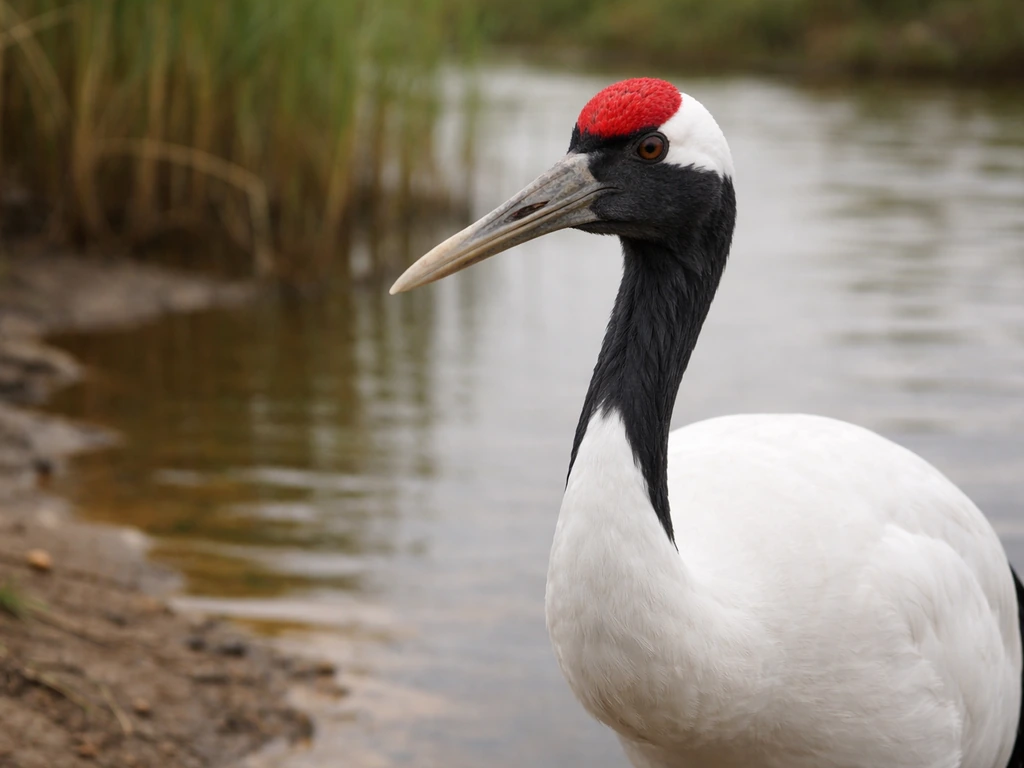
The bird most commonly associated with China as a national symbol is the red-crowned crane (Grus japonensis), known in Chinese as 丹顶鹤 (dān dǐng hè). It is a tall, striking bird with white plumage, black secondary feathers, and a distinctive vivid red patch on top of its head. If you have seen classical Chinese art, you have almost certainly seen this bird.
In 2004, a major public poll ran from May 16 to June 7, organized with the involvement of the Chinese Wildlife Animals Protection Association and several news organizations. An Internet survey for China’s national bird recommended the red-crowned crane, launched by the Chinese Wildlife Animals Protection Association together with China News Service and 20 other news organizations organized with the involvement of the Chinese Wildlife Animals Protection Association and several news organizations. The result: netizens recommended the red-crowned crane as China's national bird. Following that poll, the candidacy was formally submitted to the State Council for review. For it to become truly official, it would ultimately need confirmation through the National People's Congress Standing Committee, a full legislative process. That process was never completed, so the designation remains unofficial to this day.
Official vs. commonly claimed: how to tell the difference
This is where a lot of websites get it wrong. Many articles state flatly that the red-crowned crane is China's national bird, full stop. That is misleading. Here is how to think about the distinction:
| Category | Status | What it means practically |
|---|
| Official government designation | Does not exist | No law or government decree names a national bird for China |
| Public poll recommendation (2004) | Completed | Red-crowned crane was the public's recommended choice |
| State Council submission | Submitted, not finalized | The candidacy was reviewed but never legally confirmed |
| Cultural / symbolic recognition | Widely accepted | The red-crowned crane functions as an unofficial national bird in practice |
When you see a source saying China's national bird 'is' the red-crowned crane without any qualification, treat that as shorthand for the cultural reality, not a legal fact. Lawmakers in China have themselves argued that the country should designate a national bird, which only makes sense if the position is currently vacant. The framing in Chinese policy discussions has been that this is a gap to be filled, not a status already in place.
If you are curious how neighboring countries in the region handle this, Singapore's national bird is a useful comparison: the Crimson Sunbird was officially designated through a clear public and government process, making its status unambiguous in a way that China's is not.
Why the red-crowned crane? History and selection context
The red-crowned crane did not emerge as a candidate by accident. It has been embedded in Chinese culture for thousands of years. Classical paintings, poetry, and imperial court art all feature the crane prominently, often as a symbol of longevity, wisdom, and moral virtue. It was associated with Daoist immortals and was considered a bird of high spiritual standing.
During the imperial era, the crane was so respected that it appeared on the rank badges of first-grade civil officials, a status only the emperor outranked in the symbolic hierarchy. That kind of history makes it a natural candidate for a national symbol. When the 2004 public poll took place, the crane's cultural pedigree made it an easy consensus choice among those who participated.
The red-crowned crane is also native to East Asia, breeding in parts of northeastern China (as well as Russia, Japan, and the Korean Peninsula), which grounds it geographically as a genuinely Chinese bird rather than an arbitrary symbolic pick. For context on how this regional distribution plays out, Taiwan's national bird, the Mikado Pheasant, was chosen on similar grounds of being a species uniquely tied to the island's landscape.
What the crane symbolizes in Chinese culture
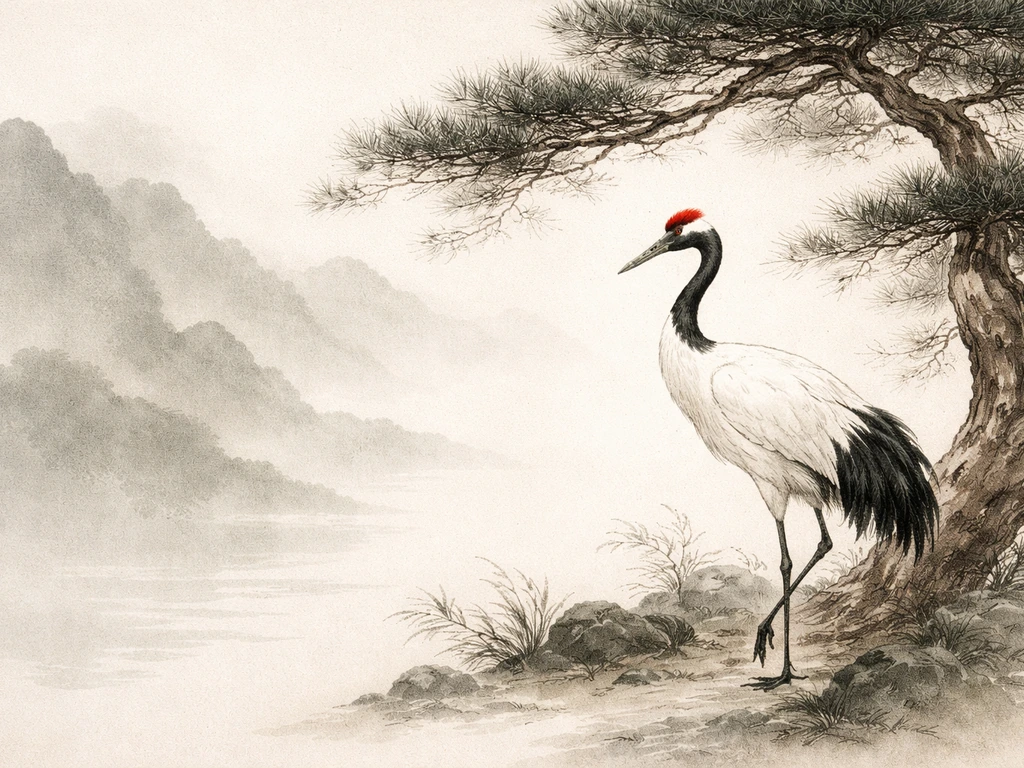
The red-crowned crane carries a dense set of symbolic meanings that have held consistent across Chinese history:
- Longevity and immortality: cranes are traditionally said to live for a thousand years and frequently appear alongside the pine tree and the deer as symbols of long life
- Wisdom and virtue: in Confucian and Daoist thought, the crane represented the ideal of a noble, virtuous person who rises above worldly concerns
- Fidelity: cranes mate for life, making them a symbol of loyalty in marriage and relationships
- Good fortune and auspiciousness: a flying crane was considered a positive omen, and crane imagery was used in art to wish people prosperity
- Spiritual elevation: Daoist tradition associated cranes with immortals and celestial beings, reinforcing their status as sacred animals
These associations made the red-crowned crane a genuinely meaningful choice rather than a superficial one. Compare this to Malaysia's national bird, the Rhinoceros Hornbill, which was chosen for equally deep cultural reasons tied to the country's indigenous heritage. In both cases, the bird chosen reflects something real and historically grounded about the nation's identity.
Facts about the red-crowned crane worth knowing
Beyond the symbolism, the red-crowned crane is genuinely fascinating as a species, and knowing a few concrete facts helps you understand why it commands so much respect: Nippon.com reports that Japan’s Ministry of the Environment downgraded the red-crowned crane (tanchō/Grus japonensis) from “threatened” to “near-threatened” after conservation-led recovery downgraded the red-crowned crane from “threatened” to “near-threatened” after conservation-led recovery.
- It is one of the rarest cranes in the world, classified as Vulnerable on the IUCN Red List, with an estimated wild population of around 2,750 to 3,000 individuals
- Adult birds stand about 150 to 158 centimeters tall (roughly 5 feet), making them one of the tallest flying birds on Earth
- The red crown is not feathers but bare red skin on top of the head, which becomes more vivid during courtship displays
- Their elaborate mating dances, which involve leaping, wing-spreading, and loud calls, are among the most visually striking courtship rituals in the bird world
- They are highly vocal: the call of a red-crowned crane can carry for several kilometers, a fact that has contributed to their mythological association with spirits and immortals
- In Japan, the species is called tanchōzuru and is equally revered there, which occasionally causes confusion about the bird's national affiliation
That last point is worth noting. Because the red-crowned crane is celebrated in Japan as well as China, some people wonder whether it is really distinctively Chinese as a symbol. The answer is yes, because the cultural significance in China is ancient, independently developed, and deeply woven into Chinese art, literature, and official ceremony over millennia. Its shared reverence across East Asia arguably strengthens rather than weakens its symbolic weight. Similarly, the Philippines' national bird, the Philippine Eagle, is a species found only in the Philippines, which makes its national symbolism particularly exclusive. China's situation is different but equally meaningful.
How to verify this and where to look next
Because China's national bird has an informal status rather than a legal one, you need to be a bit more careful than usual when checking sources. Here is how to approach it:
- Check Chinese government sources first: look for any official decree or announcement from the State Council or the National People's Congress Standing Committee. As of now, you will not find one, which confirms the designation has not been legally formalized.
- Look for the 2004 poll coverage: China.org.cn and China News Service (chinanews.com.cn) reported on the poll and the State Council submission. These are the most reliable primary sources for what actually happened.
- Check the Chinese Wildlife Animals Protection Association: as the organization involved in the 2004 recommendation, their records or communications are the closest thing to an official recommendation process.
- Be skeptical of any site that states the national bird without qualification: if a source does not acknowledge that the designation is informal or unofficial, that is a red flag for accuracy.
- Cross-reference with encyclopedic bird references like the IUCN or ornithological databases to confirm the species identity and range, even if those sources will not speak to the political question.
- For regional comparison, looking at how neighboring countries have handled their national bird designations is instructive. For example, reading about Indonesia's national bird, the Javan Hawk-Eagle (officially designated as Garuda's real-world counterpart), shows what a formalized national bird process looks like.
The short version: the red-crowned crane is China's de facto national bird by strong cultural tradition and public consensus, backed by a formal poll and a State Council submission in 2004. It has never been made official through Chinese law. Any source that tells you it is definitively official is oversimplifying. Any source that tells you China has no national bird at all is also missing the full picture. The honest answer sits between those two positions, and now you have it.