Egypt's national bird: the direct answer
Egypt's nationally recognized bird symbol is the eagle, specifically the Eagle of Saladin. You'll see it referenced in two overlapping ways: as a heraldic emblem on the flag and coat of arms (the Egyptian Golden Eagle of Saladin), and in many popular sources as the Steppe eagle (Aquila nipalensis), sometimes called the 'Saladin eagle.' Both claims trace back to the same iconic eagle imagery, which is why the two versions coexist online. If you're looking for the single clearest answer, the Eagle of Saladin is Egypt's defining national bird symbol.
Official emblem vs. commonly cited species: clearing up the confusion
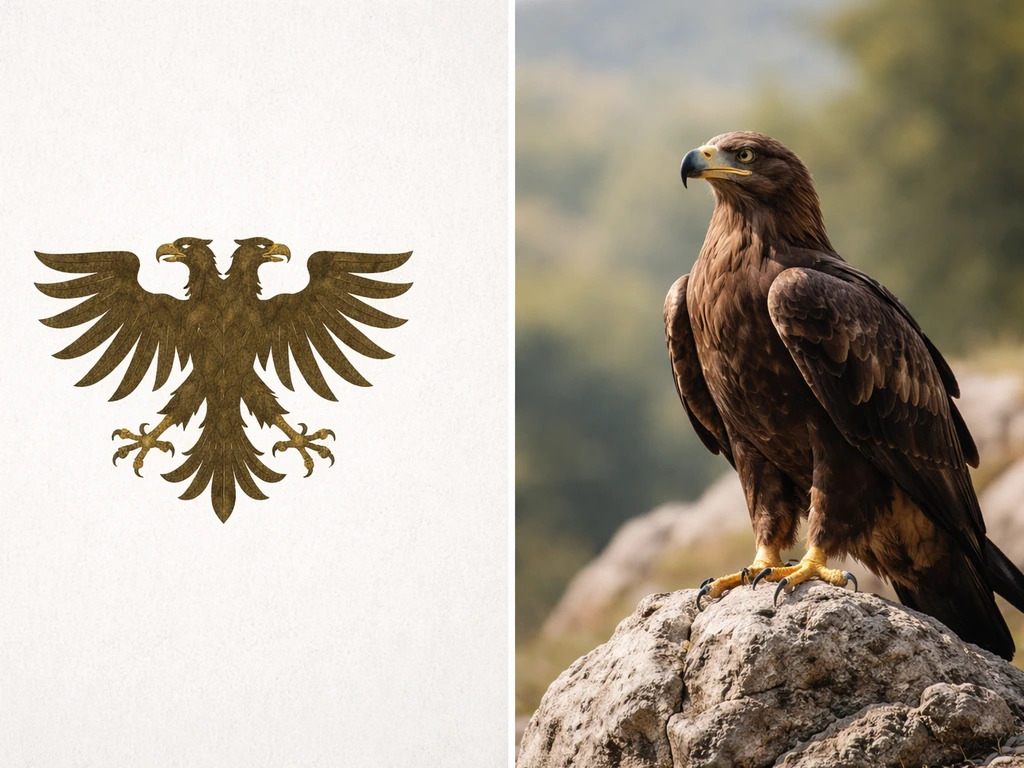
Here's where it gets slightly complicated, and it's worth being honest about that. Egypt does not appear to have a formal government decree naming a specific live bird species as the 'national bird' the way some countries do. What Egypt does have, very officially, is the Eagle of Saladin as its national emblem. This heraldic golden eagle appears centered in the white band of the Egyptian flag and forms the entire basis of blank" rel="noopener noreferrer">Egypt's coat of arms, officially described as the 'Republican Eagle' or 'Egyptian Golden Eagle.'
Many popular websites and fact sheets take that eagle symbolism and attach it to the Steppe eagle (Aquila nipalensis) as the named species, labeling it Egypt's national bird. That connection is plausible and widely repeated, but it comes from popular reference sources rather than an official government designation. On this site, we treat the Eagle of Saladin, expressed through the golden eagle, as Egypt's national bird symbol, because that is what Egyptian state symbolism actually uses and what the historical record supports most directly.
How the eagle became Egypt's symbol: the history behind the choice
The eagle's association with Egypt is rooted in the 1952 Egyptian Revolution, which overthrew the monarchy and established the Republic. Revolutionary leaders wanted a powerful, pan-Arab symbol that could represent both Egypt's new political identity and the broader Arab nationalist movement gaining momentum across the region. They reached back to a medieval icon: the Eagle of Saladin.
Saladin (Salah ad-Din Yusuf ibn Ayyub) was the 12th-century Kurdish-Egyptian sultan who founded the Ayyubid dynasty and famously united Muslim forces to reclaim Jerusalem during the Crusades. His eagle emblem, a heraldic golden eagle, had been associated with his reign and legacy for centuries. After 1952, Egyptian revolutionary leaders adopted this eagle as a direct link between the new republic and that proud historical legacy, intentionally grounding modern Egyptian identity in a symbol of strength, sovereignty, and pan-Arab pride.
The Eagle of Saladin then spread beyond Egypt. It became a foundational symbol of Arab nationalism and was adopted in various forms by other Arab states. This wider adoption actually reinforces just how potent the symbol was considered in Egypt's post-revolutionary identity. Since 1952, the eagle has been embedded in every official representation of the Egyptian state.
What the eagle represents for Egypt
The Eagle of Saladin carries layered meaning for Egypt. At the most immediate level, it represents state power and sovereignty. An eagle on a coat of arms is a near-universal signal of strength and authority, and Egypt's choice is no different in that respect.
But the Saladin connection adds something more specific: a link to Islamic heritage, historical military achievement, and Arab unity. Saladin is a figure respected across the Arab world and beyond, so his eagle is not just a generic power symbol. It ties Egypt to a narrative of cultural pride and civilizational continuity, bridging the ancient and medieval past with the modern republic.
The golden color of the eagle on the coat of arms also carries symbolic weight. Gold in heraldry traditionally signals generosity and elevation of the mind, and in the Egyptian context it visually echoes the country's ancient pharaonic imagery and the warmth of the desert landscape. Put together, the Eagle of Saladin functions as Egypt's way of saying: we are ancient, we are strong, and we stand for Arab dignity.
Key facts and trivia about Egypt's eagle

Whether you focus on the heraldic Eagle of Saladin or the Steppe eagle that many sources associate with Egypt, there's plenty of interesting detail worth knowing.
| Feature | Detail |
|---|
| Common name | Steppe eagle (the species most commonly cited as Egypt's national bird) |
| Scientific name | Aquila nipalensis |
| Also known as | Saladin eagle (in Egyptian national bird context) |
| Conservation status | Endangered (uplisted by BirdLife International in 2015) |
| Behavior | Migratory raptor; travels across vast regions including Mongolia, Tibet, and parts of Africa |
| Body size | Large bird of prey; one of the bigger eagle species in the Aquila genus |
| Heraldic counterpart | The Eagle of Saladin, a stylized golden eagle on Egypt's flag and coat of arms since 1952 |
| Broader symbolism | Also used in modified forms as a national symbol by other Arab states, reflecting pan-Arab significance |
One detail that surprises people: the Steppe eagle is currently classified as Endangered globally. BirdLife South Africa’s red-list page for the Steppe eagle (Aquila nipalensis) notes that the species was globally uplisted to Endangered in 2015, citing BirdLife International blank" rel="noopener noreferrer">Steppe eagle is currently classified as Endangered globally. Uganda's national bird is the grey crowned crane. Its population has declined sharply due to habitat loss, poisoning, and changes in livestock practices that affect its food supply. This gives Egypt's eagle symbol an added layer of real-world significance. The bird associated with national pride is also one that needs active conservation attention.
Another interesting trivia point: the Eagle of Saladin is not unique to Egypt. Libya, Palestine, and Yemen have all used versions of it in their state symbols, making it arguably the most shared national bird emblem in the world. That cross-border symbolism reflects the pan-Arab political movements of the 20th century more than it does any particular country's unique fauna.
How Egypt compares to its African neighbors
If you're exploring national birds across Africa, Egypt's eagle-based symbol is notably different in character from those of many neighboring countries. Several African nations chose their national birds based on endemic or regionally significant species tied directly to local ecology. Egypt's choice, by contrast, was shaped primarily by political history and cultural symbolism rather than ecological distinctiveness. That makes Egypt an interesting case study in how national bird designations can reflect a country's self-image as much as its natural heritage. Other African nations, including Kenya, Nigeria, Morocco, and Uganda, each took their own distinct approach to this choice, and comparing them gives you a fuller picture of how varied these decisions can be across the continent. Morocco's national bird is discussed in detail in its own dedicated guide, including where the designation comes from. If you are also looking into Nigeria's national bird, the answer is different and has its own official sources.
Where to go from here
If you want to dig deeper into Egypt's national bird symbol, here are the most useful next steps.
- Look up the Eagle of Saladin on Wikipedia to read the full history of the heraldic emblem, including how it evolved across different Arab states and what design variations exist.
- Check BirdLife International's species page for the Steppe eagle (Aquila nipalensis) to get current conservation status, range maps, and population trend data.
- Search for Egypt's coat of arms imagery to see exactly how the golden eagle appears in official state symbolism and how it compares to other Arab nations' emblems.
- Explore other African national birds on this site to see how Egypt's politically driven choice contrasts with ecologically inspired selections from other countries on the continent.
- If you're a student or researcher, cross-reference any 'national bird of Egypt' claim with whether the source is citing the heraldic Eagle of Saladin or the Steppe eagle species, since the distinction matters for accuracy.
The bottom line: Egypt's national bird is the Eagle of Saladin, a golden eagle symbol tied to one of the Arab world's most celebrated historical figures and adopted as a defining emblem of the Egyptian republic after 1952. It's a symbol of strength, historical pride, and pan-Arab identity. Whether you came here for a quick answer or the full story, that's the core of it. If you're specifically looking for Kenya's national bird, the answer is the kori bustard.