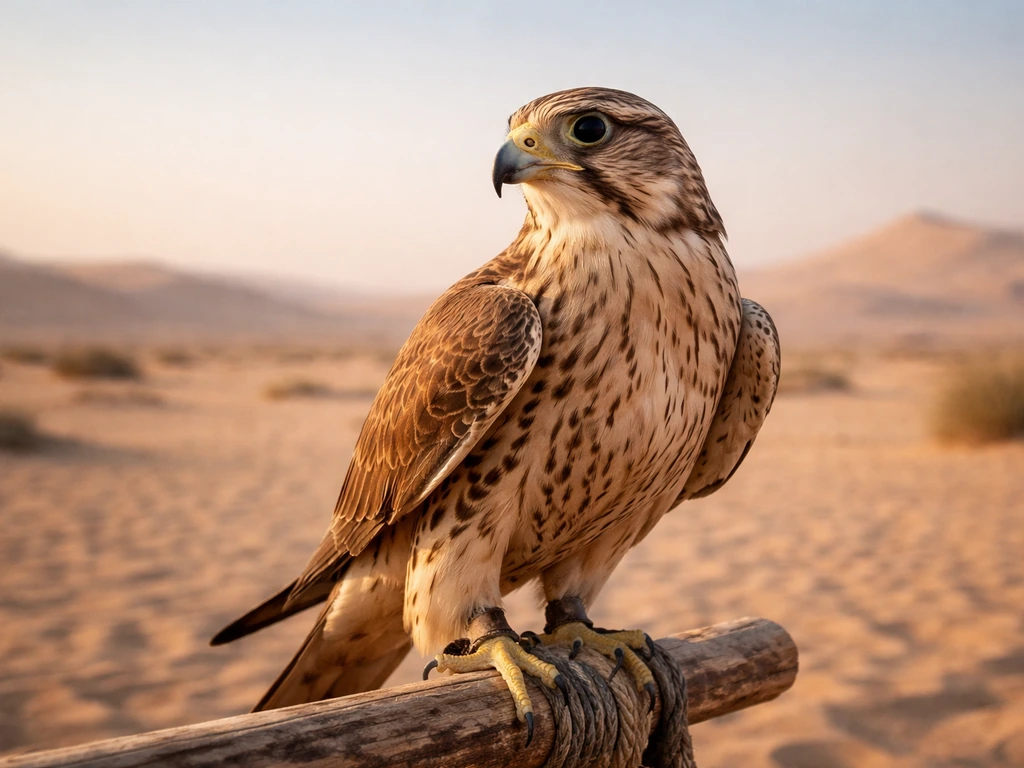
Kuwait's national bird is the falcon, most specifically identified in reference sources as the saker falcon (Falco cherrug). The falcon also sits at the heart of Kuwait's national emblem, adopted in 1962, where a golden falcon known as the "Hawk of Quraish" holds the country's shield. So whether you're looking at the national bird listing or the state emblem, the answer is the same: it's a falcon, and the saker falcon is the species most consistently named.
What Is the National Bird of Kuwait? Meaning and Facts

Marcus Chen
13 May 2026
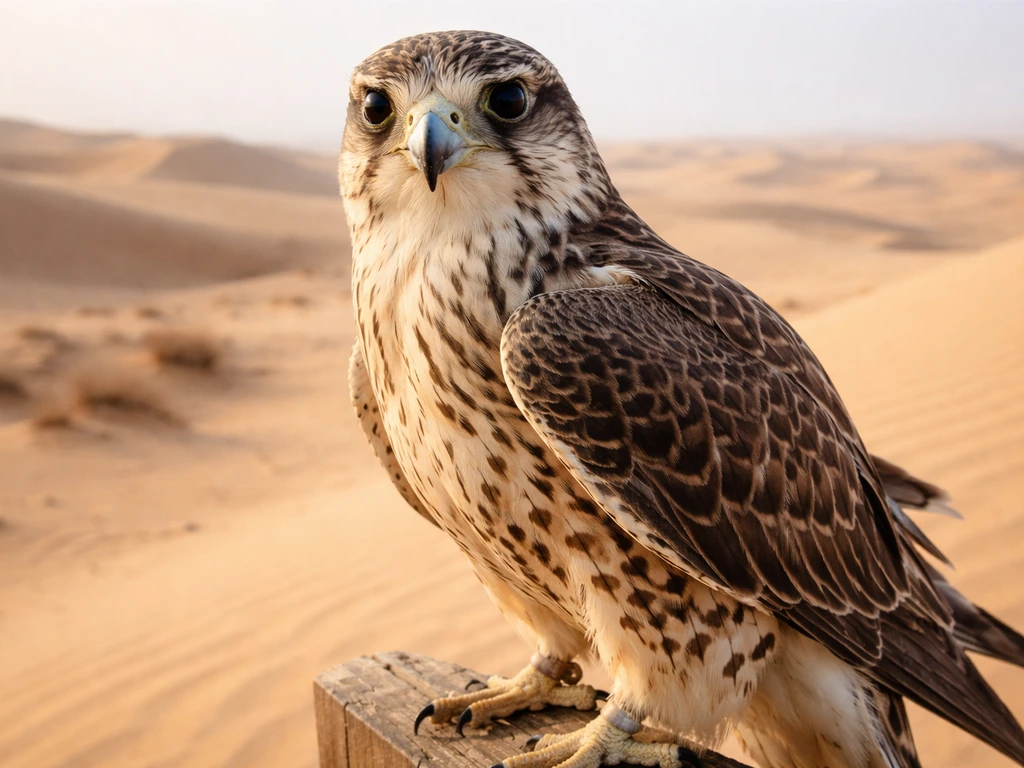
The official answer and what the sources say
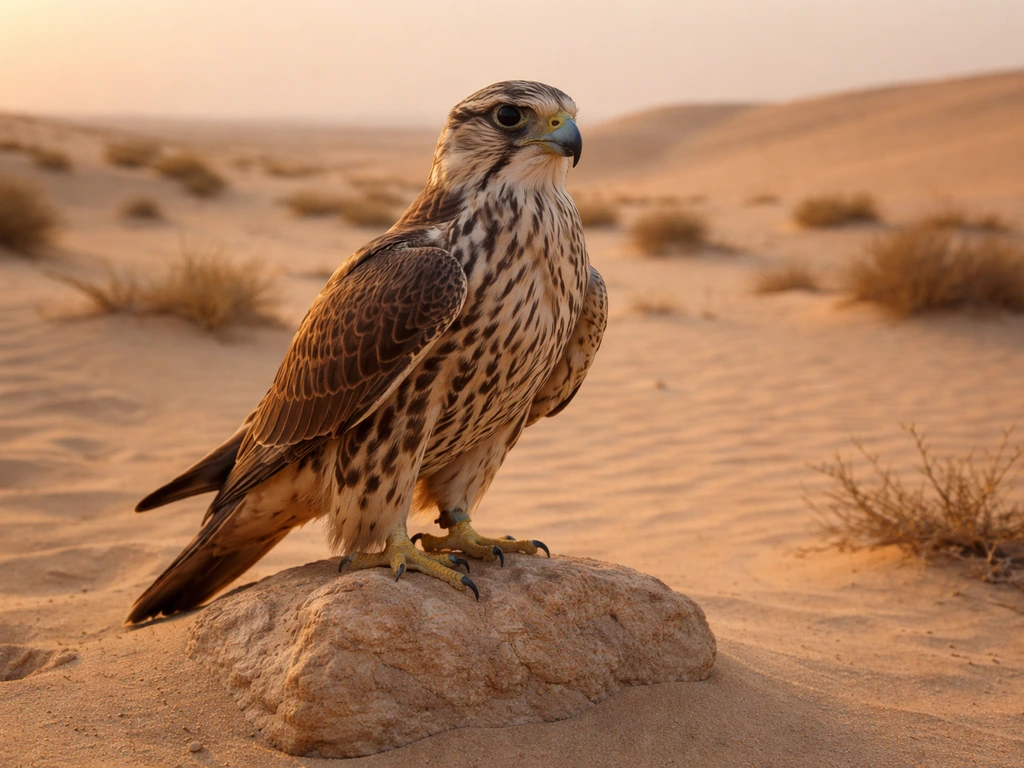
Multiple credible references point to the saker falcon as Kuwait's national bird. A U.S. government document submitted to the Commission of Fine Arts for the National Desert Storm and Desert Shield Memorial explicitly refers to "blank" rel="noopener noreferrer">the saker falcon, national bird of Kuwait." Kuwait's national symbols page lists the national bird as simply "Falcon," and the 1962 state emblem centers on a golden falcon. The saker falcon is also catalogued with a dedicated species page on KuwaitBirds.org, the country's main ornithological reference site, which gives it added local authority.
The emblem itself was designed by Mohammed Husni Zaki and officially adopted in 1962. It depicts a golden falcon with wings displayed, carrying a shield that shows the Kuwaiti flag, with a dhow (traditional sailing vessel) at the base. WorldAtlas also confirms the 1962 adoption date. The falcon on the emblem is described as the "Hawk of Quraish," a heraldic symbol used across several Arab states that ties directly to Arab and Islamic identity.
What the falcon means to Kuwait
The falcon is not just a symbol on a document. It runs through Kuwaiti culture in a living, practical way. Falconry is a deeply embedded tradition across the Arabian Gulf, and Kuwait is no exception. The Kuwait Times describes how falconry blends tradition and technology across the region, and a note tied to Kuwait's Liberation Medal even puts it plainly: "falconry is the sport of Kings in the Persian Gulf." The falcon in Kuwait's arms is read as a symbol of Kuwaiti prowess and strength, not just a decorative choice.
The "Hawk of Quraish" name adds a second layer of meaning. The Banu Quraish is the Arab tribal lineage traditionally associated with the Prophet Muhammad, so using this specific heraldic falcon is a statement of Arab identity and Islamic heritage. You see the same symbol appear across other Arab state emblems, which is why Kuwait's use of it places the country within a shared regional and civilizational tradition.
There's also a maritime angle. The dhow in the emblem sits beneath the falcon, connecting Kuwait's seafaring and pearl-diving history to the same national iconography. Falconry on land, trading by sea: the two symbols together reflect how Kuwaitis have historically defined themselves.
Why a falcon, and why this goes back further than 1962
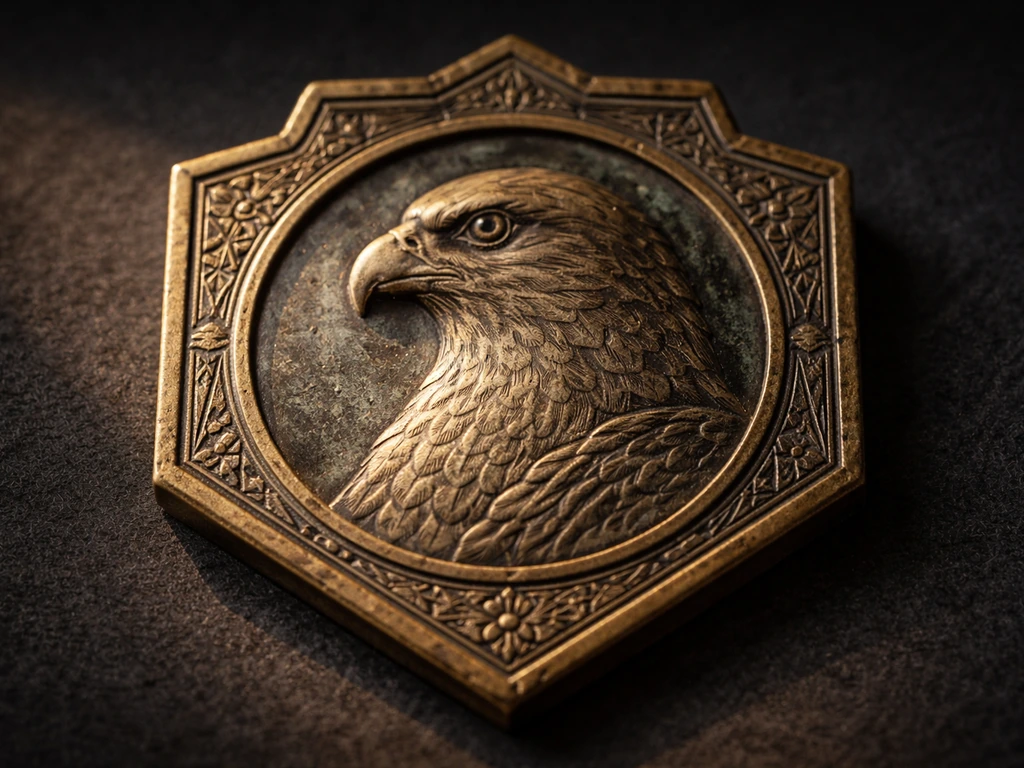
The 1962 emblem adoption was the formal moment, but falcon imagery in Kuwaiti official design predates it by decades. A Kuwaiti Ministry of Information account notes that as far back as 1940, a falcon appeared above crossed pennants in an official design context, and a 1956 emblem design also featured a raised falcon. By the time the current emblem was formalized at independence, the falcon had already been part of Kuwait's visual and symbolic language for at least two generations.
The choice of the saker falcon specifically makes practical sense too. The saker is a large, powerful hierofalcon native to a broad range from Central Europe through Central Asia and into the Middle East. It has historically been prized in falconry across the Arab world for exactly the qualities Kuwaiti culture celebrates: speed, power, and precision. Its presence in Kuwait as a species (documented by KuwaitBirds.org) means the designation reflects the bird's actual relationship with the land, not just an abstract choice.
Quick facts about the saker falcon
| Attribute | Detail |
|---|---|
| Scientific name | Falco cherrug |
| Type | Large hierofalcon |
| IUCN conservation status | Endangered (EN) |
| Call | Sharp "kiy-ee" or repeated "kyak-kyak-kyak" |
| Range | Central Europe through Central Asia to the Middle East |
| Cultural role | Prized falconry bird across the Arab world for centuries |
| Emblem appearance | Golden falcon with wings displayed, adopted on Kuwait's state emblem in 1962 |
| Emblem designer | Mohammed Husni Zaki |
One fact worth noting for conservation-minded readers: the saker falcon is currently listed as Endangered on the IUCN Red List. Demand from falconry markets, habitat loss, and illegal trapping have all contributed. This makes the species an increasingly significant symbol, not just culturally but as a conservation talking point across Gulf states.
Why you might see conflicting answers online
A few things can muddy the search results. First, Kuwait's national symbols page lists the national bird as "Falcon" without specifying the species, so some sources stop there and don't drill down to "saker falcon." That's not wrong, just incomplete. Second, the saker falcon is also listed as the national bird of several other countries (including the UAE, Hungary, and Mongolia), so you may see it come up across multiple national bird lists in a way that feels repetitive or confusing. The UAE is one of the places where the saker falcon is also listed among national bird choices the UAE, Hungary, and Mongolia.
Third, there is at least one well-publicized advocacy campaign to make the crab plover Kuwait's national bird instead. Kuwait News Agency (KUNA) reported on an environmental researcher who proposed the crab plover, pointing to Boubyan Island as a key habitat. This is a proposal, not an official designation. The crab plover is not Kuwait's national bird today. It's the kind of story that can surface in search results and create the impression of a dispute where there really isn't one at the official level.
When you're trying to verify, the most credible combination of sources is: the state emblem (officially adopted 1962), the national symbols of Kuwait reference page, and the U.S. government CFA document that names the saker falcon directly. Those three together give you a consistent, documented answer.
How Kuwait compares to its neighbors
Kuwait is far from alone in choosing a falcon as its national bird. Across the Gulf and wider Arab world, falcon symbolism is dominant. The UAE's deep connection to the peregrine falcon and the role of falconry in Emirati identity is well documented, and Qatar, Bahrain, Saudi Arabia, and Oman each have their own relationships with falcon imagery and national bird designations. For Qatar specifically, you would find that its national bird is different from Kuwait's falcon. If you are asking specifically about Dubai, the national bird in the UAE is the falcon, commonly linked with the peregrine falcon in Emirati sources UAE's deep connection to the peregrine falcon. Bahrain, like several Gulf neighbors, also uses a national-bird designation that can be checked against official sources. If you are asking specifically what Oman’s national bird is, you can look for the official national symbols guidance or a national birds reference for Oman Oman each have their own relationships with falcon imagery. Saudi Arabia's national bird is often identified in reputable national symbols references as the falcon, and it is commonly discussed alongside Gulf falconry traditions. Iraq and Jordan use different birds entirely. Jordan's national bird is also frequently listed in national symbol sources, but it is different from Kuwait's falcon Jordan use different birds entirely. Iraq's national bird is the golden oriole Iraq and Jordan use different birds entirely.. If you're researching the broader pattern of national birds in the Middle East, Kuwait fits neatly into a regional story about falconry culture shaping national identity.
Where to go if you want to dig deeper
For the most reliable next steps, here's where to look:
- KuwaitBirds.org: The most focused Kuwait-specific ornithological resource online. It has a dedicated saker falcon species page and a falcons section that puts the bird in local ecological context.
- The Emblem of Kuwait page (available on major reference encyclopedias): Gives you the full official description of the 1962 emblem, the "Hawk of Quraish" designation, and the designer's name.
- National symbols of Kuwait reference pages: Useful for a quick cross-check of how the bird is categorized at the national symbols level.
- IUCN Red List (iucnredlist.org): If you want to check the saker falcon's current conservation status and range, this is the authoritative scientific source.
- Kuwait News Agency (KUNA): For tracking any updates or developments in Kuwaiti environmental policy, including any future official changes to national symbol designations.
The answer you can walk away with right now: Kuwait's national bird is the falcon, identified most precisely as the saker falcon. It's backed by the state emblem adopted at independence in 1962, referenced in U.S. government documents, and grounded in a centuries-old falconry tradition that still defines Gulf culture today. Any source suggesting otherwise is either incomplete, outdated, or describing an advocacy position rather than an official designation.
FAQ
If some sources just say “Falcon” and not “saker falcon,” is that wrong?
Most official-style listings say “Falcon” without a species name, so if you see that wording it is still consistent with Kuwait’s symbolism. To confirm the specific species, you need a source that explicitly names it as the saker falcon (Falco cherrug) or ties it to an identification source that does.
Does the national emblem prove the species, or only that it’s a falcon?
No, the emblem and the national-bird reference point to the same concept, but they are different evidence types. The emblem (adopted in 1962) is visual proof of a golden falcon used as an official symbol, while the national-bird listings provide the text designation. Both align on “falcon,” with species identification most clearly made in sources that name the saker falcon.
What does “Hawk of Quraish” mean, and is it a different bird?
Because the “Hawk of Quraish” term is heraldic rather than a field-guide name, you can misread it as a different bird. In practice, it points to the falcon depicted on Kuwait’s arms, not an alternative species. Treat it as a name for the symbolic falcon in the emblem, not a separate national-bird category.
I keep seeing crab plover claims in search results, is there an official dispute?
The crab plover story is a proposal, not an official change. If your research is meant to answer the current question, prioritize government, official national symbols materials, and consistent documents that directly use the national-bird designation rather than advocacy claims.
Why does the saker falcon show up as a national bird for multiple countries, and how do I avoid mixing them up?
Some countries reuse the saker falcon in their national-bird lists, so repetition across lists can be misleading. When comparing pages, match the country name and then look for whether the page explicitly ties the designation to Kuwait or to the UAE, Hungary, or Mongolia for that same species.
What’s the quickest way to verify Kuwait’s national bird accurately?
If you want the fastest verification approach, cross-check three items: Kuwait’s state emblem adopted in 1962, Kuwait’s national symbols guidance that identifies “Falcon” as the national bird, and a source that explicitly names the saker falcon as Kuwait’s national bird. If any one of these is missing, you may end up with an incomplete or less precise answer.
Does the emblem’s “golden” falcon mean a specific species different from the saker falcon?
You can cite the emblem’s “golden falcon” description for the symbolic portrayal, but don’t assume “golden” means a specific species. The word describes the heraldic look (color and stylization), while species identification is about the bird type, which is most consistently given as the saker falcon in Kuwait-specific references.
Can I use Kuwait’s falconry tradition as evidence, or should it only be background context?
Yes. Kuwait’s national iconography is tied to falconry traditions, which are commonly discussed as a cultural practice across the Gulf. If you are writing something research-based, you can use this cultural context as supporting background, but the species answer still depends on the official designation and species-identifying references.
Does the saker falcon’s conservation status change what the national bird is, or only how it’s discussed?
Because the saker falcon is listed as Endangered, you may also see conservation-focused articles that reframe the falcon as a point of concern. For the “what is the national bird” question, conservation status is supplementary, but it can be useful if you need to explain why symbolism and policy interest overlap today.
Next Article
What Is the National Bird of Saudi Arabia
Get the national bird of Saudi Arabia, its symbolism, traits, habitat, and how to verify conflicting claims.