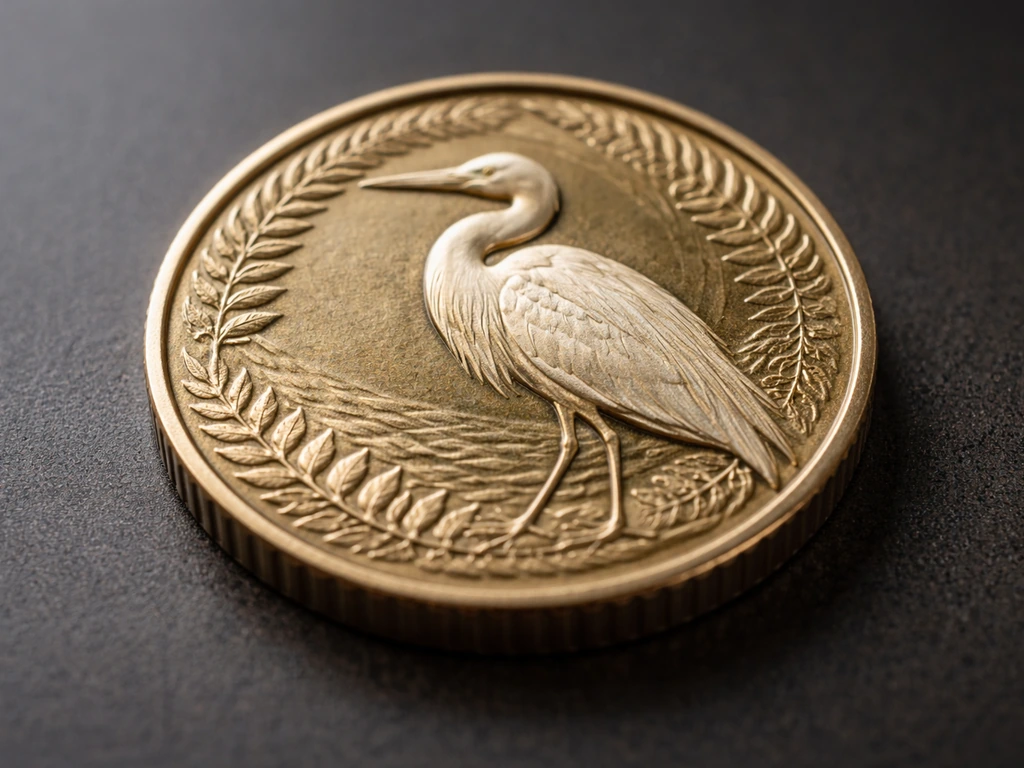
The bird on the reverse of a $2 New Zealand coin is the kōtuku, also known as the white heron (Egretta alba modesta). This has been the design since the modern $2 coin was introduced in 1990, and it remains the same today. Flip your coin over to the tails side and you'll see an elegant, long-necked white heron, one of the rarest birds in New Zealand.
What Bird Features on a $2 New Zealand Coin?

Marcus Chen
16 May 2026
Making sure you have the right $2 coin
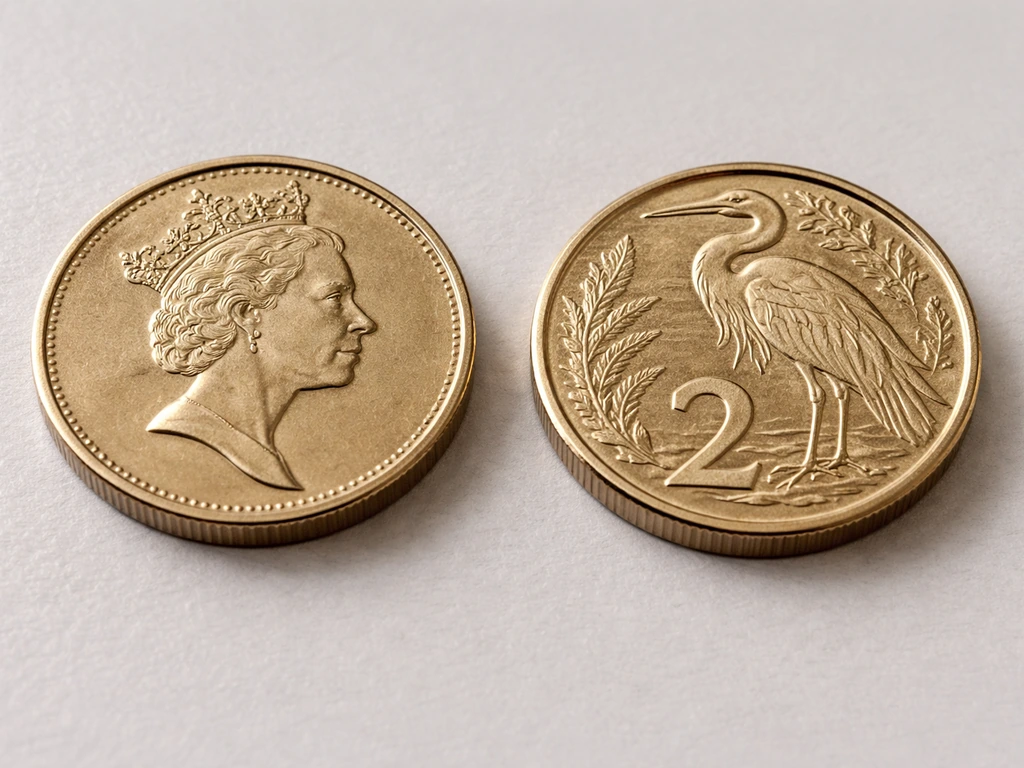
Before locking in your identification, it's worth confirming a couple of things about the coin itself. The Reserve Bank of New Zealand also provides guidance on spotting fake banknotes and coins, including security features that help you confirm authenticity before you identify what you have confirming a couple of things about the coin itself. The standard circulation $2 coin has been issued since 1990, and the kōtuku reverse design has stayed consistent across all standard issues from that year onward. However, there's one important caveat: commemorative $2 coins exist that feature completely different birds. A well-known example is the 1993 Kingfisher commemorative $2 coin, which shows a kingfisher rather than a kōtuku. So if your coin looks different from what you'd expect, check whether it's a special issue.
The obverse (front) of the coin shows a portrait of the monarch. The portrait used on the $2 changed over the years: from 1990 to 1998, the obverse used Raphael Maklouf's portrait of Queen Elizabeth II. Later issues updated the portrait to reflect the monarch's age at the time, and more recently the portrait reflects King Charles III. The monarch side doesn't affect the reverse bird design for standard coins, but checking the year helps you confirm whether you have a circulation coin or a commemorative variant.
- Check the denomination: make sure it says $2, not $1 (the $1 coin features a different native bird, the kiwi).
- Flip to the tails/reverse side: the bird should be on this side, not the monarch portrait side.
- Check the year: if it's 1990 or later and not a commemorative, you should see the kōtuku.
- Compare with the Reserve Bank's official coin specifications page, which lists the $2 reverse as 'Kotuku/White heron (Egretta alba modesta)'.
Recognizing the kōtuku on the coin
The kōtuku on the $2 coin is depicted in a natural pose, and the design was created by artist Robert Maurice Conly. On the coin, you'll see a large, graceful wading bird with a long slender neck, long legs, and a pointed beak. The bird's plumage is all white. It's often shown against a background suggesting water or wetland habitat, consistent with its real-world home at Ōkārito Lagoon on New Zealand's South Island West Coast, which is the only regular breeding site for white herons in the country.
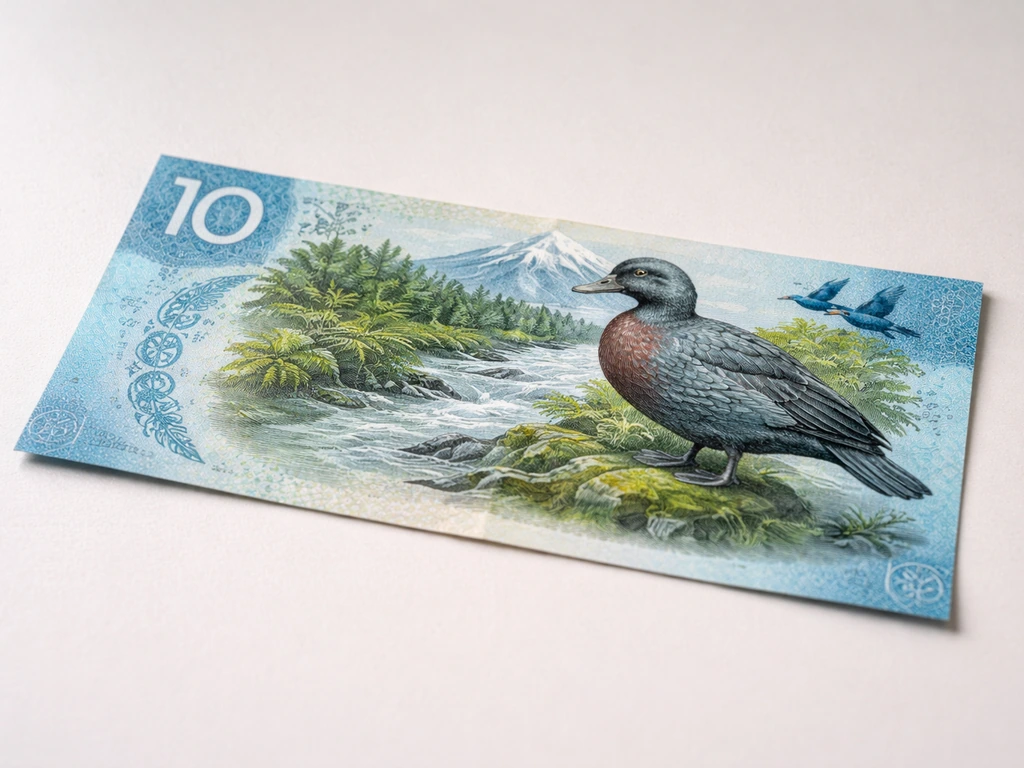
If you're comparing it to other birds on NZ currency, the kōtuku is noticeably tall and elegant with a very long neck, quite distinct from the stubby, flightless kiwi on the $1 coin. Other NZ banknotes also feature native birds: the $10 note, $20 note, and $50 note each have their own bird, making New Zealand's currency a kind of field guide in your wallet. The bird on the NZ$20 note is the kōtuku, also called the white heron. The bird on the NZ $10 note is the huia the $10 note. If you're also curious about the banknote side of things, you might wonder what bird is on the NZ $50 note what bird is on the nz 50 dollar note. If you're wondering about other denominations, New Zealand's 10 cent coin features a different bird than the kōtuku shown on the $2 coin.
Why the kōtuku became a national symbol

The kōtuku holds a unique place in Māori culture that goes well beyond its rarity as a bird. In Māori tradition, seeing a kōtuku was considered a profound event because they were so seldom spotted. This led to the expression 'He kōtuku rerenga tahi,' which translates roughly to 'a white heron of a single flight,' used as a compliment of the highest order to describe someone or something extraordinarily rare and precious, a person or moment you might encounter only once in a lifetime.
That cultural weight made the kōtuku a natural choice for a prominent place on New Zealand currency. The $2 denomination has had a bird theme going back to the era of the $2 banknote, which previously featured the rifleman. When the $2 note was replaced by a coin in 1990, the kōtuku took over the denomination's reverse design, bringing with it both the rarity symbolism and the deep Māori cultural resonance. The Reserve Bank's decision to use the kōtuku reflected a broader philosophy in New Zealand coinage: to represent native wildlife and reinforce national identity through everyday objects.
It's also worth noting that while the kiwi is New Zealand's official national bird, the kōtuku carries its own distinct symbolic status, particularly in Māori tradition. The two birds represent different aspects of New Zealand identity: the kiwi is the everyday emblem of the nation, while the kōtuku represents rarity, elegance, and reverence.
What the design elements actually represent
Every element of the $2 coin's reverse design is deliberate. The kōtuku's natural wetland habitat, suggested in the background of the design, ties the bird to Ōkārito Lagoon, which is protected as a key conservation site by the Department of Conservation. The bird's rarity, its status as one of the rarest breeding birds in New Zealand with a population that historically hovered in the dozens, makes its appearance on high-value everyday currency a quiet statement about conservation and national pride.
The choice to use the kōtuku rather than a more common or internationally recognizable bird also reflects New Zealand's willingness to center its own indigenous identity and Māori cultural values in national symbols. The Māori name 'kōtuku' appears alongside the English name in official descriptions of the coin, reinforcing that dual-heritage framing that runs through modern New Zealand public life. New Zealand’s Coinage Regulations 1967 set out legal coin design and reverse impression requirements by denomination, which is part of how official reverse specifications like the $2 kōtuku are codified.
| Detail | Information |
|---|---|
| Bird name (English) | White heron |
| Bird name (Māori) | Kōtuku |
| Scientific name | Egretta alba modesta |
| Coin side | Reverse (tails) |
| Coin denomination | $2 |
| Design introduced | 1990 |
| Designer | Robert Maurice Conly |
| Habitat shown | Ōkārito Lagoon, South Island, NZ |
Where to verify and go deeper
If you want to confirm everything with an official source, the Reserve Bank of New Zealand's 'Coin specifications and images by denomination' page is the best place to start. It lists each coin by denomination, names the bird on the reverse, and provides images. The Reserve Bank is the authoritative source for New Zealand circulation coinage, so whatever it says about the $2 reverse is definitive.
For numismatic research, Numista maintains a detailed catalog of New Zealand coins including commemorative variants, which is useful if you've identified that your coin might not be a standard circulation issue. The New Zealand Archives also has historical records of coin design decisions, including documentation from when the Reserve Bank took ownership of New Zealand's coins in 1989, which gives useful context for why the 1990 coin series looked the way it did.
For the cultural and natural history side of things, the Department of Conservation's page on the kōtuku covers the bird's conservation status, behavior, and Māori significance in detail. Te Ara, the Encyclopedia of New Zealand, has an article specifically on white herons as emblems, tracing how the kōtuku's role as a national symbol evolved over time. Both are worth reading if you want to understand why a bird this rare ended up on a coin this common.
- Reserve Bank of New Zealand: 'Coin specifications and images by denomination' (official confirmation of $2 reverse bird)
- Numista: New Zealand two-dollar coin catalog (for checking commemorative variants by year)
- New Zealand Archives: historical coin design documentation
- Department of Conservation: kōtuku/white heron species page
- Te Ara Encyclopedia: 'White herons as emblems' article
FAQ
How can I tell if my $2 coin is a standard kōtuku coin or a commemorative $2?
Most $2 New Zealand coins you handle are circulation issues, but the fastest check is to look for the year and whether the reverse image matches the kōtuku. If the bird is clearly different (for example, a kingfisher or other species), it is likely a commemorative $2 coin rather than the standard design.
If it is a $2 coin, why might it not show the kōtuku?
Yes. Some commemorative $2 coins use different reverse birds, so you cannot rely on the denomination alone. The key is to verify the reverse design against the coin year you see on the obverse.
What visual details should I look for if my coin is too worn to identify the bird?
If your coin looks worn, the beak shape and long neck are still usually distinguishable. The standard design shows a tall, long-necked white heron, with long legs and a pointed beak, and the bird is rendered all white.
Does the bird on the $2 coin ever change on standard circulation coins?
The $2 kōtuku design has been kept consistent for the modern standard circulation coin series that began in 1990, so the reverse bird is not expected to change across normal year-to-year circulation issues.
If the monarch portrait changes, does that also mean the bird design changes?
The monarch portrait on the front changes over time, reflecting different reign periods, but that front change does not alter the standard reverse bird. You can use the front portrait and year to confirm the coin is a standard circulation issue, then identify the kōtuku on the reverse.
Should I identify the bird from the front or the back of the $2 coin?
Because the reverse is the key identification feature, you can flip the coin to the tails side and focus on the bird. The only dependable way to confirm is to match the reverse image (species, posture, and background) for your coin year, especially if you suspect it is commemorative.
What should I do if my coin is spendable as $2 but doesn’t match what I expect visually?
If the reverse includes a different bird and the coin year is associated with a known special issue, treat it as commemorative even if the coin is still spendable as a $2. Keeping photos of both sides for comparison helps avoid mix-ups.
How do I avoid confusing the $2 bird with the bird on the $1 or other NZ currency?
The kōtuku is the bird commonly tied to the $2 reverse, but if you are comparing coins from different denominations, be careful not to mix it up with the bird used on other NZ currency. The kiwi on the $1 and other banknote birds are distinct, and only the $2 coin is the kōtuku in the context described here.
What is the most reliable way to confirm the exact bird on my specific $2 coin?
The Reserve Bank reference materials are the best tie-breaker when you are unsure about reverse design versus commemorative exceptions. Use the year plus the denomination page that lists each coin by denomination and reverse description.
Next Article
What bird is on the NZ 10 dollar note? Identify it fast
Identify the bird on the NZ 10 dollar note, including species and where it appears on the banknote design.