
The bird on the German flag emblem is the eagle, specifically the heraldic eagle known as the Bundesadler (federal eagle). It is a single-headed black eagle with a red beak, red tongue, and red talons, displayed on a gold or golden-yellow shield. If you are looking at an official German flag that shows a bird, that bird is always this eagle.
What Bird Is on the German Flag? Eagle Explained

Marcus Chen
28 Apr 2026
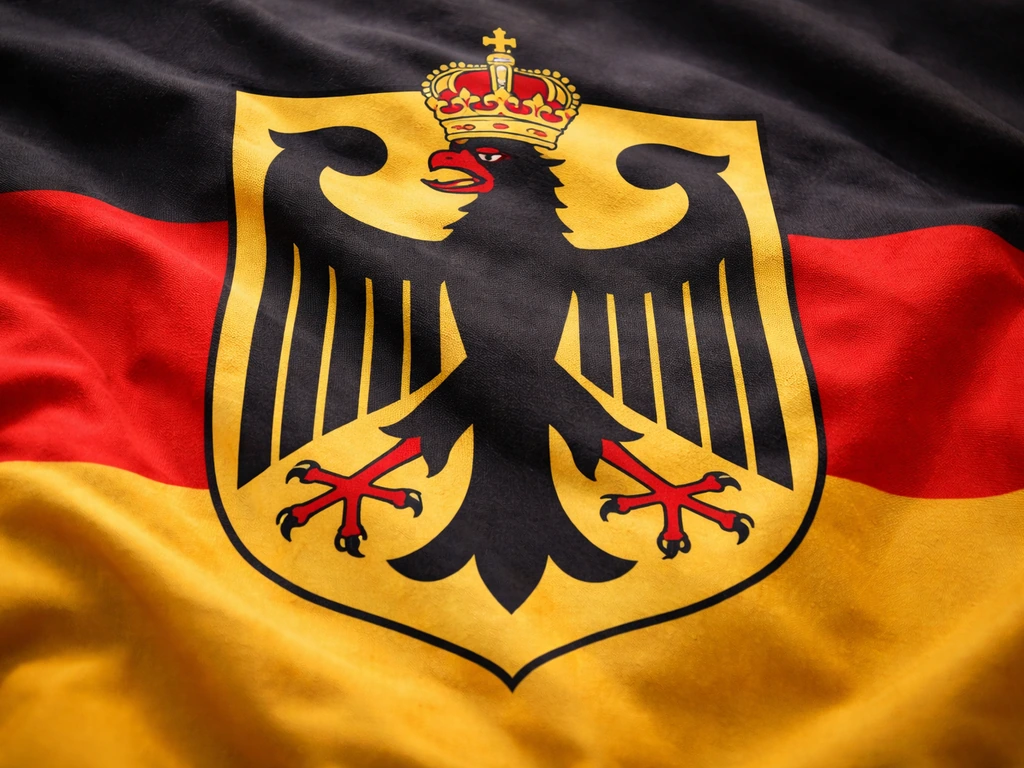
What exactly is the Bundesadler
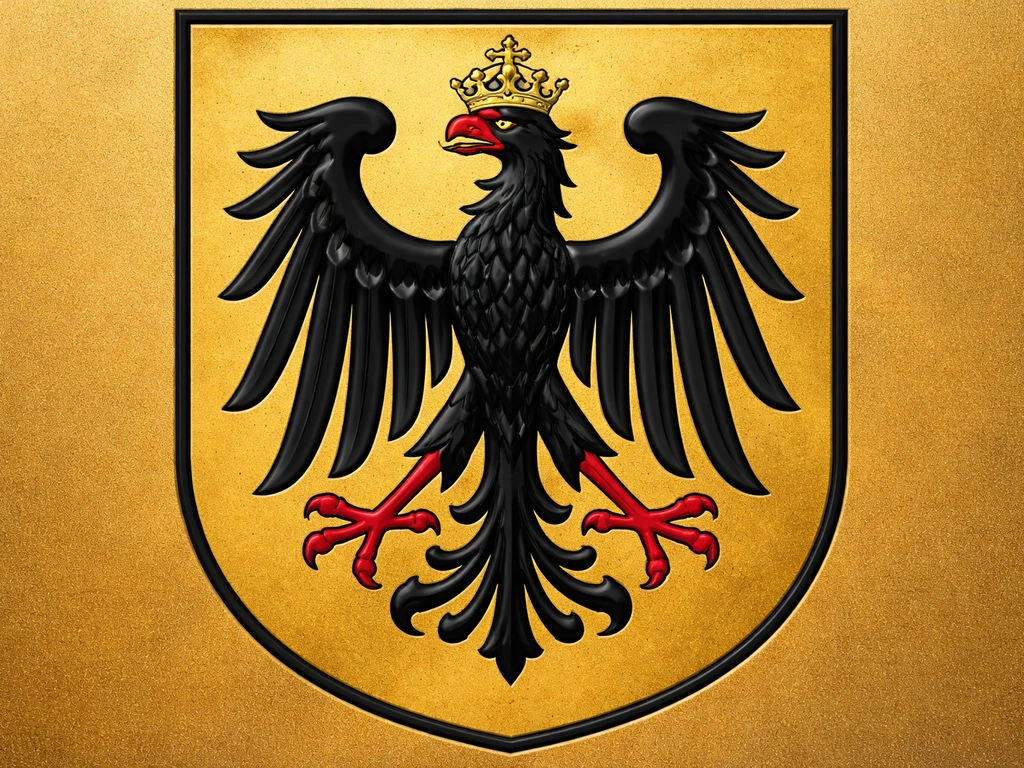
Germany's everyday national flag, the Bundesflagge, is simply three horizontal stripes: black on top, red in the middle, and gold on the bottom. There is no bird on that basic tricolor. The eagle appears when Germany uses its coat of arms or the Bundesdienstflagge, which is the official service flag used by federal authorities. The Bundesadler is used on Germany’s federal coat of arms and on the federal service flag, not on the plain black-red-gold national tricolor. That version places the Bundesschild (a shield bearing the eagle) right in the center of the tricolor.
The Bundesadler has a very specific, regulated look. The Bundestag's own description nails it down: one head, turned to the heraldic right (which is the viewer's left), wings open but with closed feathering along the edges, all in black, with the beak, tongue, and talons colored red. The shield behind it is gold. There is no crown on the eagle's head, which is one of the clearest ways to distinguish the modern German federal eagle from older imperial versions.
The history behind Germany's eagle symbol
The eagle has been tied to German-speaking lands for over a thousand years. The Carolingian dynasty used the eagle as a symbol of imperial authority in the ninth century, and it carried forward through the Holy Roman Empire. The black eagle on a gold field became firmly associated with German kingship and empire, appearing on royal seals and battle standards throughout the medieval period.
During the Weimar Republic (1919 to 1933), Germany redesigned the eagle emblem into a more stylized, modern form. That Weimar-era eagle was then replaced by the Nazi Reichsadler, which used a spread-winged eagle perched on a wreath enclosing a swastika. After World War II, West Germany deliberately broke from that imagery. The new Bundesadler, adopted in 1950, went back to the upright heraldic style but stripped away the crown and the aggressive spread-wing posture, giving it a cleaner, more democratic feel.
That 1950 design is what you see today on official German state documents, government buildings, passports, and the Bundesdienstflagge. It has remained consistent since reunification in 1990.
Why Germany chose the eagle and what it represents
Eagles in heraldry have always been associated with strength, sovereignty, and far-sightedness. For Germany, the choice was less a fresh decision and more a continuation of a symbol that had represented Germanic rule for centuries. Keeping the eagle after WWII (while deliberately updating its design) was a way of connecting to pre-Nazi tradition while rejecting the specific imagery that had been corrupted.
The single head is also significant. The double-headed eagle appeared in later Holy Roman Empire imagery and in the heraldry of neighboring states like the Austro-Hungarian Empire and later Austria. Germany's use of a single-headed eagle distinguishes it from that tradition and aligns it specifically with the Prussian heraldic line. If you are ever comparing the German eagle to the Polish white eagle or the Serbian double-headed eagle, the number of heads is one of the fastest visual shortcuts to tell them apart. The Polish flag features the white eagle, which can help you distinguish it from the German eagle symbol. The Serbian flag features a double-headed eagle rather than the single-headed eagle used in German heraldry Serbian double-headed eagle. The Polish white eagle is one of Poland's most recognizable national symbols.
How to confirm which bird is on the flag you are looking at
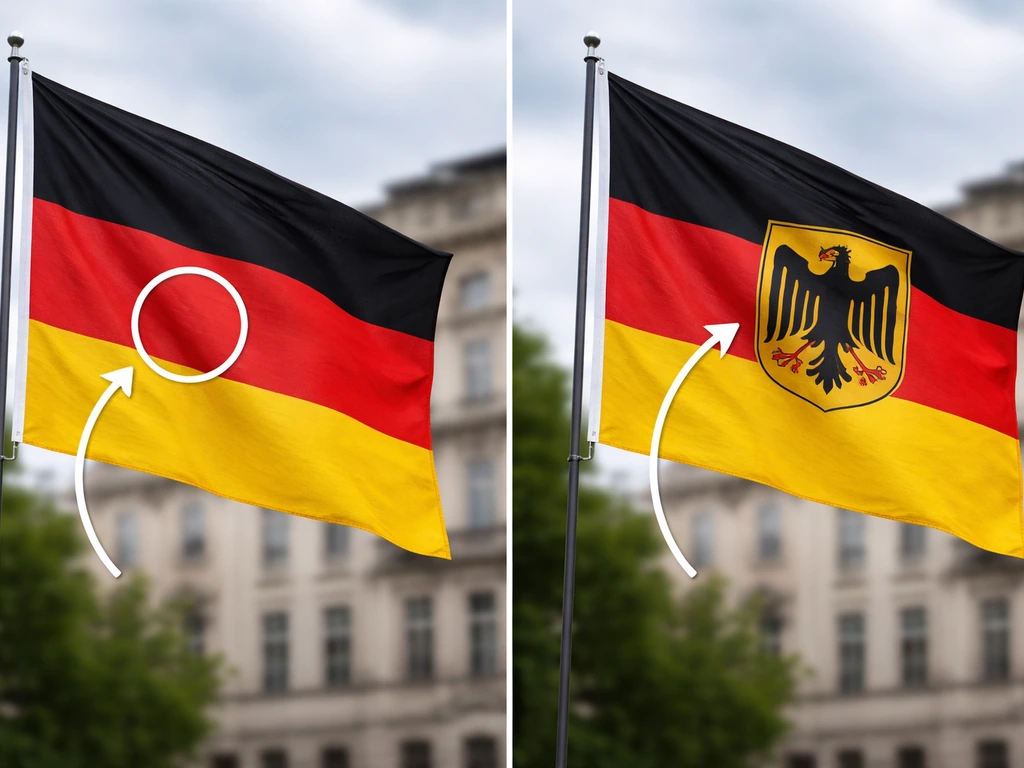
People often get confused because Germany has multiple flag variants and not all of them show the eagle. Here is a practical way to check what you are actually looking at.
- Check whether the flag is the plain tricolor or has a central emblem. If it is just three horizontal stripes with no central symbol, there is no bird at all.
- If there is a central shield or emblem, look for a single-headed bird in black on a gold background. That is the Bundesadler.
- Confirm the head direction: the eagle's head faces the viewer's left (its heraldic right). If the head faces the other way, you may be looking at a different eagle emblem.
- Check for a crown. The modern Bundesadler has no crown. A crowned eagle on a German-style flag likely means you are looking at a historical or regional variant, not the current federal symbol.
- Check talon and beak color. Red beak and red talons confirm it is the Bundesadler. If those details are yellow or a different color, it is a different heraldic design.
- If you are looking at a state-level German flag rather than the federal flag, the eagle may look different. German states (Länder) each have their own coats of arms, some of which use different animals entirely.
Quick visual comparison: German eagle vs similar emblems
| Emblem | Heads | Color | Crown | Notable difference |
|---|---|---|---|---|
| German Bundesadler | 1 | Black on gold | None | Upright posture, closed wing feathering, red talons |
| Holy Roman Empire eagle | 2 | Black on gold | Yes (imperial) | Double-headed, crowned |
| Prussian eagle | 1 | Black on white/silver | Yes (crowned) | Crown present, different shield color |
| Polish white eagle | 1 | White on red | Yes (restored in 1990) | White coloring, crown restored post-communism |
| Serbian eagle | 2 | White on red | Yes | Double-headed, white coloring |
Common mix-ups and things people get wrong
One of the most common mistakes is assuming the bird on Germany's emblem is a specific bird species, like a golden eagle or a white-tailed eagle. Heraldic eagles are stylized symbols, not accurate depictions of a real species. The Bundesadler is simply called an eagle in a general heraldic sense. Germany does have a national bird in the ornithological sense (the white stork, Ciconia ciconia, is often cited in that context), but that bird does not appear on the flag or coat of arms at all.
Another mix-up involves the Nazi Reichsadler. Some people who have seen old German imagery associate Germany's flag bird with that spread-winged eagle. The modern Bundesadler is deliberately different in posture and entirely different in what surrounds it. There is no wreath, no swastika, and the wings are not spread flat. If the eagle you are looking at has wide horizontal wings pointing left and right with something below them, that is not the current German federal symbol.
People also sometimes confuse the Prussian flag's eagle with the federal eagle. You can tell the Prussian version apart because it is a crowned, single-headed black eagle used in the Prussian heraldic tradition Prussian flag's eagle. The Prussian eagle is similar in that it is single-headed and black, but it carries a crown and appears on a white background rather than gold. If you are researching the historical Prussian symbolism specifically, that is a separate heraldic lineage, though the two traditions are closely related.
Finally, keep in mind that Germany's coat of arms and the Bundesdienstflagge (the flag with the eagle in the center) are not the same thing as the standard German national flag. Most general references to the German flag mean the plain black-red-gold tricolor, which has no bird on it. The eagle version is the official service flag for federal institutions, not the civilian national flag flown at homes or sporting events.
Interesting facts about the Bundesadler
- The Bundesadler design used today was drawn by Tobias Schwab and approved in 1950, two years after the Federal Republic of Germany was founded.
- It hangs prominently in the German Bundestag's plenary chamber, making it one of the most-seen versions of the eagle in daily German political life.
- The Bundesadler is sometimes nicknamed the 'fat hen' (Fette Henne) by Germans because of its relatively rounded, compact heraldic shape compared to more aggressive eagle designs.
- The eagle appears on all German passports as part of the coat of arms on the cover.
- Unlike the bald eagle of the United States, Germany's eagle is a purely heraldic creation with no direct tie to a specific living bird species in German territory.
- Germany's neighbor Poland also features a single-headed eagle on its national emblem, but with opposite coloring: white eagle on red, rather than black eagle on gold.
Where to cross-check what you are seeing
If you want to verify the exact design of the Bundesadler, the German Bundestag's official website publishes the full description of the federal eagle and its regulated depiction. The Bundestag’s official “Der Bundesadler” page is explicitly focused on the federal eagle, detailing its regulated depiction Bundestag's official website publishes the full description of the federal eagle. The Federal Government's state symbols page (bpb.de, the Federal Agency for Civic Education) also covers the eagle and other national symbols in detail. Both are authoritative sources that give you the official blazon description and visual references. For historical comparisons, the German National Archive (Bundesarchiv) holds imagery spanning from the Weimar eagle through to the current design, which makes side-by-side comparisons easy to find.
FAQ
Does the bird show up on every German flag?
The ordinary national flag (the plain black-red-gold tricolor, also called the Bundesflagge) has no bird at all. The eagle only appears on flag variants used with the federal coat of arms, most notably the Bundesdienstflagge where the shield with the eagle sits in the center.
How can I quickly tell the German federal eagle from other eagles on flags?
A “single-headed eagle” is the fastest visual check for the German federal eagle. In contrast, a double-headed eagle typically points you to other symbols, such as Serbia or certain Holy Roman Empire style variants. Germany’s eagle also has no crown on its head in the modern federal design.
Is the Bundesadler supposed to be a specific real bird species, like a golden eagle?
No, it is not meant to represent a specific real-world species. The Bundesadler is a heraldic, stylized eagle, so you should not expect anatomical details like a natural beak shape or feather patterns that match common bird-of-prey species.
What should I look for to avoid confusing the Bundesadler with the Nazi Reichsadler?
If the eagle has a wreath and a swastika, or the wings are drawn in an aggressive spread with the old Nazi framing, it is not the modern Bundesadler. The current federal version uses a clean heraldic upright posture and does not include those Nazi elements.
Where will I actually see the eagle, for example on government buildings versus at home?
In modern usage, the eagle is part of Germany’s federal emblem, so it appears on federal service flags and federal signage. You will not reliably find it on everyday home flags, many local or sporting-event flags, or informal national souvenirs that reproduce only the tricolor.
How do I know whether I am looking at the coat-of-arms version or just the plain national tricolor?
Germany has multiple heraldic layers, and the eagle-in-a-shield is not the same as the plain national flag. If you want the version with the bird, confirm the flag includes the centered shield (Bundesschild) rather than only three horizontal color stripes.
Can I confuse the German federal eagle with the Prussian eagle? How can I tell?
If the eagle is crowned and placed on a white background, that more closely matches Prussian heraldic tradition rather than the modern federal emblem. Germany’s current Bundesadler is not shown with a crown and is typically presented on a gold shield.
What is a good way to verify the eagle design in an official context?
The best “reality check” is to identify the flag type. If it is the Bundesdienstflagge or another federal service flag variant with a shield in the middle, the bird should match the regulated Bundesadler look described in official blazon text and approved depiction.
Does the eagle design change over time, or is it the same since reunification?
The modern Bundesadler design adopted in 1950 has been kept consistent after reunification in 1990. That said, you might still see small differences in shading or line thickness across print vendors, but the key heraldic features (single head, no crown, black eagle with red beak and talons on a gold shield) should remain.
Next Articles
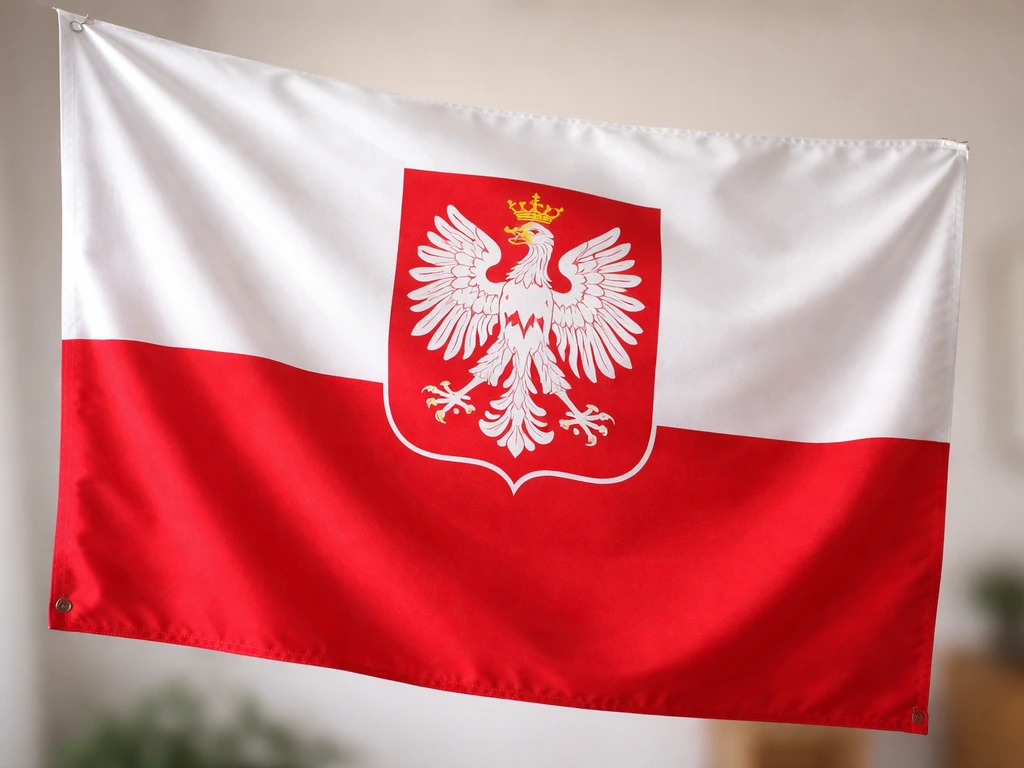
What Bird Is on the Polish Flag? Eagle Symbol ID
Identify the bird on the Polish flag and learn why the eagle emblem became Poland’s national symbol.

What Is the National Bird of Poland? Meaning and Facts
Poland national bird identified with symbolism, key facts, history, and tips to spot and verify it.
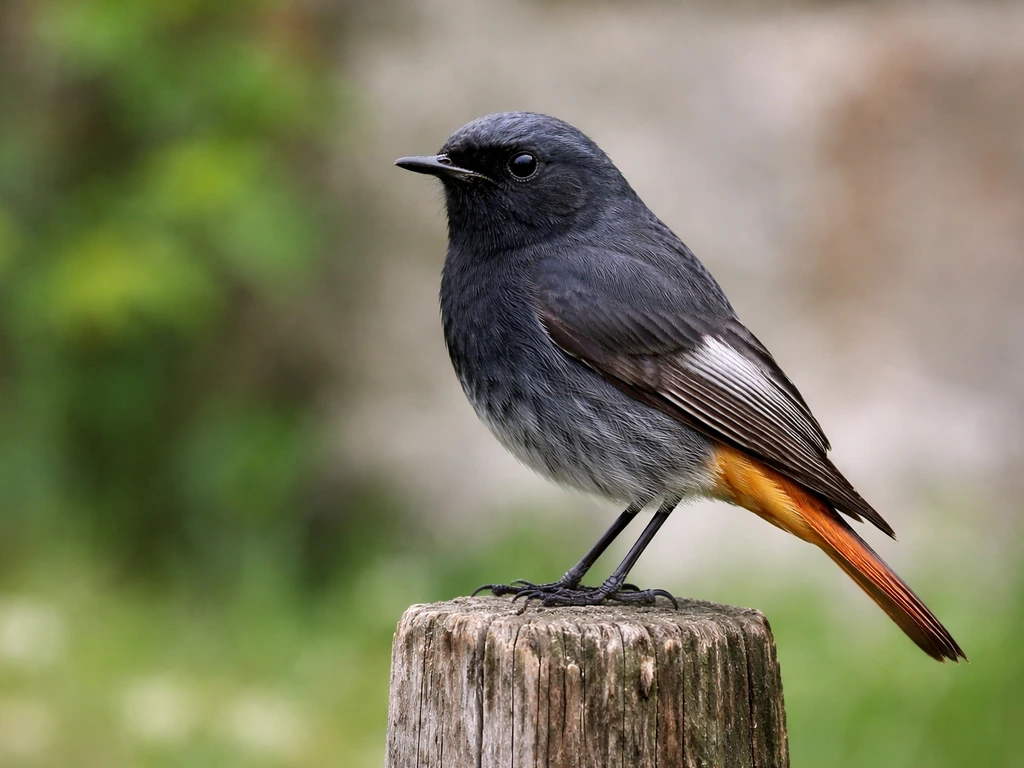
What Is Germany’s National Bird? Meaning and Facts
Germany’s national bird is the black redstart, plus why it became a symbol and key cultural history and facts.