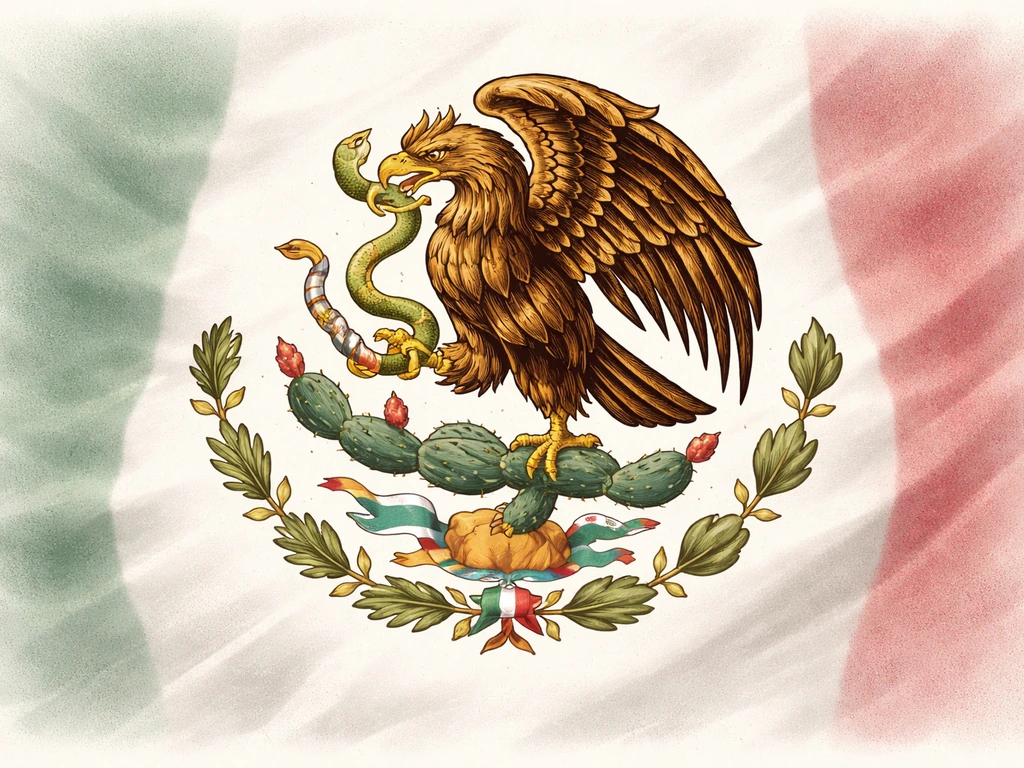
The bird on the Mexican flag is the golden eagle (águila real), shown in left profile, perched on a prickly pear cactus growing from a rock in a lake, gripping a rattlesnake in its right talon and beak while its left talon rests on the cactus. That whole scene, framed by oak and laurel branches tied with a tricolor ribbon at the bottom, is Mexico's National Coat of Arms (Escudo Nacional). Drawing it well means understanding that composition before you put pencil to paper.
How to Draw the Bird on the Mexican Flag Step by Step

Marcus Chen
23 Apr 2026
Which version should you actually draw?
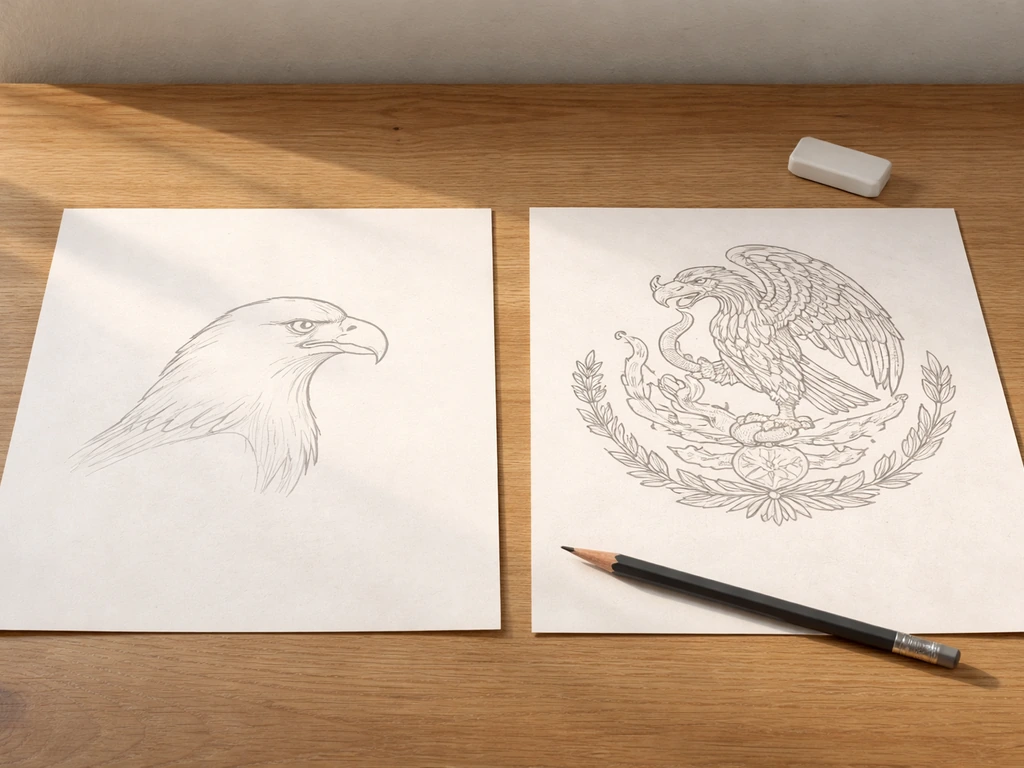
People come to this with two different goals, and mixing them up is the most common source of frustration. The first goal is drawing just the eagle: the bird alone, in left profile, talons gripping a snake. That version is simpler and works well as a standalone study. The second goal is the full emblem as it appears on the flag: the eagle on the cactus, with the oak and laurel semicircle below, all sitting in the center of the white stripe.
Mexico's law (Ley sobre el Escudo, la Bandera y el Himno Nacionales, Article 2) defines the official Escudo down to the specific posture of every element. There is also an authenticated model kept by the three branches of government. That authenticated model is the correct reference for any serious reproduction. The version you see on official documents always follows that model. Free-hand interpretations exist in a lot of places online, but they vary. If accuracy matters to you, find a high-resolution scan of the official flag or a government publication and use that as your reference image alongside these steps.
| Version | What it includes | Best for |
|---|---|---|
| Eagle only | Bird in left profile, snake in talon/beak, cactus perch (optional) | Quick sketches, symbol studies, beginners |
| Full Escudo Nacional | Eagle + cactus + rock + lake + oak/laurel branches + tricolor ribbon | Flag reproductions, school projects, detailed artwork |
| Flag context | Full Escudo centered on white stripe, diameter = 3/4 of stripe height | Drawing the complete Mexican flag accurately |
Start with proportions: laying out the emblem and perch
Before drawing any detail, block out the major shapes. Draw a vertical oval or circle that will contain the whole composition. This outer boundary represents the rough footprint of the emblem. Inside it, place a horizontal midline roughly one-third up from the bottom of the oval. Everything below that line is the cactus, rock, and lake. Everything above it is the eagle. This two-thirds / one-third split is a good working approximation of the official emblem's proportions.
Now sketch the cactus as a simple thick vertical column rising from the center of the lower third, with two short arms angling upward. The eagle sits on top of this column, slightly right of center in the overall composition because the bird faces left (its left profile faces the viewer). Mark a rough teardrop shape for the eagle's body, tilted so the chest points slightly upward and left. The tail feathers hang down toward the right. This tilted teardrop is your anchor for everything else.
Drawing the eagle's head, body, beak, and chest feathers
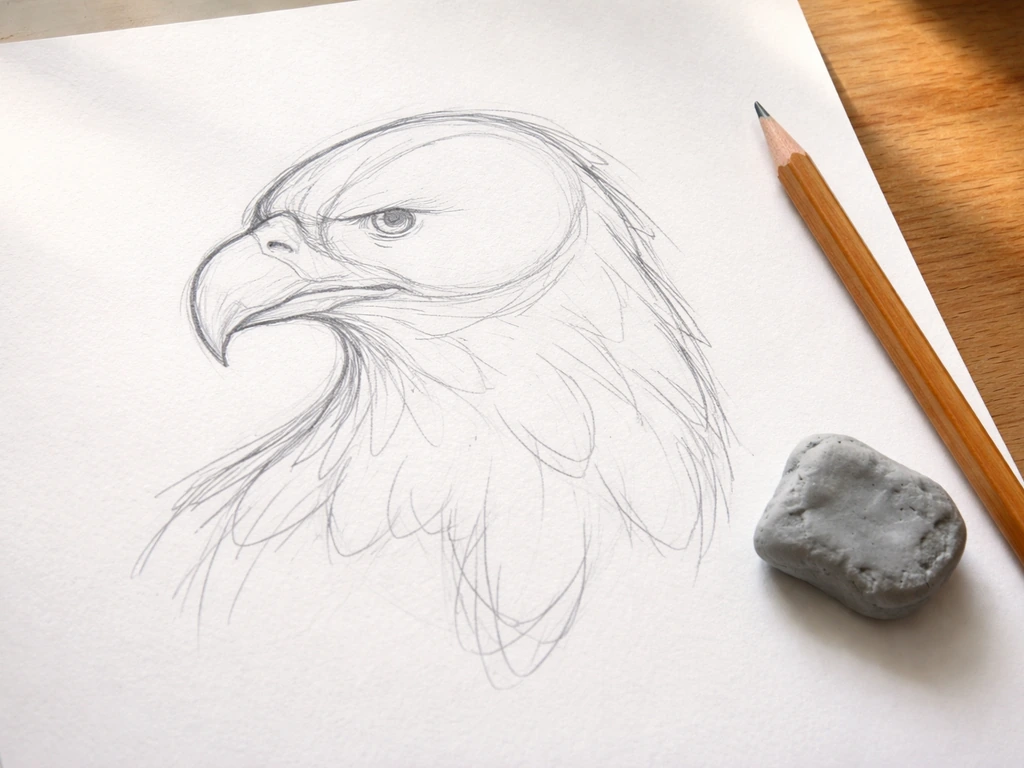
The eagle faces left, so its head turns to the left in profile. Place a small circle or oval at the top-left of your body teardrop to mark the head, slightly forward of the body's center line. The neck connects them with a gentle S-curve, thicker at the base.
The beak is prominent and hooked. Draw the upper mandible as a firm curved triangle pointing forward and downward, longer than you might expect. The lower mandible is shorter. In the emblem, the beak is open and angled downward because the eagle is in a combat posture ("en actitud de combate" is how the law describes it). Place the eye as a small circle or almond shape just above and behind the base of the upper beak.
The chest faces the viewer at a three-quarter angle because the body is in profile but slightly turned. Draw chest feathers as overlapping curved scales, broader at the top and tapering toward the belly. The golden eagle has a distinctive golden-brown nape, but in the emblem rendering this is usually shown as a lighter area around the back of the head. Keep your chest feather lines flowing downward and slightly forward, following the curve of the breast.
Adding wings, tail feathers, and the talons gripping the snake
In the official emblem, the wings are partially raised and spread, not fully extended. Think of them as lifted but folded inward at the tips, like the bird has just landed or is asserting dominance. Draw the right wing (on the viewer's left, since the bird faces left) sweeping upward and slightly outward from behind the shoulder. The left wing mirrors this on the other side. Each wing shows layered primary feathers along the trailing edge. Keep the feather groups in sets of roughly five to seven broad primaries, drawn as elongated, slightly curved shapes.
The tail hangs downward behind the cactus column. Draw five to seven broad tail feathers fanning out slightly, pointing down and to the right. These anchor the lower part of the bird's silhouette and balance the upward thrust of the wings.
Now for the talons, which are one of the most important details to get right. The left talon (the one resting on the cactus) grips the top of the cactus column. Draw three forward-facing toes and one rear-facing toe, each tipped with a curved talon. Keep the grip relaxed but firm. The right talon is what holds the snake. Draw it raised slightly and gripping the snake's body just below the head, with the talons visibly puncturing or clasping. The snake's head and upper body also reach up to the beak, so the eagle appears to be simultaneously gripping and devouring. That dual grip (right talon and beak) is specified in the legal description and is a key accuracy check.
Drawing the cactus and snake, and how to simplify them
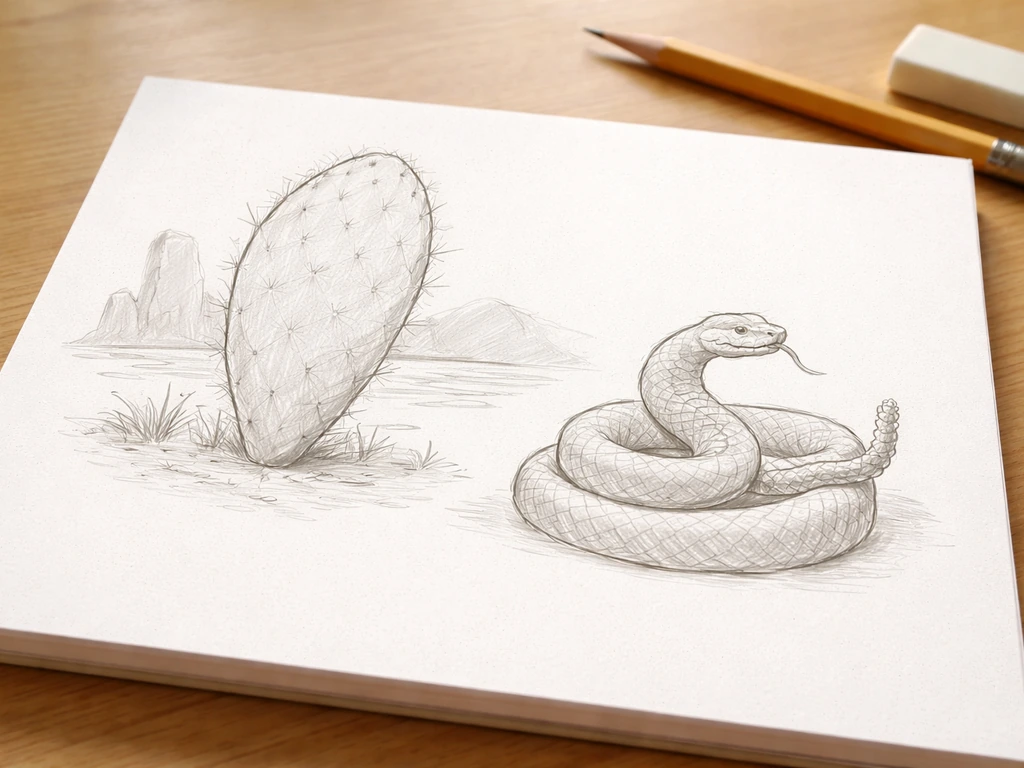
The cactus is a nopal (prickly pear). In the emblem it grows from a rock that rises from a lake. For a simplified version, draw the cactus as a thick vertical paddle shape (the main stem) with two smaller oval paddle shapes branching off partway up, one on each side. Add small dots or short lines to suggest the spines. The rock beneath it is a simple irregular mound, and the lake is suggested by a thin wavy line or a few horizontal lines at the base of the rock.
The snake is a rattlesnake (specifically a víbora de cascabel according to official sources). Its body forms an S-curve from the right talon up to the beak. Draw it with a slightly triangular head (wider at the jaw than the neck), an open mouth if you want the full combat scene, and a body that has a banded or segmented pattern. You do not need to draw every scale, but adding light crosshatch banding helps identify it as a rattlesnake. The tail end of the snake hangs or curves loosely below the talon.
For a simplified version that still reads as accurate, reduce the snake to a smooth S-curve with a triangular head and skip the detailed scaling. Reduce the cactus paddles to clean oval shapes without spine detail. These simplifications keep the composition readable without getting lost in texture.
Adding the oak and laurel branches (full emblem only)
If you are drawing the full Escudo, the lower half of the circular composition is framed by two branches forming a semicircle. The oak branch (encino) goes on the eagle's front side, which is the viewer's left. The laurel branch goes on the other side. Both are tied at the bottom by a ribbon divided into three bands matching Mexico's flag colors: green, white, and red. Draw each branch as a curving stem with five to seven leaf clusters. Oak leaves are lobed and broad; laurel leaves are narrow and pointed. This detail is what separates a casual eagle sketch from a proper Escudo rendering.
Clean linework, shading, and optional color
Once your pencil sketch feels right, go over it with a fine pen or a sharp pencil for the final outline. Use a heavier line weight for the outermost silhouette of the eagle and the cactus, and lighter, thinner lines for the interior feather details and snake banding. This contrast in line weight is what makes the emblem read clearly at a distance, which is exactly how official versions are designed.
For shading without color, use short parallel hatching on the darker areas: under the wing, the underside of the tail, the shadowed side of the cactus paddles, and the snake's belly. Leave the chest and the top of the head lighter.
If you want to add color, the official emblem uses a relatively limited palette. The eagle's body is warm golden-brown with darker brown on the wing tops and tail. The chest tends toward a lighter buff or cream tone. The cactus is medium green, the nopal paddles slightly brighter. The snake is olive-brown with darker banding. The rock is gray-brown, the water blue. The ribbon at the bottom follows the flag: green on the eagle's front side, white in the center, red on the other side. Keep your colors muted and naturalistic rather than bright, which matches the heraldic style of the official emblem.
Why Mexico uses this eagle, and what it all means
The image traces back to the founding myth of the Mexica (Aztec) people, who believed the god Huitzilopochtli told them to settle where they found an eagle on a cactus devouring a serpent. That place became Tenochtitlan, the capital of the Aztec empire and the site of modern Mexico City. Historians note that the exact image as it appears on today's flag was not documented with precision in pre-Hispanic sources, but the symbolic connection to that origin story has been maintained as a deliberate cultural statement through centuries of Mexican history.
The Escudo was standardized without the imperial crown after Mexico's 1823 decree, distinguishing the republican emblem from the brief imperial-era versions. The version with the eagle in left profile, the rattlesnake, and the oak-and-laurel branches effectively took its current form in 1916. Mexico's law since then defines and protects this exact configuration, which is why there is an authenticated model rather than leaving the design open to artistic interpretation.
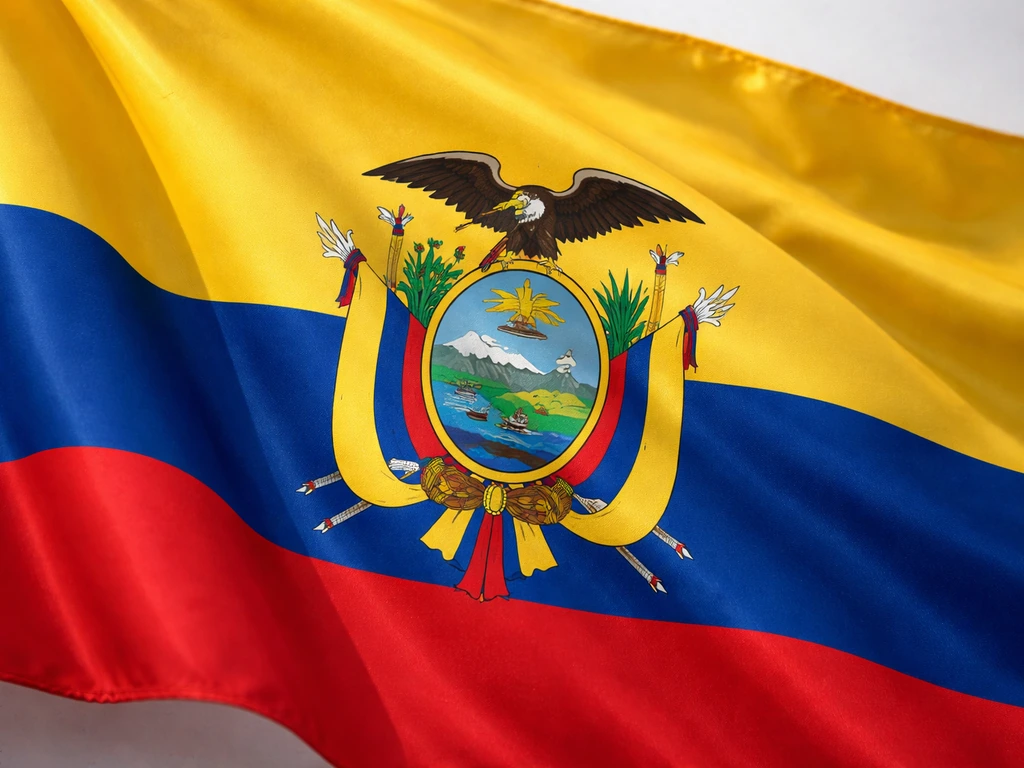
The eagle itself is the golden eagle (águila real, Aquila chrysaetos), a bird that actually lives in Mexico and was deeply associated with solar power and warrior strength in Aztec cosmology. That connection between a real, observable bird of prey and a profound founding myth is what gives the emblem such staying power. Other national flags use birds as symbols too. Other national flags use birds as symbols too, and you can compare this with what bird is on the azores flag. The eagle on Mexico's coat of arms is different from the bird shown on the Egyptian flag. The emblem tradition for birds like the condor on Ecuador's flag or the eagle on Egypt's coat of arms follows a similar logic: a powerful bird that carries cultural or historical weight specific to that nation.
When you draw this emblem, you are not just copying a coat of arms. You are reproducing a symbol that connects Mexico's present national identity to a founding narrative that is over 700 years old. Getting the posture right, the left-facing profile, the snake gripped by both talon and beak, the nopal rooted in the lake, reflects how seriously Mexico has codified that image into law. That is worth understanding before you start sketching.
FAQ
How can I confirm whether I should draw only the eagle or the entire Escudo when following the steps?
Decide first based on your end goal. If you are drawing for the flag itself, you need the full emblem inside the white stripe (eagle plus cactus, lake/rock, and the oak and laurel branches). If you are practicing anatomy or silhouette, draw the eagle alone as a study, keeping the same left-facing profile and combat posture so your practice transfers to the full emblem.
What should I do if my bird’s proportions look off even though the silhouette is correct?
Check the height split you use for the overall oval. If the cactus and rock occupy more than roughly one-third of the circle height, the eagle will look cramped or too small. Re-plot the outer oval, then redraw the midline one-third up, before you add wing and talon details.
How do I place the eagle’s left and right wings correctly for a left-facing profile?
Because the eagle faces left, the wing on the viewer’s left corresponds to the eagle’s right side. When you mirror wings, mirror the direction of lift and the layered feather groups, not just the outer shape, otherwise the wing tips will rotate the wrong way relative to the beak and tail.
What is the most common talon mistake when drawing the eagle gripping the snake?
People often grip the snake with only the talon or only the beak. The emblem’s combat scene reads correctly only when both the right talon clasps the snake’s body near the head and the beak is open or angled as if engaging the snake at the upper portion. If one of those grips is missing, the posture will look like an ordinary perched bird instead of the devouring scene.
Do I need to draw the snake’s rattle and every band to make it recognizable?
No. For a clean, accurate simplified version, keep the triangular head, the S-curve, and light banding or crosshatch segments on the body. You can omit the rattle detail entirely and it will still read as a rattlesnake because the head shape and band rhythm carry the identification.
How should I draw the cactus spines without over-detailing?
Use sparse cues. Put small dots or short, tapered tick marks along the top and outer edges of the nopal paddles, then stop. Too many spines will clutter the silhouette and make the cactus look textured in a way that the official emblem style does not.
If I want to add line weight like the official version, where exactly should I apply thicker lines?
Use heavier lines for the outermost silhouette of the eagle, cactus, and the main branch boundaries. Keep interior feather lines, spine dots, and snake band accents lighter. This ensures the emblem reads at a distance, and it also prevents the interior details from overpowering the composition.
How can I shade in grayscale so the eagle still looks “golden” and not flat?
Aim for contrast instead of trying to color-match. Darken under the wing, under the tail, and along the shaded side of the cactus paddles. Leave the chest and the top of the head comparatively light, then use small hatching clusters around the wing tops to suggest the darker brown areas.
What are practical steps to transfer my sketch into a final clean drawing?
Let the sketch composition settle first, then do a two-pass inking. Pass 1: ink the major silhouettes (outer oval boundary cues, eagle outline, cactus outline, snake outline). Pass 2: add interior details like feather group sets and snake banding. This sequence reduces smudging and makes corrections easier before you commit to fine lines.
When coloring, how do I avoid making the emblem look too bright or cartoonish?
Use muted, naturalistic tones and limit saturation. Keep the eagle’s gold-brown warm but not neon, use olive-brown for the snake with darker bands, and keep the water blue subdued. If your colors feel vivid, desaturate and reduce contrast rather than changing the main colors completely.
Can I draw the emblem without the branches and ribbon, and still have it be accurate?
It can be accurate as an eagle study, but it will not match the official Escudo composition. If your goal is fidelity to what appears on the flag, the oak and laurel semicircle and the tricolor ribbon placement are part of the coded layout, so omit them only if you are intentionally practicing the bird or cactus-and-snake scene.
What should I do if my final drawing doesn’t look like a left-facing profile even though I started correctly?
Do a quick “profile check” before adding feathers. Verify that the head, beak direction, and tail angle all consistently point left. If any one element is rotated to the right, it can flip the perceived orientation even when the outline seems right. Then rebuild the neck S-curve and beak angle to re-establish the correct orientation.
Next Article
What Bird Is on the Ecuadorian Flag? Meaning and Facts
Learn the exact bird on Ecuador’s flag and its emblem meaning, history, and standout facts.