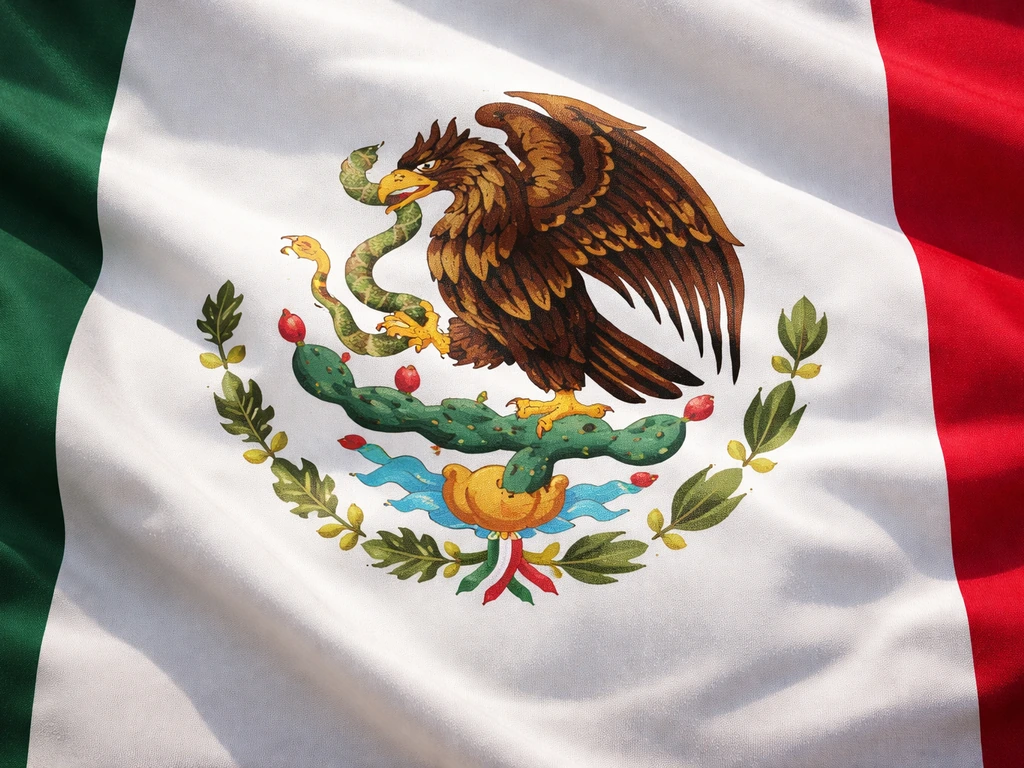
The bird on Mexico's flag is an eagle, specifically referred to in Mexican law as the "águila mexicana" (Mexican eagle). It appears on the central coat of arms of the green, white, and red tricolor, perched on a prickly-pear cactus (nopal) growing from a rock in a lake, with a curved serpent gripped in its beak and right talon. That image is not just decoration. It is one of the most symbolically loaded national emblems in the world, rooted in a founding myth that is over 700 years old.
What Bird Is on the Mexico Flag? Eagle Meaning Explained

Marcus Chen
2 Apr 2026
The eagle on Mexico's flag, identified
Mexico's national law (the Ley sobre el Escudo, la Bandera y el Himno Nacionales) describes the bird precisely: it is shown in left profile, wings slightly spread in a "combat attitude," perched on a flowering nopal cactus, and actively devouring a curved serpent held in its beak and right claw. The law calls the bird the "águila mexicana" (Mexican eagle) rather than assigning it a Latin species name. That is a deliberate choice. The emblem represents a mythic and national symbol, not a field-guide specimen.
That said, when people ask which real species the emblem most likely represents, the answer is almost universally the golden eagle (Aquila chrysaetos), sometimes called the "Águila Real" or royal eagle in Spanish. Golden eagles do range across central and northern Mexico, they are large and powerful raptors with distinctive golden nape feathers, yellow feet, and a commanding presence in the sky. Mexico's environmental agency PROFEPA formally identifies the Águila Real as an emblematic species of Mexico, which reinforces the connection even without a direct species law. Some earlier scholars suggested the bird in pre-Hispanic codices might be a crested caracara, but that view has largely been set aside in favor of retaining the golden eagle as the intended species behind the emblem.
What the eagle means on the Mexican flag
The eagle on the coat of arms carries layered meaning. In Aztec (Mexica) cosmology, the eagle was the earthly form of Huitzilopochtli, the god of the sun and war. Eagles were associated with the sun because they soar at heights no other creature reaches, and were seen as intermediaries between the earth and the heavens. SEMARNAT, Mexico's environmental ministry, describes the eagle as "the very representation of the tutelary god of the Mexica" and frames the entire coat of arms as a visualization of the founding myth of their civilization.
The serpent in the eagle's grip is also significant. The legal text calls it simply a "curved serpent," but in the mythological and cultural reading it represents the vanquishing of opposing forces, sometimes interpreted as enemies of the Mexica people or as a dualistic symbol of earth and sky. Every element in the scene, including the cactus, the rock, the lake, and the branches of oak and laurel at the bottom, carries its own weight in the overall symbolic reading.
The founding myth behind the image
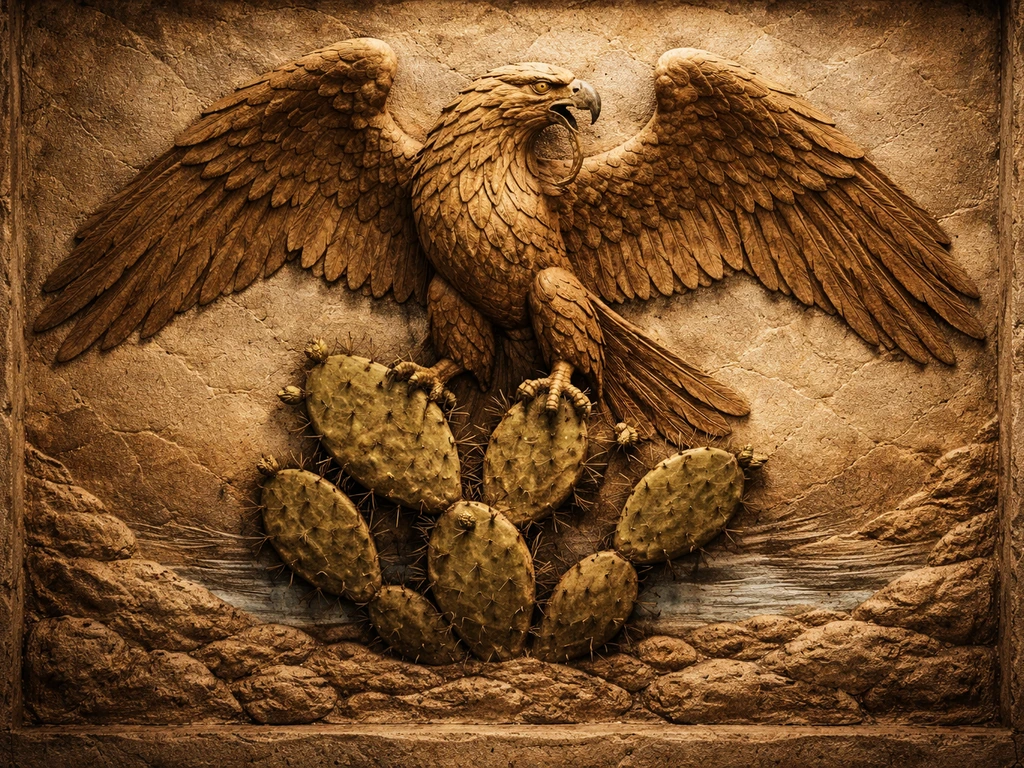
The scene on the flag traces directly back to the founding legend of Tenochtitlan, the city that would become Mexico City. According to Mexica tradition, Huitzilopochtli directed his people to end their long migration when they found an eagle perched on a cactus growing from a rock in the middle of a lake, devouring a serpent.
One widely cited date for the founding of Tenochtitlan tied to this legend, as presented by an article referencing INAH historian Luis Barjau, is March 13, 1325 The founding myth of 700. The Mexica found that sign on a small island in Lake Texcoco [around 1325 CE](https://apnews.
com/article/c82e3cbd69d0604cdcca8c35b903205a), and they built their capital there. That city, Tenochtitlan, became the heart of the Aztec Empire and later the seat of New Spain, and eventually Mexico City.
The image carried over into the colonial period. In 1523, under Charles V, a coat of arms was granted that referenced the eagle and cactus imagery in connection with the city. After independence, a key legal moment came with the decree of April 14, 1823, which formally established a republican coat of arms featuring the eagle on a nopal rock between the waters of the lake, attacking a serpent with its right claw and beak, surrounded by oak and laurel branches. That 1823 decree stripped out the imperial crown that had appeared under Agustín de Iturbide's short-lived empire and shifted the emblem toward the republican form still recognized today.
Later reforms continued to sharpen the design. By 1968, the emblem was refined with greater heraldic and iconographic precision, including details like the red tunas (cactus fruit) and the water glyph beneath the rock. The current legally governed version carries the note of its last reform as of July 21, 2025, meaning the specifications are actively maintained, even though the core iconography has remained remarkably stable for two centuries.
How to recognize the eagle in the flag's artwork
If you are looking at the coat of arms and trying to identify the eagle's features, here is what the law actually specifies. The eagle faces left (from the viewer's perspective, the bird's head turns toward your right). Its wings are slightly open, not fully spread, in a posture suggesting readiness for combat. The upper part of the wing is raised above the level of the plume (the crest area), and the sustaining wing feathers visually reach the tail. These are precise artistic instructions, not vague descriptions.
The eagle is perched on the nopal cactus, which is in bloom, growing from a rock that sits in water. In the foreground, the bird's right claw and beak hold the curved serpent "in attitude of devouring." At the base of the design, an oak branch appears on one side of the eagle and a laurel branch on the other, joined by a ribbon in the three colors of the Mexican flag. If you ever want to try recreating this design yourself, there is a detailed guide on how to draw the bird on the Mexican flag that walks through the visual elements step by step.
Facts about the eagle tied to its symbolic role
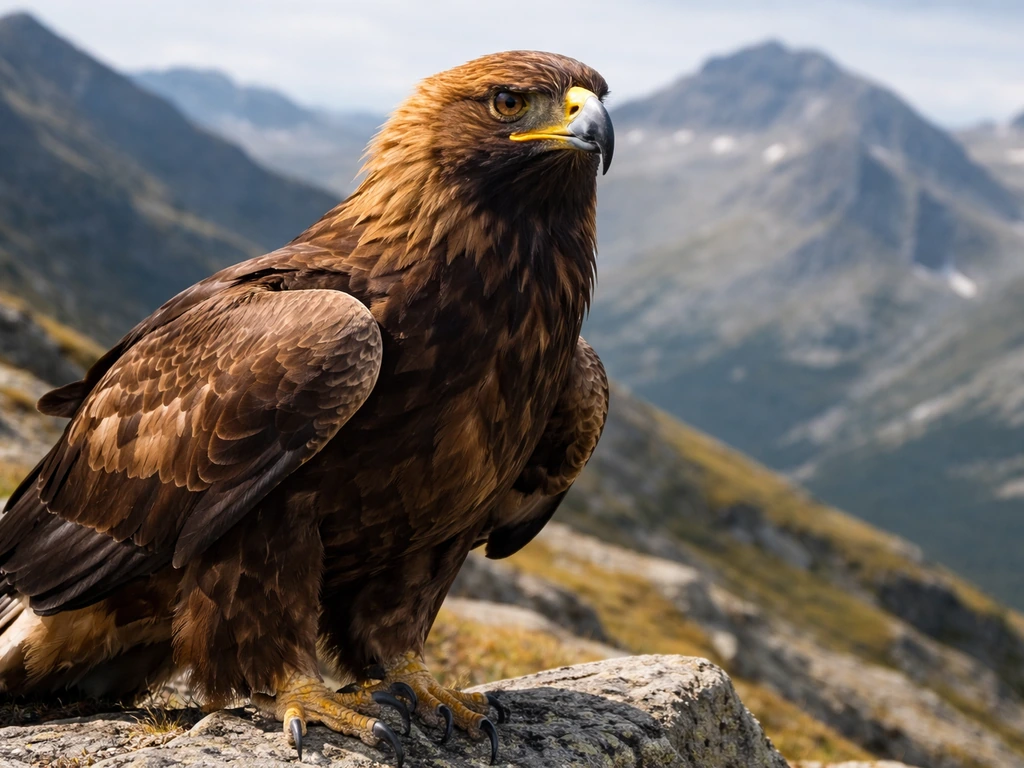
A few things about real golden eagles make the symbolism feel earned rather than arbitrary. They are among the largest birds of prey in the Northern Hemisphere, with wingspans reaching up to 7.5 feet (about 2.3 meters). They are known hunters, capable of taking prey much larger than themselves, including snakes and other reptiles. Their ability to soar at high altitudes made them logical candidates for solar symbolism across many cultures, not just in Mesoamerica. The golden nape plumage that gives them their name is distinctive and visually striking in the field.
In Mexico specifically, the Águila Real is considered an emblematic and conservation-priority species. It is not common or easily spotted, which arguably adds to the reverence around it. The bird's rarity, power, and sky-reaching flight all map cleanly onto the mythological role it was given by the Mexica centuries ago.
It is worth noting that the eagle-and-serpent motif is not unique to Mexico in the broader world of national symbols. Other countries have similarly placed birds at the center of their flags and coats of arms. For example, the bird on the Egyptian flag is the Eagle of Saladin, which carries its own deep historical and political meaning rooted in pan-Arab nationalism. And the bird on the Azores flag is a goshawk, directly tied to the archipelago's name. Each case is its own story.
The flag's eagle vs. Mexico's national bird
Here is a distinction worth clearing up, because it confuses a lot of people. The eagle depicted on the Mexican flag is the national emblem, governed by the Ley sobre el Escudo, la Bandera y el Himno Nacionales. It is not formally designated as the "national bird" through separate wildlife or conservation legislation in the way some countries designate a national bird species. Mexico does not have a single officially legislated national bird in the conventional sense that, say, the United States has the bald eagle or India has the Indian peacock.
In practice, when people refer to Mexico's national bird, they almost always mean the golden eagle (Águila Real, Aquila chrysaetos), because it is the species most closely associated with the flag emblem and has been identified by Mexican environmental institutions as an emblematic national species. Various global "national birds" reference lists assign Mexico the golden eagle for exactly this reason, treating the emblem species as functionally equivalent to a national bird designation. So: the bird on the flag is the águila mexicana, the symbolic species it represents is the golden eagle, and that same bird is widely accepted as Mexico's national bird even without a standalone law to that effect.
This pattern of a flag emblem doubling as a national bird is actually fairly common across Latin America. In South America, for instance, the bird on the Ecuadorian flag is the Andean condor, which is simultaneously one of the most recognizable national symbols of Ecuador and a species with its own deep cultural significance in the Andean world. These overlaps between flag imagery and national bird identity are worth exploring if you are building a broader understanding of how countries use birds as symbols.
Quick visual summary of the coat of arms elements
| Element | What it is | Symbolic meaning |
|---|---|---|
| Eagle (águila mexicana) | Golden eagle, shown in left profile, wings slightly spread | Solar deity Huitzilopochtli, power, and the sun |
| Curved serpent | A serpent gripped in the eagle's beak and right talon | Vanquishing of enemies, earth-sky duality |
| Nopal cactus | Prickly-pear cactus in bloom, with red tunas | The site of the founding myth; life in harsh conditions |
| Rock in the lake | Stone emerging from water, on which the cactus grows | The island of Tenochtitlan in Lake Texcoco |
| Oak and laurel branches | Joined at the base by a tricolor ribbon | Strength (oak) and victory/glory (laurel) |
The short answer to the original question is this: the bird on Mexico's flag is an eagle, most closely identified with the golden eagle (Aquila chrysaetos), called the Águila Real in Mexico. It represents the sun god Huitzilopochtli, the founding myth of the Mexica people, and centuries of national identity stretching from the city of Tenochtitlan to the modern Mexican state. Every element in the coat of arms earns its place in that story.
FAQ
Is the eagle on the Mexican flag the same thing as Mexico’s “national bird”?
In Mexico’s legal description, the bird is explicitly called “águila mexicana” and the emblem is treated as a national icon, not a field-guide identification. The most likely real-world match discussed in science and by Mexican environmental authorities is the golden eagle, “Águila Real,” but you should not claim the law names the Latin species.
Why do some versions of the Mexican coat of arms show the eagle facing a different direction?
The coat of arms depicts the eagle with specific orientation, left-facing in the legal artwork (so the head points toward your right). If a poster or hoodie shows the eagle facing the opposite way, it is typically a redesign or a non-authoritative version rather than the governed specification.
What visual details matter most when matching the flag eagle to the official design?
The emblem includes a “combat attitude” with wings slightly spread rather than fully outstretched. If you’re comparing images, check for that restrained wing position, and for whether the upper wing sits above the crest area, which are part of the legal-art detail rather than stylistic variation.
Does the Mexican flag eagle look the same on all flags and official uses?
Mexico’s flag uses the coat of arms, but not every use of the symbol is identical in size or style. For official documents, uniforms, or government signage, you typically want the standardized coat-of-arms layout and proportions, because minor changes like ribbon placement or cactus depiction can make it a different “version,” even though the core motif stays the same.
Do we know what kind of snake the eagle is devouring?
The serpent is described legally only as a “curved serpent,” but in interpretation it functions as the defeated opposing force within the founding myth. So when you’re researching symbolism, it’s safer to treat it as mythic rather than try to assign it to one specific snake species.
Could the emblem bird have been a different species than the golden eagle?
Yes. Some earlier discussions proposed a different raptor that appeared in pre-Hispanic imagery (such as a caracara), but the prevailing consensus keeps the golden eagle association. In practice, if you want the emblem’s most accepted real-species interpretation, the answer to use is golden eagle, even if the exact species cannot be proven like a modern identification.
What field characteristics make the golden eagle the best match for the emblem?
If you are trying to identify which animal best matches the emblem, look for a golden-nape look, yellow feet, and an overall heavy, large raptor silhouette. The emblem is stylized, so field markings are simplified, but those traits are why the golden eagle is the leading candidate.
Is the bird officially part of the flag, or is it the coat of arms that is governed?
In everyday conversation, people may say “eagle on the flag,” but the official regulated element is the “coat of arms” placed on the flag’s center. That distinction matters if you are looking for legal wording or official artwork rules, because the emblem artwork details are the governed part, not a separate “flag bird” specimen designation.
Next Article
What Is the National Bird of Zimbabwe? Symbolism and Facts
Discover Zimbabwe’s national bird, its distinctive traits, and the history and symbolism behind the emblematic choice.