The country name 'Turkey' came first, and it's not even close. The word 'Turkey' (referring to the land of the Turks) shows up in English writing as far back as the late 1300s. The word 'turkey' for the bird doesn't appear until the 1550s, roughly 150 years later. So if you're keeping score: country wins, bird loses, and the bird actually got its name partly because of the country.
Which Turkey Came First Bird or Country Names Explained

Marcus Chen
24 Apr 2026
First, let's untangle what 'turkey' actually means here

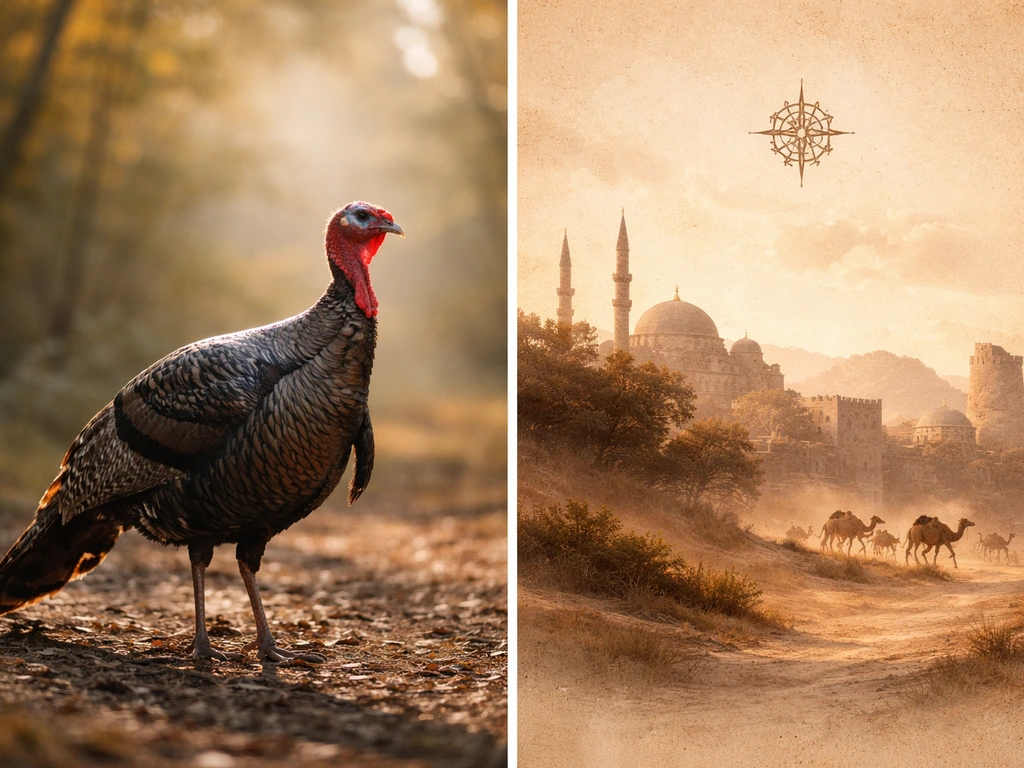
The riddle only works because the same word does double duty in English. When you say 'turkey' (lowercase), you mean the bird, the large, fan-tailed creature eaten at Thanksgiving or kept on farms, descended from the wild turkey of North America. When you say 'Turkey' (capital T), you mean the country, the nation spanning parts of southeastern Europe and western Asia, historically known as the land of the Turks and home to the Ottoman Empire.
These two words look identical in casual writing, which is exactly why the riddle trips people up. But they come from completely different directions historically, and untangling that is where the real story lives.
When 'turkey' the bird entered English
The word 'turkey' for the bird appears in English records in the 1550s. But here's the twist: it wasn't originally describing the American bird at all. English speakers had already been calling a different bird, the blank" rel="noopener noreferrer">guinea fowl, imported from Africa, a 'turkey' or 'turkeycock,' because it came to Europe through Turkish-controlled trade routes. Oxford Learner’s Dictionaries notes this bird-name origin with a mid-16th-century date and describes it as a shortening of turkeycock or turkeyhen, originally applied to the guinea fowl before being mistakenly extended to the American bird the guinea fowl, imported from Africa, a 'turkey' or 'turkeycock'. When European explorers brought back the large American bird in the early 1500s, people at home thought it looked similar enough to the guinea fowl that they just borrowed the same name. It stuck, even though the American turkey and the guinea fowl are completely different species.
So the word 'turkey' for the bird was essentially a case of mistaken identity compounded by trade geography. The name was transferred, not invented fresh. By the mid-16th century, 'turkey' in common English usage had settled on the American bird we know today, and the guinea fowl connection faded from memory.
When 'Turkey' the country name entered English

The country name has a much longer paper trail in English. Etymonline traces the word 'Turkey' in English to the late 14th century, spelled at the time as 'Turkie.' This referred to the territory of the Turks, essentially the region dominated by the Ottoman and earlier Seljuk Turks in Anatolia and beyond. The name came into English from Medieval Latin 'Turchia' and Old French 'Turquie,' all tracing back to the people themselves, the Turks.
It's worth noting that using 'Turkey' as a country name in the modern sense, a defined sovereign state with that official name, is a more recent thing. But as a place-name and geographic label in English, 'Turkey' was already in circulation by the 1300s, long before anyone in England had seen a North American bird.
The timeline side by side
| Term | First Attested in English | What It Referred To | How It Got the Name |
|---|---|---|---|
| Turkey (country) | Late 14th century (1300s) | Land of the Turks, Ottoman/Seljuk territory | From Medieval Latin 'Turchia' and Old French 'Turquie,' named after the Turkic peoples |
| turkey (bird) | 1550s (mid-16th century) | Originally guinea fowl, then the American bird | Named because the bird arrived via or was associated with Turkish trade routes; later misapplied to the New World species |
So which actually came first?
The country name 'Turkey' came first by roughly 150 years. The late 14th century versus the 1550s is not a close call. And the relationship between them is directional: the bird got its name because of the country (or at least because of the Turkish-controlled trade routes that brought exotic birds into Europe), not the other way around. The country didn't get named after the bird. The bird got named because of the country's geographic and commercial influence.
From a national symbols and bird history perspective, this is a fascinating case of how bird names get invented. The turkey is essentially carrying a geographical label that was slapped on it by mistake and then inherited by the American species through pure cultural momentum.
Why this riddle fools so many people
A few things collide to make this genuinely confusing. First, the spelling is identical in casual writing, 'turkey' and 'Turkey' look the same unless you're careful about capitalization. Second, most people encounter the word 'turkey' almost exclusively as a food and bird term, so the country feels like the secondary meaning even though historically it came first. Third, the idea that a country would be named after a bird is actually not that strange, national birds are culturally powerful symbols, so the mix-up feels plausible. It also helps to know whether any specific claim about a “national bird” was ever tied to Ben Franklin, because the turkey riddle is more about naming history than symbolism. The question of what used to be the national bird is often tied to old, country-specific symbolism stories. For a broader look at the “first national bird,” you can explore how different countries chose their symbols and when those decisions were recorded.
There's also a layer of trade history that most people never learn. The spice and goods trade through Ottoman-controlled regions in the 15th and 16th centuries shaped what Europeans called all sorts of products and animals. 'Turkey' wasn't the only word that picked up this geographic flavor, it just happens to be the one that created the most enduring naming riddle.
It's also worth knowing that in other languages, the bird got completely different names. In French, the turkey is called 'dinde' (from 'd'Inde,' meaning 'from India,' because French explorers thought America was India). In Turkish, the bird is called 'hindi' for the same reason. So English is actually the outlier in naming the bird after Turkey, most of Europe named it after India instead.
Where to dig deeper if you want the full story
If you want to verify any of this yourself, the best starting point is Etymonline (etymonline.com), which gives you first-attestation dates and source languages for both 'turkey' the bird and 'Turkey' the country. Look up both entries separately, they're listed under different headings. The Oxford Advanced Learner's Dictionary also has a concise word origin note on 'turkey' that confirms the mid-16th century date and the guinea fowl connection.
For the country's naming history, the Oxford English Dictionary (OED) is the most authoritative source, though it requires a subscription. Many university library portals provide free access. Search for 'Turkey' as a place-name and look at the earliest dated citations, you'll find 14th-century entries that predate the bird by generations.
If you're curious about how national birds get their names and how geography shapes animal names more broadly, the history of the turkey is a great entry point. National birds are culturally important too, so if you are wondering what is the national bird of the world, it helps to compare how different countries select theirs. Questions like what makes a bird iconic enough to represent a nation, or which bird was considered first for various countries, open up a whole branch of cultural and symbolic history that goes well beyond this one naming riddle.
- Check Etymonline for both 'turkey' (bird) and 'Turkey' (country) — the entries are separate and give first-use dates clearly
- Look at the Oxford Advanced Learner's Dictionary word origin note on 'turkey' for the guinea fowl connection
- Use the OED (free via many public and university libraries) for historical citations of 'Turkey' as a place-name in English
- Compare how other languages name the bird (French 'dinde,' Turkish 'hindi') to see that English is the exception, not the rule, in connecting the bird to Turkey
- Explore how other national bird names picked up geographic or trade-route labels — the turkey's story is unusual but not unique
FAQ
Why do people often think the bird came first?
Most people meet “turkey” first as food and bird-related language, so their mental default is the animal meaning. But historically, the place-name used in English predates the bird term by about 150 years, and the bird label arrived through adoption of an existing trade-based word, not from a new naming process.
Does the country get its name from the bird at all?
No. The country name comes from the ethnonym for the Turks (via Medieval Latin and Old French paths), while the bird term was transferred from a different bird associated with trade routes. If you see claims online that the country was named after the animal, they are mixing the direction of borrowing.
What was the “turkey” word originally used for in English before the American bird adoption?
In earlier English usage, the word “turkey” (and “turkeycock”) was applied to guinea fowl, a different bird imported from Africa. The later American bird label stuck because it was seen as similar and because the earlier trade label was already present.
Is it really true that the bird was named because of Turkish trade routes?
The key point is that English borrowed or adapted a label tied to “Turkish” intermediaries in European trade geography. Even if the exact mechanism varies by source, the essential pattern is the same: the name traveled with commerce and then got applied to a new, similar-looking animal.
How do I tell which meaning someone intends, the country or the bird?
Capitalization is the quick clue: “Turkey” usually signals the country, “turkey” signals the bird. In ambiguous contexts like headlines or quotes, also look at surrounding words (national institutions, Ottoman history, geography for the country, cooking, farms, Thanksgiving for the bird).
When did English stop using “turkey” for guinea fowl and start using it for the American bird consistently?
By the mid-16th century, the bird term in common English usage had settled on the American bird. The earlier guinea fowl association faded because the American animal became familiar enough in Europe to dominate everyday meaning.
Do other languages show the same “Turkey equals American bird” pattern?
No. Many European languages instead name the bird with an “India” idea (for example, French “dinde” and Turkish “hindi”). That contrast supports the idea that naming followed exploration geography and perceptions, not a shared, universal link to the country-name.
Could someone point me to where to check earliest dates?
Use etymology databases that list first attestations separately for each meaning. Practically, search the word entries for “turkey” the bird and “Turkey” the place-name as distinct items, because they are filed under different etymological histories.
Is “Turkey” as an official sovereign-state name also from the 1300s?
Not exactly. The place-name and geographic label show up in English early (around the 1300s), but the modern expectation of “the state” with that official name is later. Place-name usage and political naming conventions do not always line up.
How does this relate to “national bird” questions or symbolism claims?
The naming-riddle is about word transfer and geography, not why countries choose symbols. If a separate claim says a person or event tied the turkey to national symbolism, treat it as a different question, because symbolism histories and etymology timelines are usually unrelated.
Next Article
Did Ben Franklin Really Want the Turkey as National Bird?
Verifies the Ben Franklin turkey national bird claim with primary sources, context, and checks for misquotes or later em