
The Blue Crane is the national bird of South Africa. It was chosen because it is deeply woven into South African cultural identity, particularly through Xhosa tradition, and because it is a near-endemic species whose existence is almost entirely tied to South African landscapes. In short, it represents the country both culturally and ecologically in a way very few birds could.
Why Is the Blue Crane Our National Bird? The Reason

Marcus Chen
28 May 2026
Which country are we talking about?
If you searched "why is the blue crane our national bird," you are almost certainly South African, or researching South Africa. The Blue Crane (scientific name Anthropoides paradiseus) is officially listed as South Africa's national bird on the South African Government's own national symbols page, and it appears in the Department of Sport, Arts and Culture (DSAC) official materials under the heading "The National Bird is the BLUE CRANE." There is no ambiguity here: this bird belongs to South Africa's national identity, not to any other country.
What the Blue Crane actually symbolizes
The Blue Crane is not just a pretty bird that someone picked at random. It carries real symbolic weight that goes back centuries in South African culture, especially within Xhosa tradition. In Xhosa custom, Blue Crane feathers (known as indwe) were awarded to men who had distinguished themselves through acts of bravery and heroism. Wearing these feathers was a mark of honor, tied to warrior status, the restoration of peace, and the maintenance of social order. That kind of deep cultural resonance is exactly what you want in a national symbol.
On a broader national level, the bird represents grace, dignity, and a connection to the open landscapes that define much of South Africa's geography. It is not a flashy tropical bird. It is elegant in a quiet, understated way, which arguably suits the national character more honestly than something more showy would.
How it became the official national bird
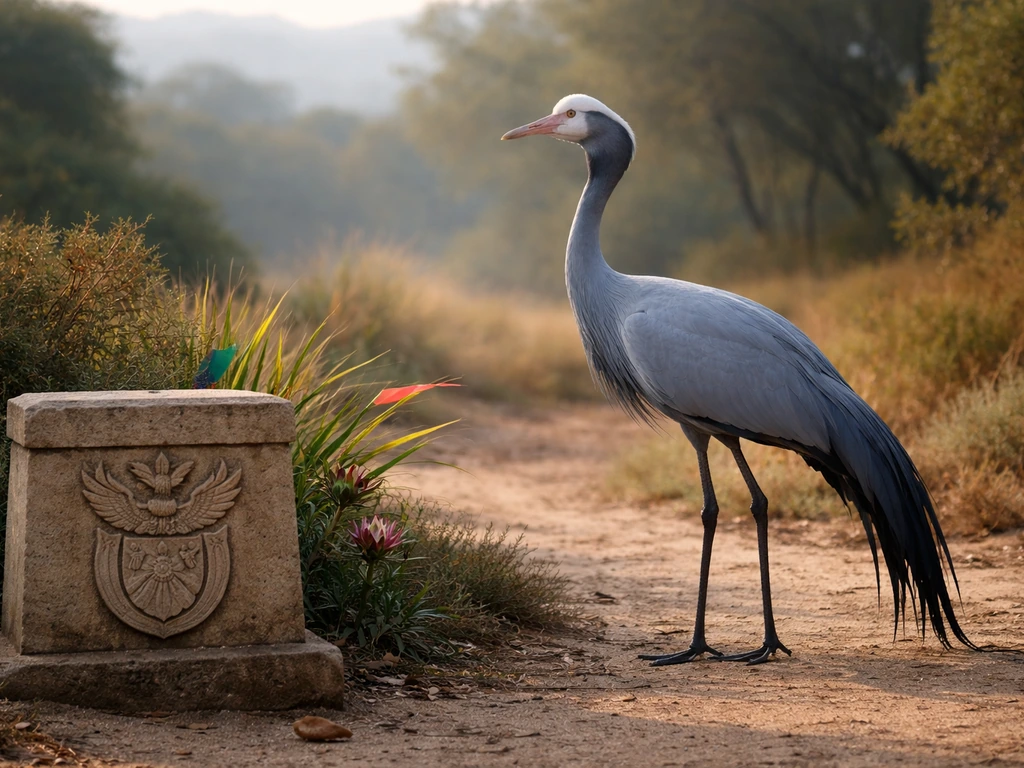
The honest answer is that the official government sources focus on the designation itself rather than a detailed play-by-play of when and how the decision was made. What is clear is that the Blue Crane has been part of South Africa's official set of national symbols for decades, and it is now firmly embedded in government communications, heritage materials, and arts and culture annual reporting. This matches the South African Government arts and culture annual reporting focus on blank" rel="noopener noreferrer">“THE NATIONAL BIRD: BLUE CRANE” in its Government Communications (GCIS) annual report. The DSAC national symbols documentation treats the Blue Crane as an established, non-negotiable part of South Africa's national identity framework, sitting alongside symbols like the springbok and the protea.
Organizations like the International Crane Foundation have built entire media and marketing campaigns specifically to honor the Blue Crane as South Africa's national bird, reinforcing the designation at a public and institutional level. So even if the original legislative moment of selection is not widely publicized, the symbol has been consistently upheld and actively promoted through both government and conservation channels.
The cultural stories that keep this symbol alive
The Xhosa ceremonial use of Blue Crane feathers is probably the most striking cultural story connected to this bird. The practice of awarding indwe feathers to distinguished individuals created a direct, tangible link between the crane and ideas of honor, community leadership, and earned recognition. This is not a vague symbolic association. It was a concrete, practiced tradition in which the bird's feathers literally marked a person's place in the social order.
More broadly, the Blue Crane appears in public education campaigns and heritage conversations as a rallying point for South Africans to connect with their natural environment. When conservation groups and government bodies talk about protecting the Blue Crane, they are not just making an ecological argument. They are making a cultural one: this bird is part of who South Africa is, and losing it would mean losing a piece of national identity.
Why the Blue Crane fits South Africa so specifically
From an ecological standpoint, the Blue Crane is about as South African as a bird can get. It is near-endemic, meaning the overwhelming majority of the global population lives in South Africa. Groups like the Overberg Crane Group describe the species as strongly associated with South African landscapes, with only a small isolated population found elsewhere. Choosing it as a national bird makes intuitive sense: if South Africa does not protect this bird, there is essentially no one else to do it.
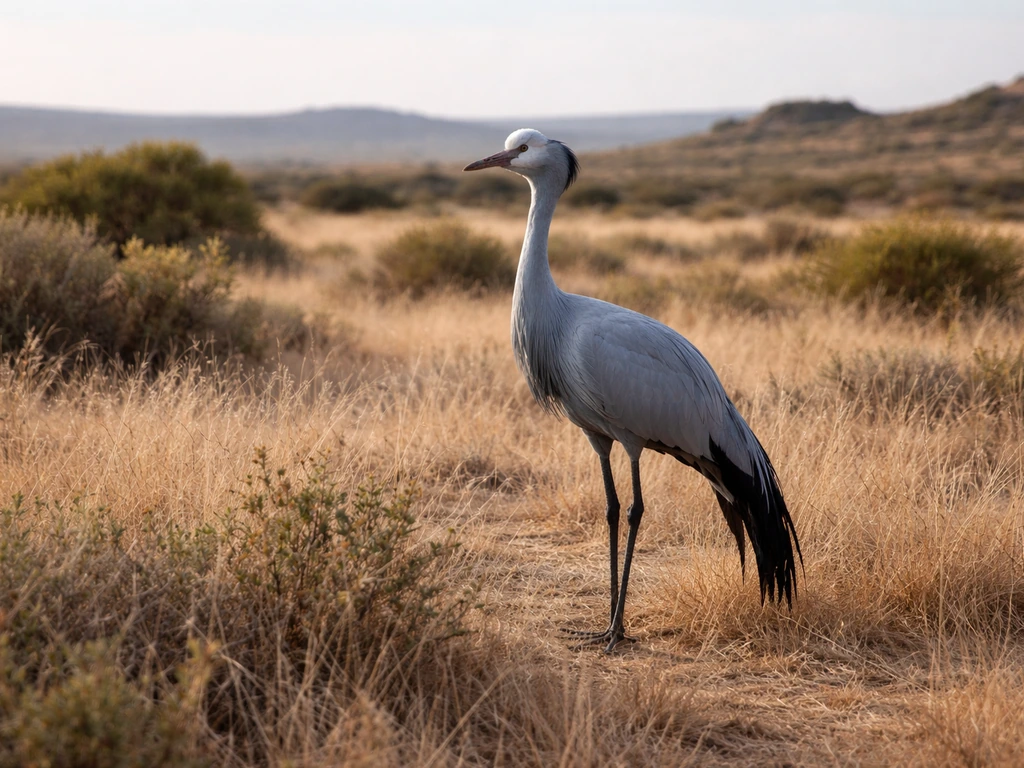
The Smithsonian's National Zoo describes Blue Cranes as closely associated with grasslands, particularly dry grassy uplands and high-elevation grassland areas. These habitats are a defining feature of South Africa's interior landscape. The bird's natural home mirrors the country's own geography, which strengthens the symbolic logic of the choice.
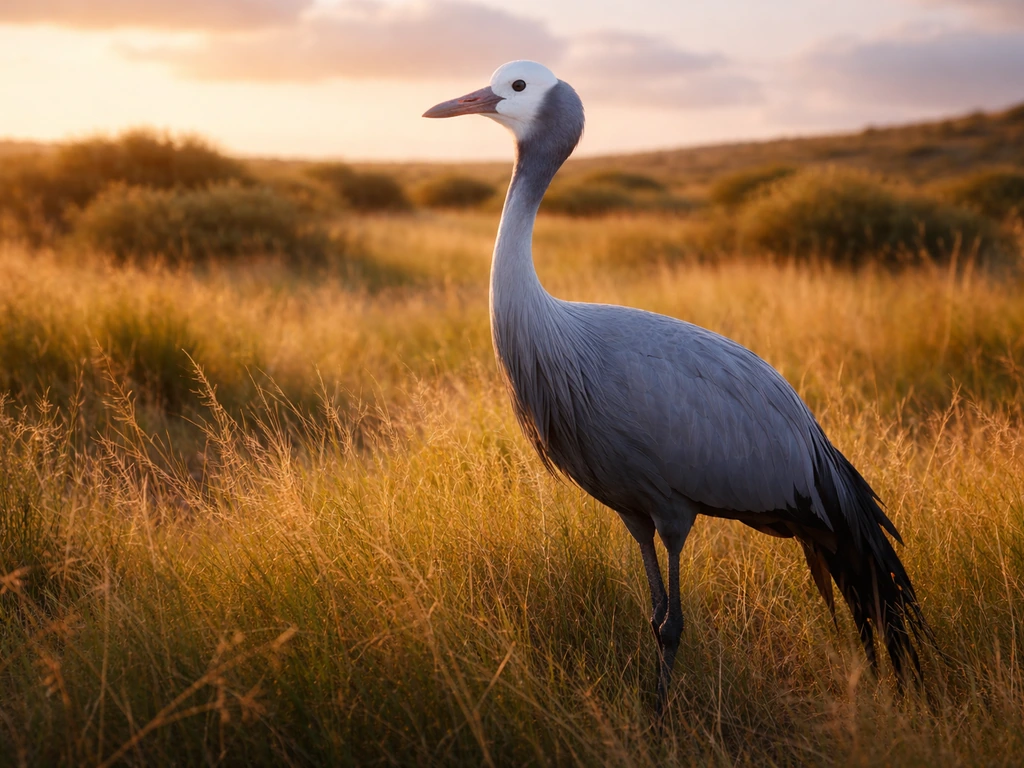
Physically, the Blue Crane is striking in a way that photographs well and is easy to recognize. It stands up to about 1 meter (roughly 3.5 feet) tall, with a distinctive light blue-grey plumage, a long neck, and a somewhat rounded, bulbous head. Females are slightly smaller than males. It lays two eggs per clutch, with an incubation period of 30 to 33 days, and chicks become independent after 3 to 5 months.
The threats the Blue Crane faces today
Part of understanding why the Blue Crane matters as a national symbol is understanding how precarious its situation is. According to the Smithsonian, the species faces several serious threats:
- Poisoning, often from bait meant for other species
- Habitat loss as natural grasslands are converted to forestry plantations
- Agricultural conversion of feeding and nesting areas
- Capture for the illegal pet trade
- Limited protection from reserves, since much of the population nests outside formally protected areas
The fact that the bird is both the national symbol and under real conservation pressure makes the symbolism more urgent, not less. Campaigns to protect the Blue Crane are simultaneously conservation efforts and acts of cultural preservation.
Key facts to keep in mind and where to verify them
| Fact | Detail | Where to verify |
|---|---|---|
| Official designation | National bird of South Africa | South African Government national symbols page (gov.za) |
| Scientific name | Anthropoides paradiseus | Smithsonian National Zoo species page |
| Physical description | Light blue-grey, long neck, bulbous head, up to ~1 m tall | DSAC National Symbols PDF / Smithsonian |
| Cultural link | Xhosa indwe feathers awarded to distinguished men | Heritage and cultural education sources |
| Habitat | Grasslands, dry grassy uplands, high-elevation areas | Smithsonian National Zoo |
| Endemism | Near-endemic to South Africa (most of global population) | Overberg Crane Group |
| Egg clutch and incubation | 2 eggs, 30-33 days incubation, chicks independent at 3-5 months | Smithsonian National Zoo |
| Institutional reinforcement | ICF media campaigns, DSAC annual reporting, gov.za listings | International Crane Foundation, DSAC PDF |
If you want to verify the official designation yourself, the clearest starting point is the South African Government's national symbols page at gov.za, which lists the Blue Crane directly. From there, the DSAC's "The National Symbols" PDF provides a brief official description of the bird's appearance and its status. For biological detail, the Smithsonian National Zoo's Blue Crane page is reliable and easy to read. For conservation context, the Overberg Crane Group and the International Crane Foundation both provide up-to-date information on population status and protection efforts.
If the broader topic of national birds interests you, it is worth noting that South Africa's choice reflects a pattern seen with other countries too: the most meaningful national birds tend to be species with both cultural depth and a strong geographic tie to the nation itself. For example, flamingo is national bird of some countries where it is a strong geographic and cultural marker national birds. Other countries also choose national birds for similar reasons, such as the white stork being the national bird of Brazil white stork is the national bird of brazil. The Blue Crane checks both boxes more clearly than almost any other bird could for South Africa.
FAQ
Is the Blue Crane the national bird of South Africa officially, or is it just a commonly used symbol?
It is an official national bird designation. The government national symbols materials and DSAC national symbols documentation list the Blue Crane as South Africa’s national bird, not as an informal or regional emblem.
Why is it called “near-endemic,” and what does that mean for its national-bird status?
Near-endemic means most of the species’ global population is tied to South Africa, with only a small isolated part elsewhere. That strengthens the national-bird logic because South Africa’s conservation actions carry outsized impact.
What is the Xhosa tradition linked to the Blue Crane, and does it relate to modern recognition of the bird?
In Xhosa custom, the feather used was the indwe, awarded to men who distinguished themselves through bravery and leadership. That tradition is a concrete cultural reason the bird carries honor-based meaning, which helps explain why it fits a national symbol beyond appearance.
Is the Blue Crane an endangered species, and does that affect why it’s celebrated?
The article highlights that the species faces serious threats, which is important because national symbols can increase public attention. In practice, conservation messaging often uses the bird’s identity role to motivate protection rather than treating conservation as purely ecological.
When was the Blue Crane chosen as the national bird, and why isn’t the original decision moment easy to find?
The available government and heritage materials emphasize the established designation over the exact selection timeline. That is why the historical “when and how” is not widely detailed, even though the symbol has been consistently present in official communications for decades.
Is there any confusion with other cranes or similarly named birds in South Africa?
Yes, confusion can happen because “crane” is a broad term and some birds can look similar at a distance. The Blue Crane’s distinctive light blue-grey plumage, long neck, and rounded head help with identification, and official descriptions focus on these features.
Does the Blue Crane’s habitat link to national landscapes, and where is it typically found in South Africa?
Its close association with grassland environments, including dry grassy uplands and high-elevation grassland, mirrors South Africa’s interior geography. That habitat alignment supports why the bird is treated as both a cultural and ecological stand-in for the country.
How can I cite the official designation if I’m writing a paper or report?
Start from the South African Government national symbols listing, then corroborate with the DSAC national symbols document for additional official description. For biology and threats, use a reputable zoological or conservation reference to avoid mixing cultural symbolism with scientific facts.