
Pakistan chose the chakor (chukar partridge) as its national bird because the bird carries deep roots in the region's poetry, folklore, and mountain culture. For West Bengal, the national bird is the common house sparrow. It was officially designated as the national bird of Pakistan in 1985, and the choice reflects both the chakor's symbolic meaning in South Asian tradition and its strong presence in Pakistan's northern highland terrain.
Why Chakor Is the National Bird of Pakistan

Marcus Chen
21 May 2026
Why Pakistan picked the chakor
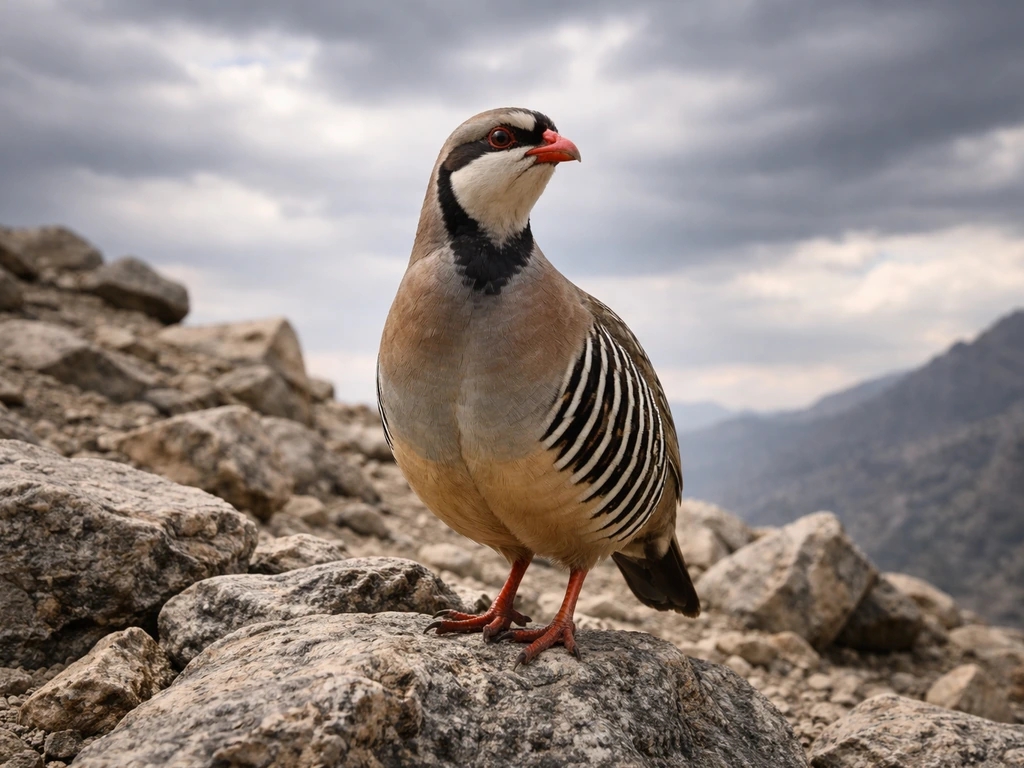
The chakor was not chosen at random. Its selection in 1985 was rooted in centuries of cultural weight the bird already carried across the region. In classical Urdu and Persian poetry, the chakor is a symbol of devoted, unrequited love. The bird is famously associated with gazing at the moon, and poets used that image to describe a lover who pines endlessly for someone just out of reach. That kind of poetic symbolism matters in a country where classical poetry has always been central to cultural identity.
Beyond poetry, the chakor is a bird of the highlands. It lives in the rugged mountain regions that form a huge part of Pakistan's geography, making it a genuinely representative choice rather than a decorative one. It is a bird people in northern Pakistan actually encounter, hunt, and reference in daily life. Picking a bird with both cultural depth and real geographic presence is exactly the kind of reasoning that tends to drive national symbol decisions.
What the chakor actually is and where it lives in Pakistan
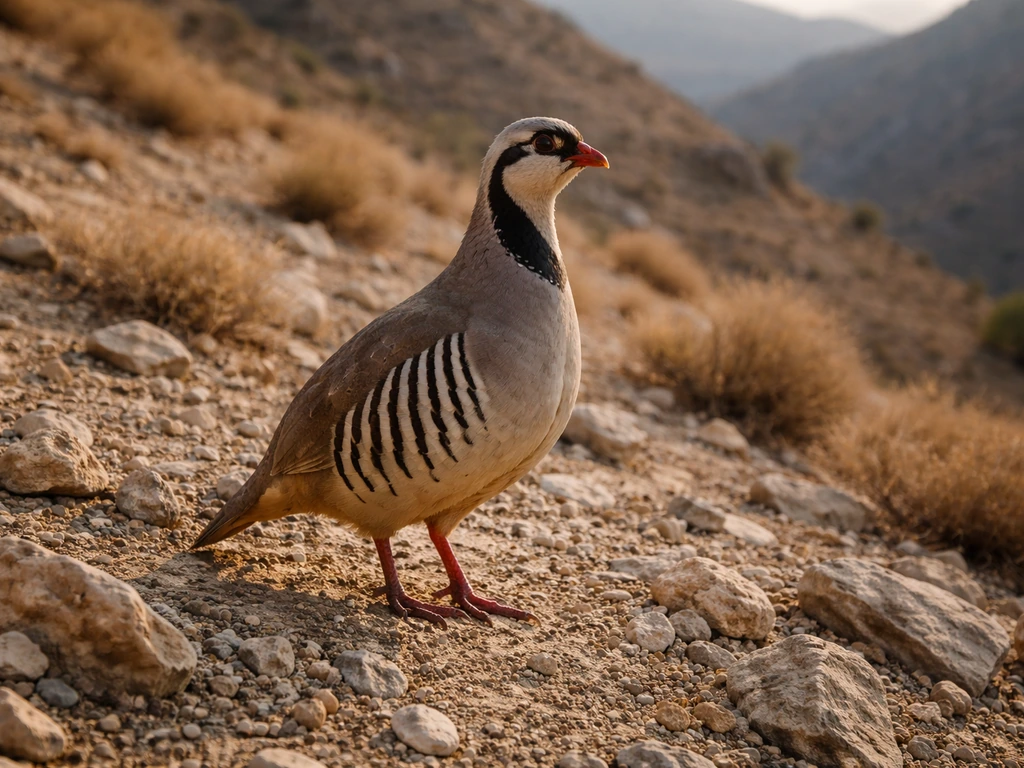
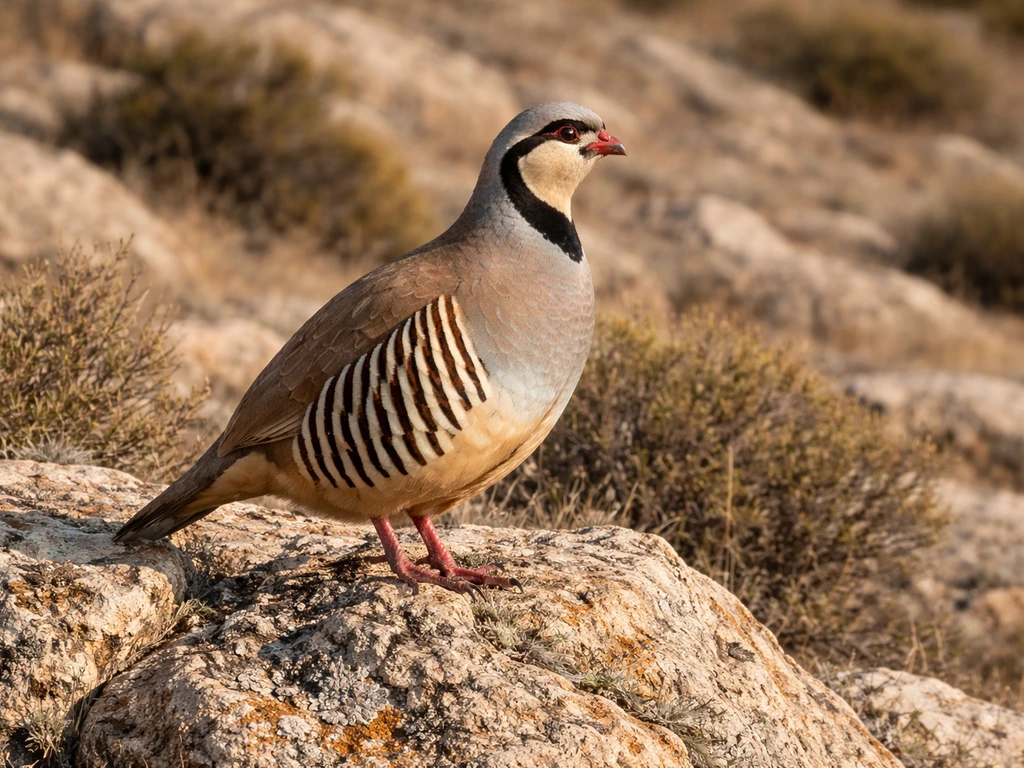
The chakor is formally known as the chukar partridge, scientific name Alectoris chukar. It is a medium-sized ground-dwelling bird in the pheasant family (Phasianidae). Adults typically measure around 32 to 35 centimeters in length and have a distinctive look: a pale sandy-brown body, bold black and chestnut barring on the flanks, a clean white face and throat framed by a sharp black band, and a bright red bill and legs. It is a handsome, immediately recognizable bird.
In Pakistan, the chakor is found primarily in the rocky, arid highlands of regions like Balochistan, Gilgit-Baltistan, Khyber Pakhtunkhwa, and parts of Kashmir. It thrives at elevations from around 1,000 meters up to roughly 4,000 meters, preferring steep hillsides, rocky scrubland, and areas with sparse vegetation. Its range extends across a wide band from southeastern Europe through Central Asia and into South Asia, but in Pakistan, the highland zones are its heartland.
The cultural symbolism behind the chakor
The most powerful reason the chakor resonates in Pakistani culture is its role in poetry and legend. In classical Urdu and Persian literary tradition, the chakor is said to be so in love with the moon that it stares at it constantly, never able to reach what it loves most. Poets like Rumi and later Urdu masters used this image repeatedly to illustrate the pain and beauty of longing. In a culture that deeply values poetic expression, a bird this embedded in the literary imagination carries enormous symbolic weight.
The chakor also stands for resilience and endurance. It lives in harsh, high-altitude terrain where few other birds thrive, surviving cold winters and rocky landscapes. That toughness aligns well with how Pakistani national identity is often framed, particularly given the country's mountainous north and the communities that live there. Choosing a bird that endures difficult conditions rather than a purely decorative species reflects something intentional about the symbolism.
There is also a regional pride element. The chakor is a bird that people across northern Pakistan know from direct experience, whether from hunting it, hearing its distinctive call in the hills, or seeing it referenced in local folk music and storytelling. It is not an exotic or distant creature but a familiar presence.
How and when it became Pakistan's national bird
The chakor was blank" rel="noopener noreferrer">officially designated Pakistan's national bird in 1985. The Pakistan Museum of Natural History (PMNH) recognizes it under its scientific name Alectoris chukar, and Pakistan's Ministry of Foreign Affairs lists it among the country's national symbols. If you're wondering about Bangladesh instead, the national bird of Bangladesh is the Asian pied starling Pakistan's national bird. The 1985 designation happened during a period when Pakistan, like many countries, was formalizing and codifying its national symbols to strengthen a coherent national identity.
It is worth noting that unlike some countries where the selection of a national bird was driven by a specific wildlife campaign or public vote, Pakistan's designation appears to have been a government-level decision reflecting existing cultural consensus rather than a new idea. The chakor was already a deeply familiar symbol long before 1985. The official designation simply formalized what the culture had already established.
Traits that make the chakor a fitting national symbol
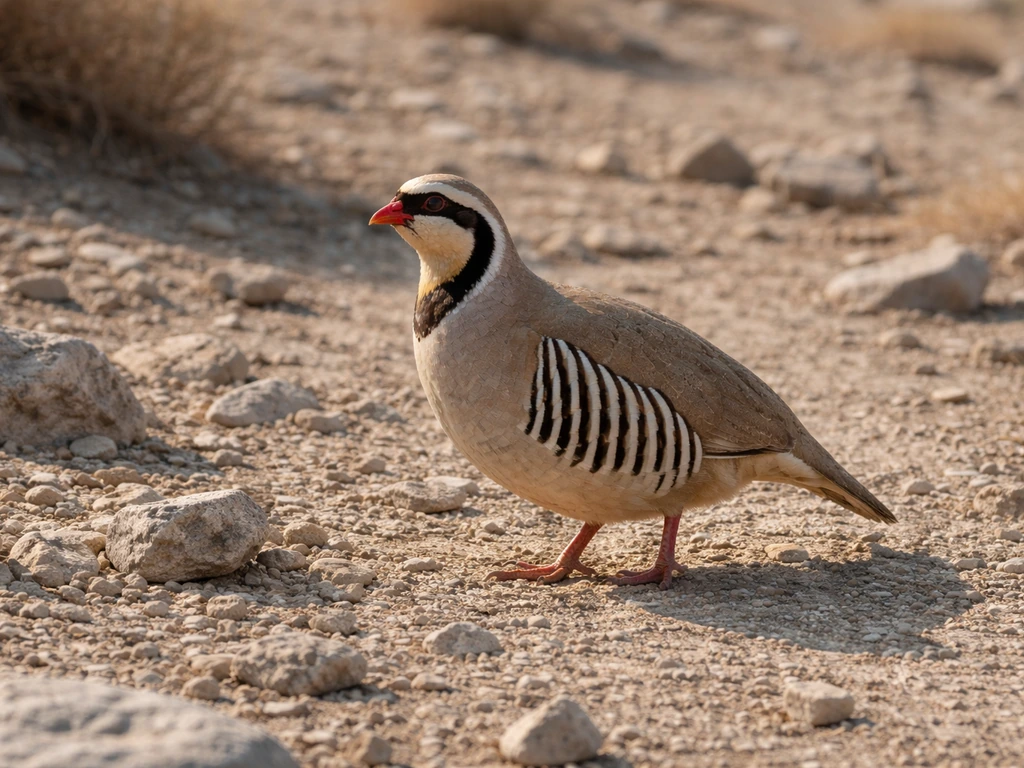
A national bird tends to work best when its real-world characteristics reinforce its symbolic meaning. The chakor checks that box well.
| Trait | What it looks like in the wild | Why it fits the symbolism |
|---|---|---|
| Appearance | Sandy-brown plumage, bold black and chestnut flank bars, red bill and legs, white face with black border | Striking and recognizable, easy to identify as a distinctive emblem |
| Habitat | Rocky highlands from 1,000 to 4,000 meters elevation in Balochistan, Gilgit-Baltistan, KP, Kashmir | Deeply tied to Pakistan's geographic identity, especially the rugged north |
| Behavior | Ground-dwelling, runs rather than flies when threatened, highly alert and agile on steep terrain | Suggests resilience, groundedness, and adaptation to tough conditions |
| Call | Loud, rhythmic chukar-chukar call, often heard echoing across hillsides | The call is a familiar sound in the highlands, adding to the bird's cultural presence |
| Social nature | Lives in coveys (small groups), pairs bond strongly during breeding season | The loyalty theme aligns with the poetic image of devotion |
Interesting facts and stories people commonly share about the chakor
The moon-gazing legend is the most repeated story, and it shows up across cultures from Persian to Punjabi. The idea is that the chakor falls so deeply in love with the moon that it cannot look away, even knowing it can never reach it. Some versions of the story say the chakor tries to drink the reflection of the moon in water, which makes the image even more poignant. This tale has been retold in hundreds of Urdu ghazals and nazms.
- The name 'chukar' actually comes from the bird's call. Say 'chukar-chukar' out loud and you'll hear why.
- The chakor is a popular game bird across its range, including in Pakistan, where it is hunted in the highlands.
- It is one of the most widely distributed partridges in the world, found from the Balkans to northern China, but Pakistan's highlands are considered a core part of its natural range.
- The bird also appears in the national symbols context of neighboring regions. India's state of Jammu and Kashmir claims the chakor as its state bird, which makes sense given the shared geography and cultural traditions of the region.
- In folk music traditions across Punjab and the Northwest, the chakor is often invoked as a metaphor for the soul yearning for the divine, not just romantic love.
It is also worth knowing that the chakor holds a similar cultural role in parts of India, particularly in the Punjab and the broader Himalayan belt. If you want to draw the national bird of India, start by sketching its basic shape and then add feather details and the head markings you can observe in reference photos national birds of India.
If you are curious about how neighboring countries make these choices, the national birds of India, Bangladesh, and the state of Jammu and Kashmir all have their own fascinating selection stories that parallel Pakistan's in interesting ways. The national bird of Jammu and Kashmir is the Kashmir flying squirrel, a small mammal associated with the region. Similarly, you may be wondering what is the national bird of Bangladesh and why it was chosen.
If you are wondering what it is, India also has a national bird with a different origin story and cultural significance national birds of India. The national bird of India is the Indian peafowl, also known as the peacock.
How to verify what you've read and where to dig deeper
If you want to confirm any of the details here, the most authoritative sources are official Pakistani government channels and recognized natural history institutions. Pakistan's Ministry of Foreign Affairs lists national symbols including the chakor on its official pages. The Pakistan Museum of Natural History (PMNH) in Islamabad is the country's leading institution for natural history documentation and maintains records on the country's flora and fauna designations. These are the two sources to go to if you want a primary, government-level confirmation.
For bird biology, distribution maps, and field identification, the Cornell Lab of Ornithology's Birds of the World database and Birdfact both carry detailed species profiles on Alectoris chukar that confirm the bird's range, behavior, and status. If you want to draw the national bird of Nepal, focus first on the bird's overall shape, then add feather patterning and a clear eye, using a reference sketch Alectoris chukar. Those are reliable, well-maintained resources for species-level facts. If you want to learn how to draw the chakor step by step, use a basic guide that starts with its head shape and distinctive red bill, then adds the feather pattern how to draw national bird.
For the cultural and poetic symbolism angle, classical Urdu literature anthologies and academic texts on South Asian poetic traditions will give you the richest picture. The chakor's role in Urdu ghazal poetry is well-documented in literary scholarship, and searching for the bird's name in the context of Urdu or Persian poetry will surface dozens of examples from major poets.
To summarize what matters most: the chakor is Pakistan's national bird because it was already a deeply embedded cultural symbol long before it was officially designated in 1985. Its poetic legacy, its presence in Pakistan's highland geography, and its qualities of endurance and loyalty all made it a natural fit. The official designation simply put a formal stamp on what Pakistanis already knew.
FAQ
What does “chakor” mean, and is it the same as “chukar partridge”?
In Pakistan, “chakor” commonly refers to the chukar partridge. The bird’s formal scientific name is Alectoris chukar, and most official and natural-history descriptions use that scientific label to avoid confusion with other similar partridges.
Why is the “moon gazing” story so central to the national bird choice?
Because it captures the exact poetic idea Pakistan’s literary tradition values, longing expressed as devotion. Even though the story is symbolic, it helps explain why the chakor, not a different highland bird, became a recognizable cultural emblem across Urdu and Persian poetry.
Is the chakor mainly found in the northern areas of Pakistan, or is it widespread?
It’s strongly associated with Pakistan’s rocky highlands, especially regions such as Balochistan, Gilgit-Baltistan, Khyber Pakhtunkhwa, and parts of Kashmir. It prefers steep, arid, sparsely vegetated terrain, so sightings and local familiarity are more concentrated in mountainous zones than in lowland agricultural areas.
How can I identify a chakor if I see one in the mountains?
Look for its ground-dwelling behavior in rocky hillsides, then confirm the distinctive patterning: a sandy-brown body, black and chestnut barring on the flanks, a white face and throat framed by a strong black band, and red bill and legs. These features help distinguish it from many other partridge-like birds.
Does the Chakor’s endurance theme mean it survives extreme weather everywhere in Pakistan?
No. The resilience idea connects to its ability to live in cold, high-altitude, rocky landscapes where conditions are harsher than in many lowland habitats. It’s a good match for mountainous identity, but its survival depends on suitable terrain and food availability in those specific habitats.
Was Pakistan’s choice based on public voting or wildlife campaigns?
The article suggests it was not driven by a new campaign or public vote. Instead, it appears to have been a government-level formalization of an already established cultural symbol, with the 1985 designation acting as a codifying step rather than a starting point.
Are there similar chakor legends in neighboring countries, and does that affect Pakistan’s claim?
Yes, the legend appears across parts of the wider Himalayan and Punjab cultural belt. That doesn’t change that Pakistan formally designated the bird in 1985, but it explains why the same symbol can feel “regional” rather than uniquely Pakistani in origin.
What is a common mistake people make about the chakor and the national bird of Pakistan?
Confusing cultural symbolism with wildlife location. Some people assume a national bird must be present nationwide, but the chakor is best understood as a highland bird that is both symbolically prominent and practically known in mountainous areas.
Can the chakor be confused with other partridge species in Pakistan?
Yes, partridges and related ground birds can look similar at a distance. The fastest way to reduce mistakes is to combine location (rocky, high-elevation scrub), behavior (ground dwelling), and the chakor’s head and flank patterning, especially the black band around the white face and throat.
If I want to verify the official status, which sources should I check?
Start with official Pakistani government listings for national symbols, and cross-check with a recognized natural history institution’s species documentation. For identification details, use reputable bird-species databases that provide range and field-mark notes for Alectoris chukar.
Next Articles
What Is the State Bird of West Bengal? Answer and Facts
West Bengal state bird is the white-necked stork. Learn why, its symbolism, and the national vs state bird distinction.
What Is the National Bird of Bangladesh? Symbolism and Facts
Bangladesh national bird answer and meaning, with symbolism, common mix-ups, and how to verify the official emblem
What Is the National Bird of Pakistan? English and Urdu Names
Pakistan national bird is the Chukar partridge, in English and Urdu names, with meaning and selection history.