
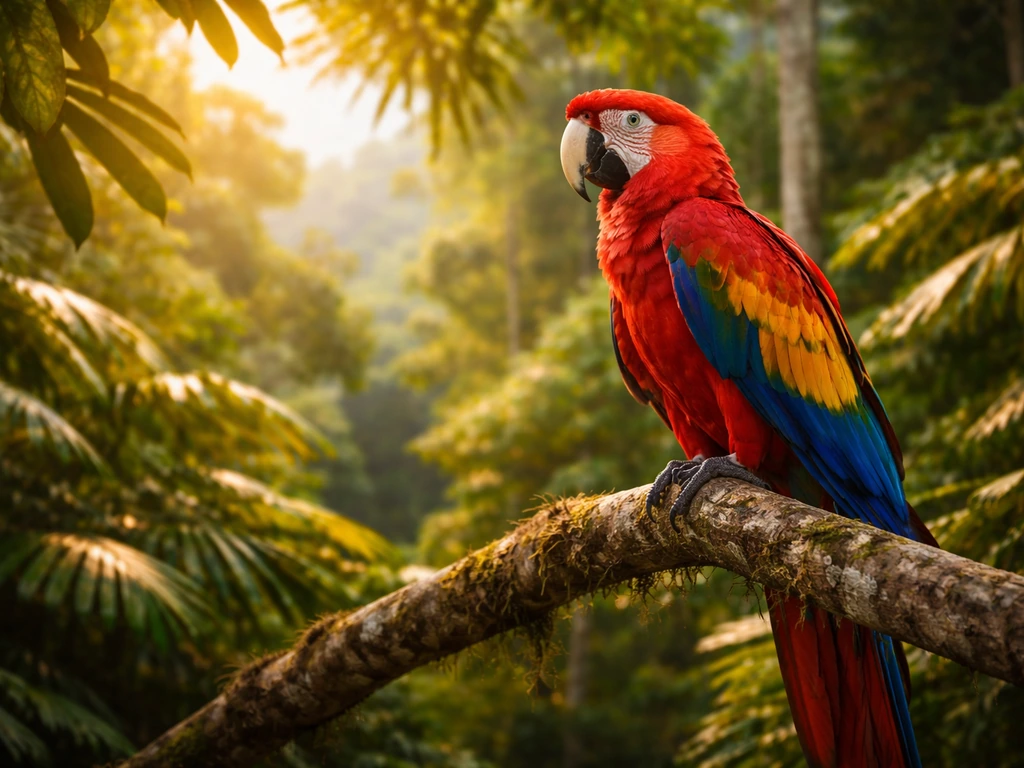
Honduras's national bird is the Scarlet Macaw, known in Spanish as the Guacamaya Roja or Guara Roja, with the scientific name Ara macao. That's the definitive answer, backed by Honduran government documents, official education ministry materials, and conservation agency records. If you've seen different answers floating around online, read on, because the confusion is worth clearing up.
What Is Honduras National Bird? Species, Meaning, History

Marcus Chen
5 Apr 2026
The official answer, confirmed
Honduras declared the Scarlet Macaw (Ara macao) its national bird on June 28, 1993, through Decreto Legislativo No. Esto coincide con lo que indica el CONED (Gobierno de Honduras) sobre que la “guacamaya o guara roja” fue declarada Ave Nacional de Honduras mediante el Decreto 36-93, del 28 de junio de 1993 [la “guacamaya o guara roja” fue elegida como símbolo de la fauna nacional y declarada ave nacional de Honduras conforme al Decreto Ejecutivo/legislativo No. 36-93](https://www. coned.
gob. hn/2023/06/26/fauna-nacional/). 36-93. This was an act of the National Congress, not just an administrative decision, which gives the designation full legal weight.
The bird's official Spanish name in Honduran law is 'La Guacamaya o Guara Roja,' and both names are used interchangeably across government documents.
Multiple official sources confirm this: the Secretaría de Educación (Honduras), the Instituto Nacional de Conservación y Desarrollo Forestal (ICF), and civic education guides published by the Honduran government all identify Ara macao as the Ave Nacional. En una publicación sobre decomisos en Honduras, la Fiscalía del Ambiente identifica al Ara Macao (Guacamaya roja o Guara) como Ave Nacional “desde 1993” Ara macao como la Ave Nacional. There is no credible competing candidate. The bird also has its own national holiday, the Día Nacional de la Guacamaya Roja, celebrated every June 28 to mark the anniversary of the original decree.
Clearing up the common confusion
The main source of confusion is terminology. 'Guacamaya,' 'Guara Roja,' and 'Scarlet Macaw' all refer to exactly the same bird: Ara macao. Some readers also confuse it with other macaw species in the region, since Central America has several brightly colored parrots. But Ara macao is the only species with national-bird status in Honduras, and it is distinct from other macaws in both appearance and legal standing under Honduran law. The CITES listing for Ara macao treats it separately from related species like the Blue-and-yellow Macaw or Military Macaw, reinforcing why species-level precision matters here.
You might also occasionally see the white-tailed deer mentioned alongside the Scarlet Macaw in Honduran symbol lists. That's because the same 1993 decree designated both animals as national symbols of fauna. The deer is a fauna symbol, but only the Scarlet Macaw holds the specific title of Ave Nacional (national bird).
Why Honduras chose the Scarlet Macaw
The choice wasn't arbitrary. The Scarlet Macaw has deep roots in Honduran natural heritage and pre-Columbian culture. The ancient Maya, whose most famous Honduran site is Copán, held the bird in high regard. Its brilliant plumage and commanding presence made it a symbol of vitality, freedom, and the richness of the natural world.
From a modern conservation standpoint, the 1993 declaration was also a strategic move. Honduras was dealing with significant deforestation and wildlife trafficking at the time, and elevating the Scarlet Macaw to national-bird status was partly designed to strengthen public support for protecting it. The bird functions as a flagship species: protect its forest habitat, and you protect entire ecosystems. Honduran environmental education materials make this link explicit, tying the Ave Nacional directly to biodiversity preservation goals.
The Scarlet Macaw also represents Honduras in a broader regional context. If you're exploring Central America's national birds, you'll find that neighboring countries have made similarly meaningful choices. For example, Nicaragua's national bird carries its own cultural weight, and comparing these choices across the isthmus reveals how deeply birds are woven into national identity throughout the region.
How the 1993 declaration came about
By the early 1990s, Honduras had lost significant forest cover, and the Scarlet Macaw population had declined sharply due to habitat destruction and illegal capture for the pet trade. The National Congress responded with Decreto Legislativo No. 36-93, signed on June 28, 1993, which formally designated the Guacamaya Roja as the Ave Nacional de Honduras.
The decree was part of a broader wave of environmental legislation in Central America during that era, influenced by international conservation momentum and regional biodiversity agreements. For Honduras, it was also a practical move: giving the bird official national status created a legal framework for prosecution of trafficking and habitat destruction involving the species. Conservation agencies like the ICF now use the national-bird designation as a cornerstone of their public awareness campaigns.
It's worth noting that Honduras wasn't alone in using national-bird status as a conservation tool. Costa Rica's national bird, the Clay-colored Thrush, was similarly elevated partly for cultural and civic reasons, showing how these designations across Central America often serve dual purposes.
What the Scarlet Macaw is actually like
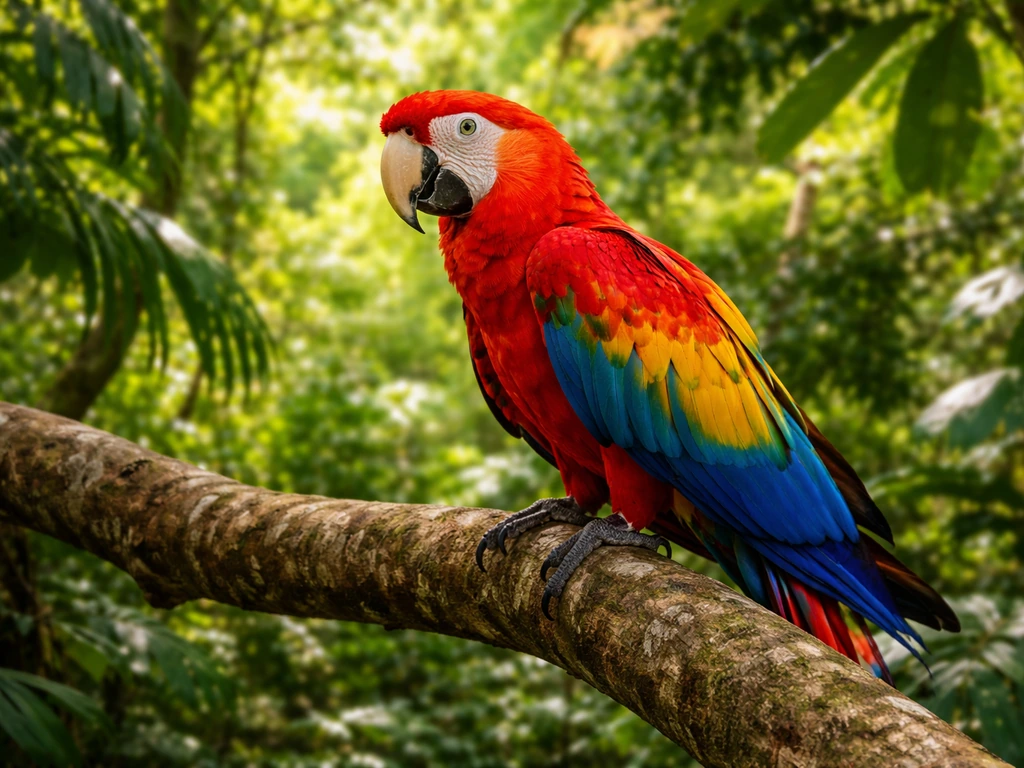
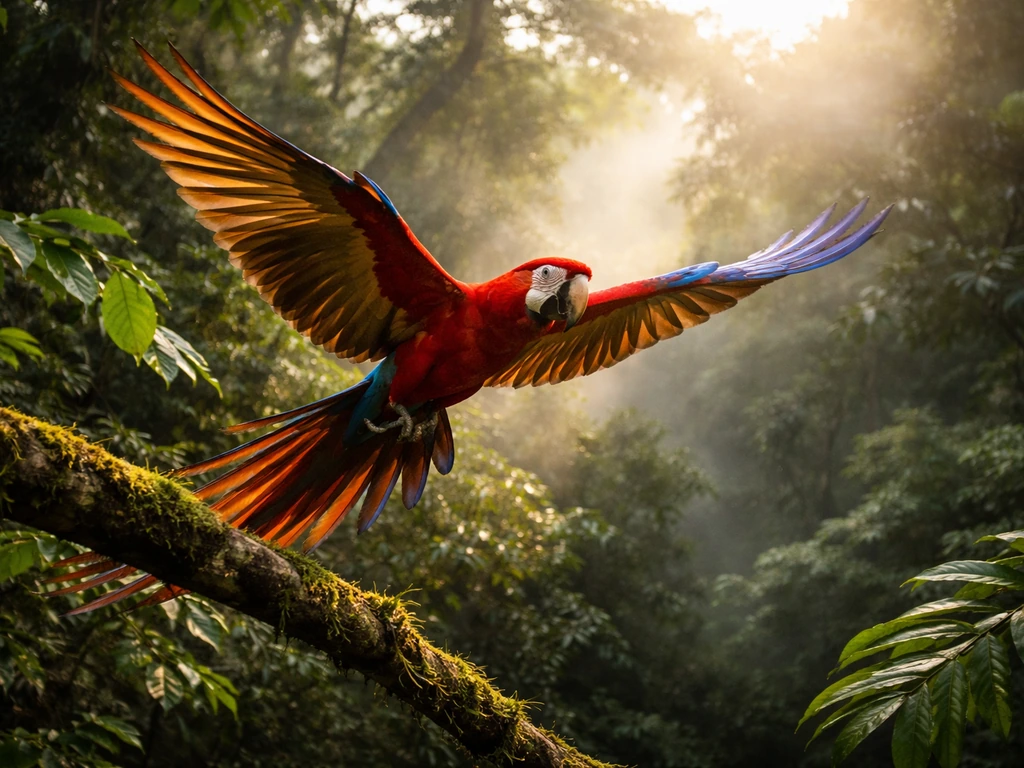
The Scarlet Macaw is one of the most visually striking birds in the Western Hemisphere. It's large, reaching about 81 to 96 centimeters (roughly 32 to 38 inches) in length, with a wingspan that makes it impossible to miss in flight. The plumage is predominantly scarlet red, with bands of yellow and blue on the wings. The bare facial patch is white, and the iris is pale yellow. The upper mandible is pale horn-colored and the lower is dark, giving it a distinctive two-toned bill.
In Honduras, the bird inhabits lowland tropical forests, particularly humid evergreen jungle and gallery woodlands near rivers. It tends to avoid heavily disturbed areas and needs large, intact forest patches to nest and forage. eBird describes it as occurring very locally in lowland rainforest and adjacent semi-open areas with large trees, typically seen in pairs or small flocks. That preference for deep forest is exactly why deforestation has hit the population so hard.
Its range spans from southern Mexico through Central America and into parts of northern South America, so Honduras sits in the middle of its natural distribution. But local populations are fragmented, and the bird is now considered locally rare in many areas where it once thrived.
| Attribute | Detail |
|---|---|
| Scientific name | Ara macao |
| Spanish names | Guacamaya Roja, Guara Roja |
| Length | 81 to 96 cm (32 to 38 inches) |
| Plumage | Scarlet red with yellow and blue wing bands |
| Habitat in Honduras | Lowland humid tropical forest, gallery woodland near rivers |
| Typical behavior | Usually seen in pairs or small groups |
| Decree date | June 28, 1993 |
| Decree number | Decreto Legislativo No. 36-93 |
Fun facts and how Honduras celebrates its national bird
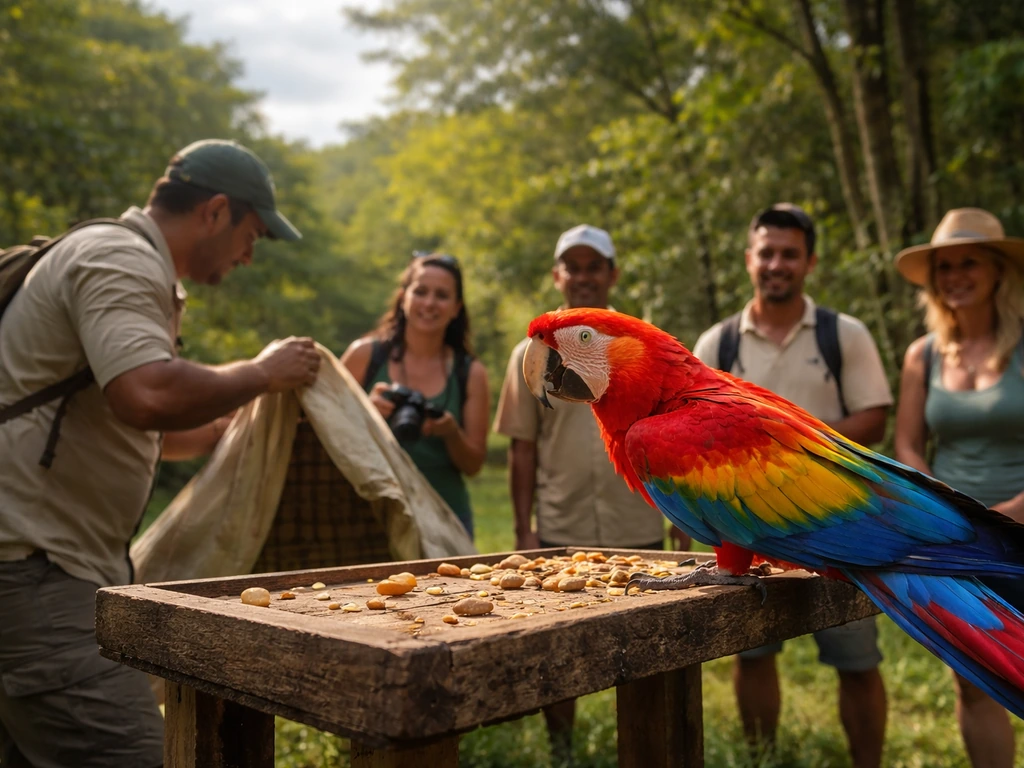
Every June 28, Honduras observes the Día Nacional de la Guacamaya Roja to mark the anniversary of the 1993 decree. Events typically include releases of captive-bred birds back into the wild, educational programs, and community celebrations, particularly in Copán Ruinas, the town closest to the ancient Maya ruins where the bird has strong historical associations.
Copán Ruinas also hosts the Guacamaya Fest, a festival specifically dedicated to the bird. The official goal of the festival includes promoting conservation of the Ave Nacional, which is described by the Honduran tourism authority as part of the country's 'natural and cultural heritage.' This dual framing, natural and cultural, reflects how seriously Honduras takes the Scarlet Macaw as a living national symbol, not just a protected species on a government list.
One of the most compelling conservation stories tied to the bird involves the Indigenous Miskito people of Honduras's Caribbean coast. National Geographic has reported on how Miskito communities, who were once involved in capturing scarlet macaws, have become some of their most active protectors. That kind of transformation, from hunting to guardianship, is exactly the type of outcome that national-symbol status can help catalyze when paired with genuine community engagement.
The Scarlet Macaw is also impressively long-lived for a wild bird, with lifespans that can reach 40 to 50 years in the wild under good conditions. It mates for life, which has added to its symbolic resonance in Honduran culture. Pairs are often seen flying together, and the sight of two Scarlet Macaws in flight over a tropical forest canopy is genuinely hard to forget.
How Honduras compares to its neighbors
Central America has a remarkable concentration of meaningful national bird choices. If you're building out your knowledge of the region, the national bird of Panama is the Harpy Eagle, one of the most powerful raptors on Earth, while El Salvador's national bird, the Torogoz (Turquoise-browed Motmot), is known for its striking tail feathers and appears on the country's coat of arms. Each choice tells you something real about the country's landscape, culture, and values.
Honduras's choice of the Scarlet Macaw fits that pattern perfectly. It's a bird that is unmistakably tropical, deeply tied to the Maya heritage of western Honduras, and ecologically dependent on the very forests the country has pledged to protect. For anyone studying national birds around the world, Honduras is a clear example of a country using its Ave Nacional as both a symbol and a conservation statement.
FAQ
Are “Guacamaya Roja” and “Guara Roja” different birds, or just different names for the same one?
“Guacamaya Roja” and “Guara Roja” are legal naming variants used in Honduran materials, but they always refer to the same species, Ara macao (Scarlet Macaw). The safest way to avoid mix-ups is to match both the common name and the scientific name Ara macao.
Does Honduras’s national bird include the white-tailed deer, or is that a different symbol?
No. The white-tailed deer mentioned in some national symbol lists is a separate fauna symbol in the 1993 framework, while the title “Ave Nacional” (national bird) specifically belongs to the Scarlet Macaw, Ara macao.
Why do some websites mention other macaws when the national bird is supposed to be the Scarlet Macaw?
The national-bird designation is Ara macao (Scarlet Macaw). Other regional macaws that can look similar, such as the Blue-and-yellow Macaw or Military Macaw, do not hold the national-bird status in Honduras, so they should not be substituted even if they appear in informal “national bird” lists online.
When is Honduras’s national holiday for the Scarlet Macaw, and is it always on the same date?
Honduras observes the Día Nacional de la Guacamaya Roja on June 28 each year, tied to the anniversary of the June 28, 1993 decree. Some event calendars may list activities on nearby dates, but the date commemorated is June 28.
How can I confirm I’m seeing the Scarlet Macaw (Ara macao) in Honduras rather than a different parrot?
In flight and in color pattern, the Scarlet Macaw is typically recognizable by its predominant red plumage plus yellow and blue wing bands and a pale facial patch. If you are trying to confirm a sighting, compare those field marks and also note that Ara macao in Honduras favors large trees in lowland tropical forest rather than heavily disturbed habitats.
What does the national-bird designation practically change for conservation, and what should travelers do on the ground?
The decree’s conservation impact is strongest when it is linked to habitat protection and anti-trafficking enforcement, not just public awareness. Practically, that means supporting protected lowland forest areas and avoiding purchases or handling of wild-caught macaws, since demand still pressures capture even when a species has symbolic status.
What wording should I use for Honduras’s national bird in Spanish and English to avoid mistakes?
If you are writing about Honduras’s national bird, use the Spanish legal phrasing as needed (La Guacamaya o Guara Roja) and pair it with the scientific name Ara macao at least once. That combination reduces the risk of confusion caused by translation differences or informal online lists.
Is the Scarlet Macaw common across Honduras today, or only in certain regions?
The national-bird status does not mean the species is abundant everywhere in Honduras. The Scarlet Macaw is locally rare in many areas because it requires large, intact forest patches for nesting and foraging, so you should expect uneven distribution rather than “common nationwide” sightings.