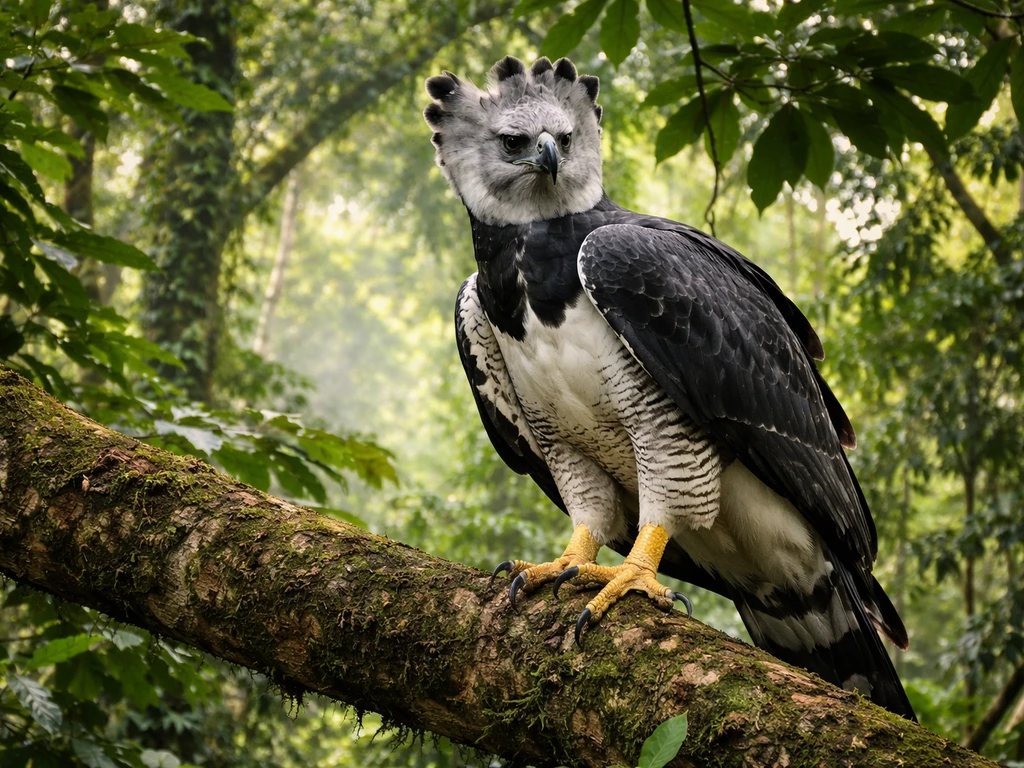
Panama's national bird: the harpy eagle
Panama's national bird is the harpy eagle, known in Spanish as the Águila Harpía. The scientific name is Harpia harpyja. This was officially established by Law No. 18, signed on April 10, 2002, which declared the Águila Harpía the "Ave Nacional de la República de Panamá" (National Bird of the Republic of Panama). If you've seen the name spelled "Águila Arpía" (without the 'h'), that's just a common alternate spelling in Spanish-language coverage, referring to the same bird.
What exactly is the harpy eagle
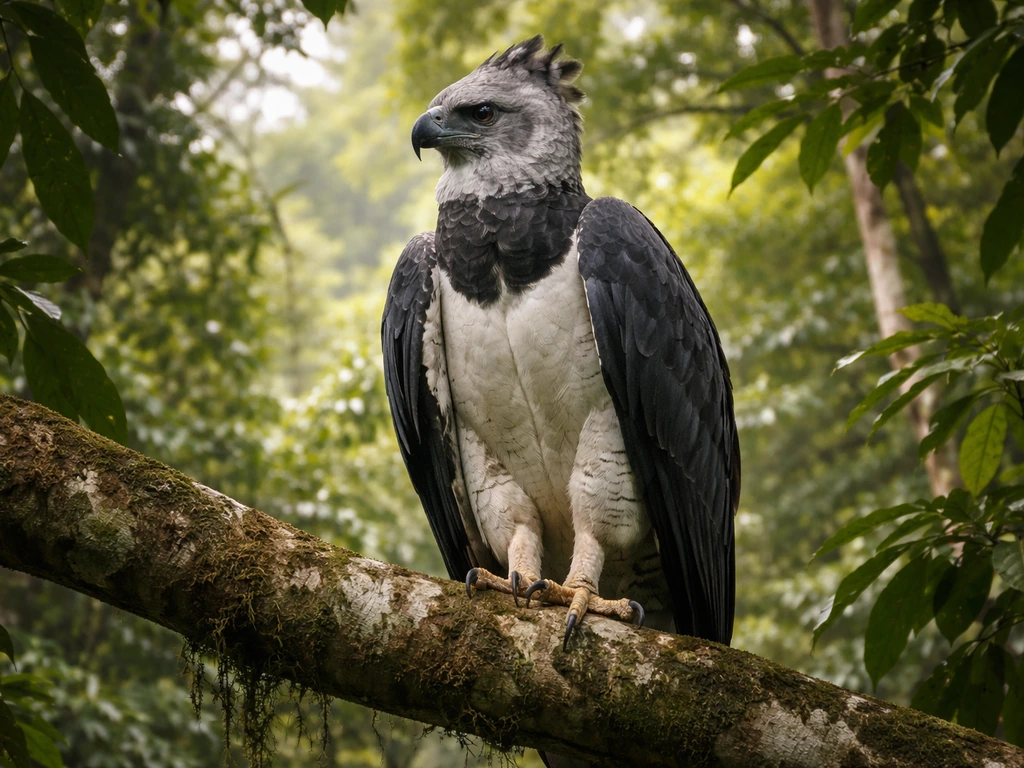
The harpy eagle (Harpia harpyja) is one of the largest and most powerful birds of prey on the planet. It's built for the forest, not for open skies, with broad wings and a short wingspan relative to its body size that help it maneuver through dense tropical canopy. Its wingspan still exceeds 2 meters, so there's no missing it if you're lucky enough to spot one. Britannica notes that adult harpy eagles are about 89, 104 cm long and can have a wingspan up to about 2 meters, and it also describes the crest behavior when alarmed Its wingspan still exceeds 2 meters.
Identifying one in the field is actually fairly straightforward once you know what to look for. The back and upper wings are slate-black, while the underparts are mostly white. The feathered legs (tarsi) are distinctively striped in black and white. The head features a dramatic divided crest that fans out when the bird is alert. Males and females look identical in plumage, so you can't tell them apart by color alone.
As an apex predator, the harpy eagle sits at the top of the food chain in the rainforest. Its diet reads like a who's who of tree-dwelling animals: sloths, monkeys, opossums, porcupines, iguanas, snakes, macaws, and even young deer. It hunts by ambush, using the forest canopy as cover, and its talons are large enough to grip and carry prey as heavy as a sloth.
Why Panama chose the harpy eagle
The harpy eagle isn't a random choice. It's a bird that genuinely represents Panama's ecological identity. Panama is one of the most biodiverse places on earth, sitting at the crossing point of North and South America, and the harpy eagle lives at the very top of that ecosystem. Choosing it as a national symbol is a statement about what Panama values: raw natural power, pristine forest, and a kind of fierce independence.
The symbolism runs even deeper because the harpy eagle appears on Panama's coat of arms. La Prensa Panamá reports that legislation to ensure the harpy eagle appears on Panama’s coat of arms was approved in the National Assembly. Law 18 (2002) made it the national bird, and a later law, Law 50 approved on May 17, 2006, amended the original legislation to formally specify that the harpy eagle (Harpia harpyja) shown on the national coat of arms is that same species. So the bird isn't just a symbol in the abstract, it's literally woven into the visual emblem of the Panamanian state.
There's also an element of conservation messaging here. The harpy eagle needs vast tracts of undisturbed lowland tropical forest to survive. Studies have shown it requires landscapes with at least roughly 50% forest cover to sustain breeding populations. By elevating this bird to national symbol status, Panama signals a commitment to protecting the forests that define so much of the country's geography and tourism economy.
How the national bird came to be official
Panama's national symbols are established through formal legislation passed by the National Assembly. The harpy eagle's designation came through Law No. 18 of April 10, 2002, published in the Gaceta Oficial (Panama's official government gazette), issue number 24530. That's the primary legal document. If you ever need to cite the exact legal authority for a school project or research paper, those are the details to use.
Other countries in the region follow similar processes. For example, Costa Rica's national bird was also chosen through a combination of cultural significance and formal recognition, reflecting how Central American nations tend to treat their avian symbols as genuine points of national pride rather than formalities. Panama's approach fits squarely in that tradition.
It's worth noting that the 2002 law wasn't the end of the story. The 2006 amendment (Law 50) refined the original by explicitly connecting the harpy eagle to the coat of arms. That kind of legislative follow-up is common when a symbol has both a standalone designation and an embedded role in other official iconography. It keeps the legal record consistent.
Harpy eagle facts worth knowing, and where to see one
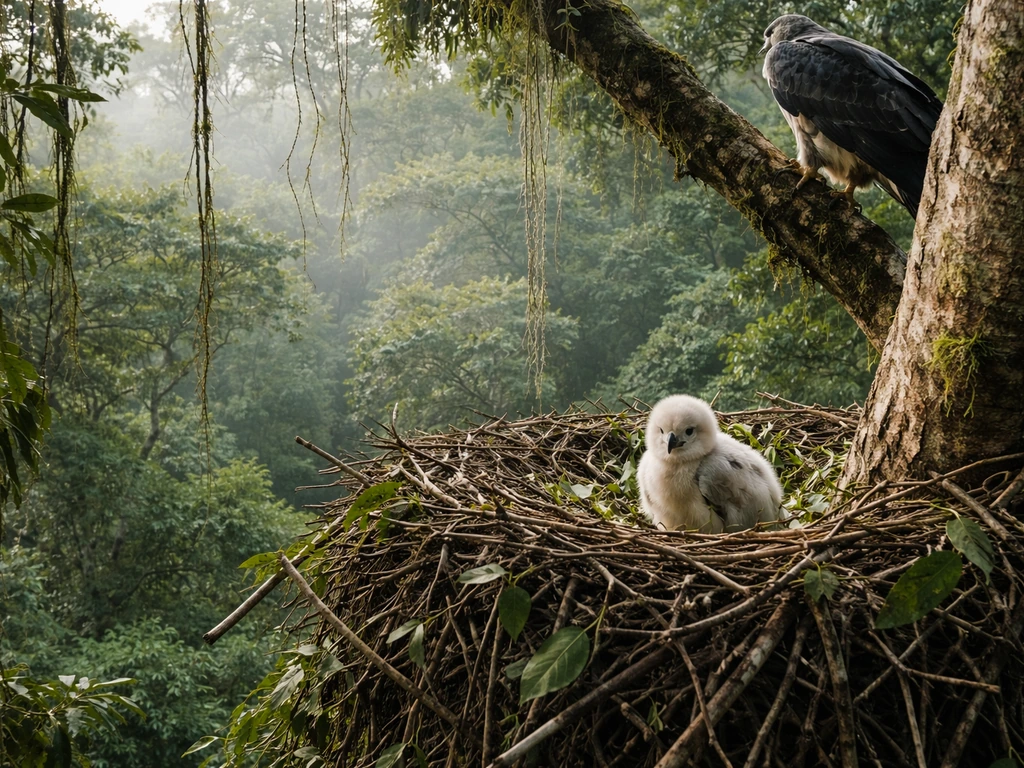
Harpy eagles breed slowly. Pairs typically raise only one chick every two to three years, which makes population recovery difficult when habitat is lost. Nests are enormous, built in large, tall trees high above the forest floor, about 1.2 meters thick and 1.5 meters across. Pairs are famously loyal to their nests too, often reusing the same structure over many years, sometimes across generations.
In Panama, the largest concentration of harpy eagles is found in Darién National Park, a UNESCO World Heritage Site in the Darién province near the Colombian border. National Aviary lists the harpy eagle as Panama's national bird. It's the most remote and biodiverse region in the country, and it's genuinely one of the best places in the world to see this bird in the wild.
If Darién feels too remote, there are more accessible options closer to Panama City. Soberanía National Park, just outside the capital, is a well-known birdwatching destination where harpy eagles have been spotted. The park's Pipeline Road (Camino del Oleoducto) is particularly popular with birders and is one of the most famous birdwatching trails in all of Central America.
For a guaranteed sighting without trekking deep into the jungle, Summit Park (Parque Summit) in Gamboa offers a captive harpy eagle as part of its wildlife exhibits. It's not the same as seeing one in the wild, but it's a practical option for visitors who want a close look at Panama's national bird and are short on time.
Key harpy eagle facts at a glance
| Feature | Detail |
|---|
| Scientific name | Harpia harpyja |
| Spanish name (official) | Águila Harpía (also written Águila Arpía) |
| Wingspan | More than 2 meters |
| Nest size | Approx. 1.2 m thick, 1.5 m across |
| Diet | Sloths, monkeys, opossums, iguanas, porcupines, snakes, macaws |
| Primary habitat | Lowland tropical forest (requires ~50%+ forest cover) |
| Best place to see wild | Darién National Park, Soberanía National Park |
| Captive viewing | Summit Park, Gamboa |
| Legal designation | Law No. 18, April 10, 2002 |
How the harpy eagle compares to other Central American national birds
The harpy eagle is by far the most physically imposing national bird in the Central American region. Most neighboring countries chose smaller or more colorful birds. To put it in context:
| Country | National Bird | Why Notable |
|---|
| Panama | Harpy eagle (Harpia harpyja) | Apex predator, one of the world's largest raptors, on the coat of arms |
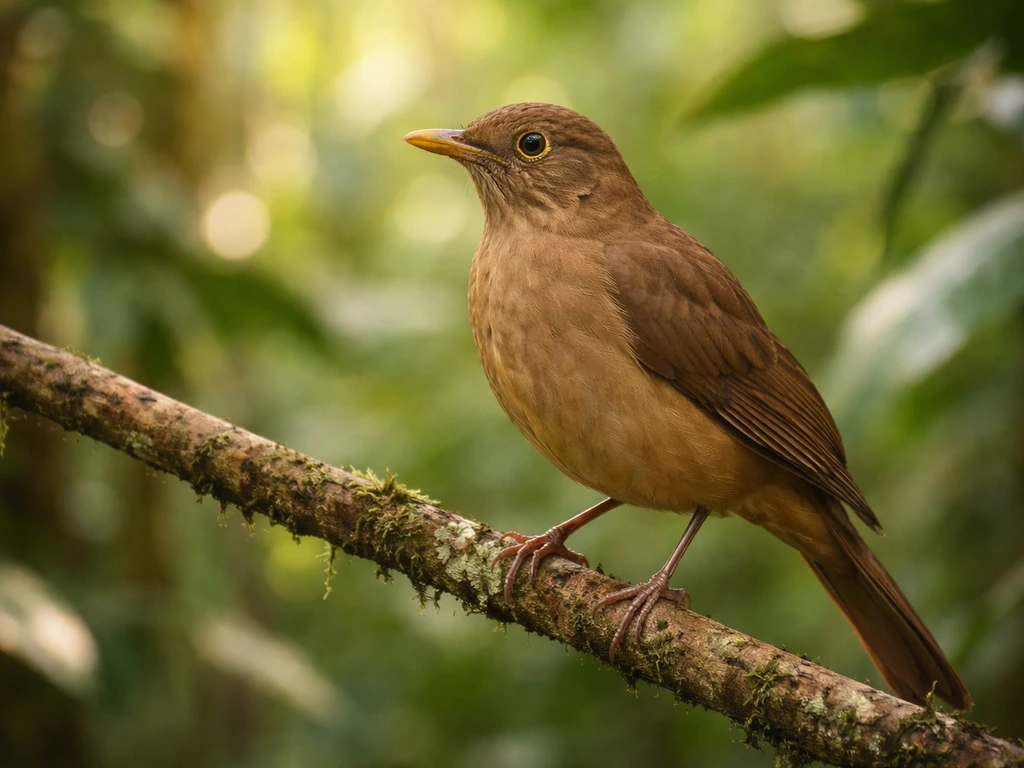
| Costa Rica | Clay-colored thrush (Turdus grayi) | Common, beloved songbird tied to the rainy season |
| Honduras | Scarlet macaw (Ara macao) | Vibrant color, cultural significance in Mayan heritage |
| El Salvador | Turquoise-browed motmot (Eumomota superciliosa) | Colorful, regionally symbolic across multiple countries |
| Nicaragua | Turquoise-browed motmot (Eumomota superciliosa) | Same species as El Salvador, but with distinct local cultural meaning |
Panama's choice stands out because the harpy eagle is an ecological heavyweight. While countries like Honduras chose the scarlet macaw for its striking visual beauty and cultural ties, Panama went with raw power and ecological dominance. It's a choice that reflects a national identity closely tied to the country's extraordinary biodiversity and forest heritage.
Interestingly, Nicaragua's national bird is the turquoise-browed motmot, the same species as El Salvador's, which shows how national bird selections don't always prioritize uniqueness. Panama took a different approach by anchoring its symbol to a species that is genuinely rare, threatened, and specific to undisturbed Neotropical rainforest, the kind of habitat Panama has in abundance compared to many of its neighbors.
If you want to explore further, El Salvador's national bird, the turquoise-browed motmot, offers an interesting contrast in how national bird symbolism works across the isthmus, with a bird that is common and colorful rather than rare and powerful.
How to verify this yourself

If you need to confirm this for a school assignment or just want to double-check, here's how to do it quickly and reliably.
- Search for "Ley 18 del 10 de abril de 2002 Panamá" and look for results from Panama's Gaceta Oficial or Justia Panama. These are direct legal sources for the original law.
- Look up "coat of arms of Panama" on any reputable encyclopedia. The harpy eagle's role in the coat of arms and its national bird designation are consistently documented there.
- Check the Peregrine Fund's species account for the harpy eagle. They document its status as Panama's national bird as part of their conservation research.
- For a quick cross-reference, search "Harpia harpyja Panama national bird" on encyclopedia sources like Britannica or educational sites like Animal Diversity Web.
- If you want a Spanish-language media confirmation, look for "Águila Harpía ave nacional" in La Prensa Panamá's archive, which has covered the conservation status of Panama's national bird in detail.
The answer is consistent across legal documents, wildlife organizations, encyclopedias, and media coverage: Panama's national bird is the harpy eagle (Harpia harpyja), officially designated by Law No. 18 on April 10, 2002. That date is worth remembering, because today, April 10, 2026, marks exactly 24 years since the law was signed.