
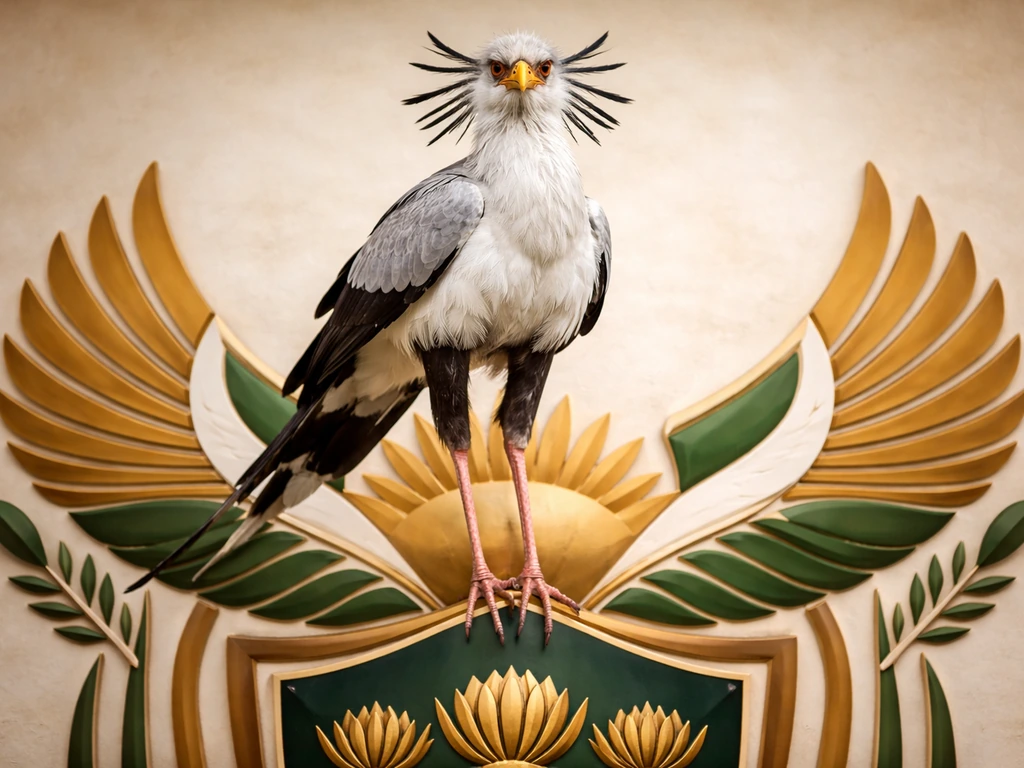
The secretary bird (Sagittarius serpentarius) is a national emblem of both South Africa and Sudan. On the blank" rel="noopener noreferrer">r/Symbology Emblems thread, people discuss identifying a gold secretary bird on Sudan-related emblem designs. In South Africa, it appears prominently on the national Coat of Arms, launched on Freedom Day, 27 April 2000. In Sudan, the secretary bird features on the national emblem as a distinctive local substitute for the eagle motif used across many Arab nations. Neither country lists the secretary bird as its official "national bird" in the strict category sense, but it holds genuine, formally recognized emblem status in both.
Secretary Bird Is the National Emblem of Which Country

Marcus Chen
2 May 2026
The exact role in South Africa and Sudan
South Africa is the country most commonly associated with the secretary bird as a national emblem, and the connection is official and documented. The bird appears on the South African Coat of Arms, where its powerful legs are interpreted as representing defence and authority. Its uplifted wings symbolize ascendance and protection. The Coat of Arms design was introduced on 27 April 2000, so the secretary bird has been a formal national symbol for over two decades.
One important distinction worth knowing: South Africa's official national bird is the blue crane, not the secretary bird. The South African government maintains separate categories for national bird, national animal (the springbok), and national coat of arms. The secretary bird belongs firmly in the coat of arms category. If a quiz or homework question asks which country has the secretary bird as a national emblem or symbol, South Africa is the correct answer. When people ask which bird is the emblem of the US, the usual answer is the bald eagle, not the secretary bird South Africa is the correct answer. If the question specifically asks about the national bird, the blue crane is what you want.
Sudan also incorporates the secretary bird into its national emblem. Rather than using the more common Eagle of Saladin seen on many Arab national emblems, Sudan adopted the secretary bird as a distinctly indigenous African substitute. The emblem shows a secretary bird with a native shield on its breast. Adoption details have changed across different political periods, with notable versions tied to 1970 and subsequent revisions.
What the secretary bird actually is
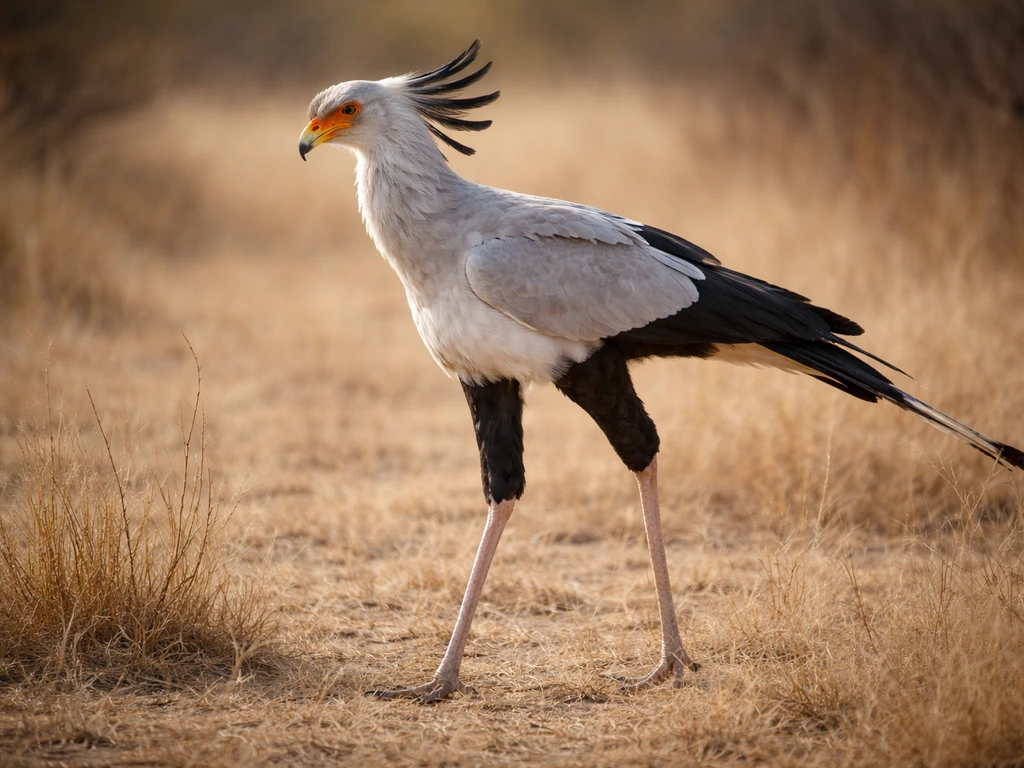
The secretary bird is a large, long-legged bird of prey found across sub-Saharan Africa. Its scientific name is Sagittarius serpentarius, and it is genuinely unlike any other raptor. While most birds of prey hunt from the air, the secretary bird hunts almost entirely on foot, striding through open grassland and savanna and stamping prey, including snakes, to death with its powerful legs.
Physically, it has a light gray body, black thighs, and contrasting dark flight feathers with lighter wing linings. The long crest feathers at the back of its head are its most distinctive feature and the origin of its popular name, which many believe refers to the old image of a secretary with quill pens tucked behind the ear. It stands roughly 1.2 to 1.5 meters tall and has a wingspan of around 2 meters.
In terms of habitat, secretary birds prefer grassland, dwarf shrubland, open savanna, and open woodland. They avoid dense forest and thick vegetation. Their range covers much of sub-Saharan Africa, with the main exception being the dense forested regions around the equator in west and central Africa. They are well adapted to the open landscapes that define large parts of both South Africa and Sudan.
Why the secretary bird works so well as a national symbol
A national emblem is rarely chosen at random. The secretary bird carries specific traits that translate well into symbolic language. Its snake-stomping hunting style made it a natural symbol of vigilance, power, and the defeat of enemies or danger. For South Africa's post-apartheid Coat of Arms, introduced in 2000 as part of the democratic era's national identity, that combination of strength and protection carried obvious meaning.
The bird's legs in the South African Coat of Arms are directly linked, in official government descriptions, to a spear and a knobkierie, both traditional weapons representing defence and authority. The symbolism is intentional and layered: the bird's physical attributes and cultural associations both feed into the meaning the designers wanted to communicate.
For Sudan, choosing the secretary bird over the more common Eagle of Saladin used by Egypt, Iraq, and other Arab countries was a way of asserting a specifically African identity. The secretary bird is native to Africa in a way that a heraldic eagle simply is not, making it a statement about geography and heritage at the same time.
How national emblems and national birds get chosen
Countries select national symbols through a range of processes, and not all of them are formal parliamentary votes. Some national birds were designated by government decree, others through ornithological society recommendations, and some simply accumulated official status over time through consistent use in government contexts. The secretary bird's role in South Africa's Coat of Arms falls into the official design-and-decree category: the entire Coat of Arms was formally designed, approved, and publicly launched as a state act.
It is worth understanding that the category labels matter. A country can have a national bird, a national animal, a national flower, and a coat of arms that each feature different species. South Africa is a good example of this. The blue crane is the national bird, the springbok is the national animal, and the secretary bird appears on the Coat of Arms. A national flag that features a bird of paradise points you to Papua New Guinea. All three are official. None of them cancel the others out.
This is why you sometimes see conflicting information online when searching for a country's national bird or emblem. Someone writing about the secretary bird in the context of South Africa is not wrong, but the context matters. The category they are referring to changes the answer. Other national emblems around the world show the same pattern: the bird on a coat of arms may be different from the separately designated national bird.
If you are curious about countries that feature birds directly on their national flags, that is yet another distinct category with its own list of examples. If you meant a question like what flag has a bird on it, that is a separate category from coats of arms, so the emblem discussion above is still a helpful comparison point national flags.
For the “bird in flag” question, it helps to identify whether the bird appears on the national flag versus the national emblem or coat of arms bird in flag which country. Countries that feature birds directly on their national flags are a separate category from emblems and national birds. You can also search for what flag has a bird in the middle, since that refers to a different type of national symbolism bird on the national flags.
How to verify this for yourself

If you need to confirm the secretary bird's emblem status for a school project, a trivia question, or just personal satisfaction, here is how to do it reliably. The strongest sources are official government websites, and in South Africa's case those are easy to find and clearly organized.
- Go to the South African government's official website (gov.za) and navigate to the national symbols section. It separates national bird, national animal, and national coat of arms into distinct pages, each with a clear description.
- The Coat of Arms page on gov.za confirms the secretary bird's presence in the design and provides the launch date of 27 April 2000.
- The Presidency of South Africa's national symbols page provides the official interpretive language describing the secretary bird's legs as representing defence and authority.
- For Sudan, check the Wikipedia article on the Emblem of Sudan as a starting reference, then cross-check with CRW Flags (Flags of the World) for adoption dates and design descriptions.
- BirdLife South Africa's secretary bird factsheet is a useful secondary source that confirms the bird is 'proudly displayed on the South African coat of arms' and interprets its symbolic role as protection.
When evaluating any source, look for whether it clearly distinguishes between emblem categories. A page that simply says 'the secretary bird is South Africa's national symbol' without specifying the coat of arms context is slightly imprecise, even if it is pointing in the right direction. The gov.za category pages are the gold standard here because they are organized exactly around those distinctions.
South Africa vs Sudan: a quick comparison
| Country | Role of Secretary Bird | Context | Date Formalized |
|---|---|---|---|
| South Africa | Featured on the national Coat of Arms | Legs represent defence and authority; wings represent ascendance and protection | 27 April 2000 (Freedom Day) |
| Sudan | Central figure on the national emblem | Replaces the Eagle of Saladin as an indigenous African symbol | Variants adopted in 1970 and later revisions |
South Africa is the more commonly cited answer to this question, and for good reason: the symbolism is well documented, officially described, and easy to verify through government sources. Sudan's use is equally real but less widely discussed in English-language resources. If the question you are trying to answer is specifically about a coat of arms or national emblem (rather than national bird), South Africa is almost certainly the intended answer in most quiz and educational contexts.
FAQ
If a worksheet asks for the secretary bird as a “national emblem,” do they mean South Africa or Sudan?
In most school and quiz contexts, “national emblem” points to South Africa because the secretary bird is shown on the South African Coat of Arms, which is widely documented. Sudan’s emblem also uses the secretary bird, so if the question expects two correct answers, both countries can fit.
Why does the answer change between “national emblem” and “national bird” for South Africa?
Because the terms refer to different categories. South Africa officially treats the secretary bird as part of the Coat of Arms symbolism, while its separately designated national bird is the blue crane.
Can the secretary bird be considered a national emblem if it is not listed as a national bird?
Yes. National emblem status does not require the animal to be the country’s national bird. Many countries separate categories like national birds, national animals, and coat of arms figures, which can lead to apparent contradictions online.
What should I do if I find conflicting pages online saying the secretary bird is “the national bird” of a country?
Check whether the source specifies the category. If it does not clearly say coat of arms or national emblem context (and instead claims “national bird”), treat it as imprecise. For South Africa, the most reliable approach is to verify through official government Coat of Arms descriptions.
Is the secretary bird on South Sudan’s symbols or on Sudan’s?
The secretary bird discussed here is tied to Sudan’s national emblem, and South Africa’s Coat of Arms. South Sudan has its own national symbols, so a claim that the secretary bird is part of South Sudan’s emblem should be verified separately.
Does the secretary bird appear on Sudan’s emblem in every political period?
No. Sudan has had emblem and heraldic revisions tied to different regimes, so the secretary bird’s presence and exact styling can vary by version. If your project needs a specific year or version, you should confirm the emblem design for that exact period.
How can I confirm the secretary bird is on the South African Coat of Arms for an assignment?
Look for an official government page that explains the Coat of Arms elements and their symbolism. Avoid general pop-history pages that say “national symbol” without explicitly linking the bird to the Coat of Arms.
If the question is about “a bird on a national flag,” is that the same as the secretary bird emblem question?
No. A bird on a national flag is a different category from a bird on a coat of arms. The secretary bird question is specifically about emblem symbolism, not flag design.
Next Articles
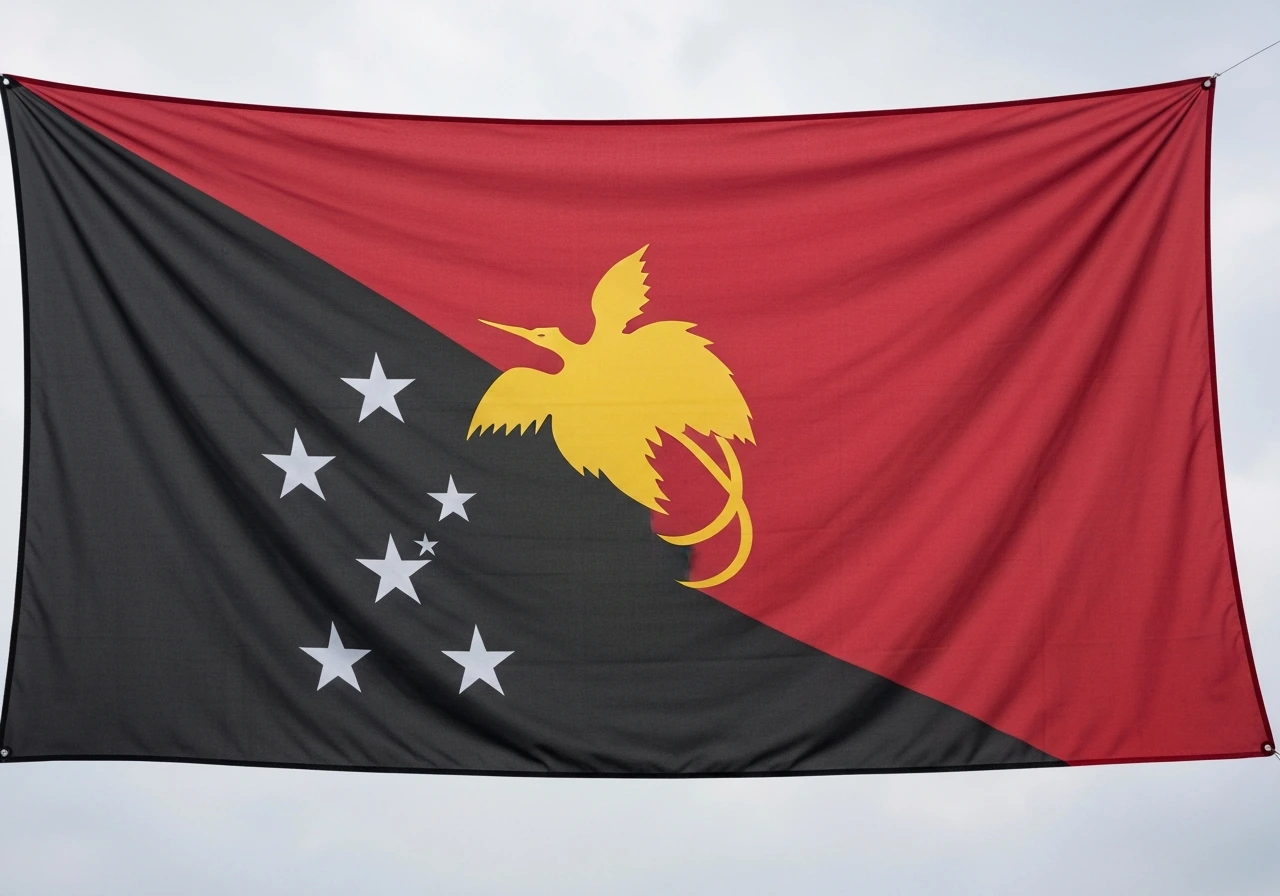
Which Nation’s Flag Features a Bird of Paradise?
Learn which country’s flag shows a bird of paradise, where it appears, and how to verify the symbolism and history.

What Country Has a Bird on Its Flag? How to Identify It
Identify which country has a bird on its flag using emblem location, bird type, and how to verify its national bird.
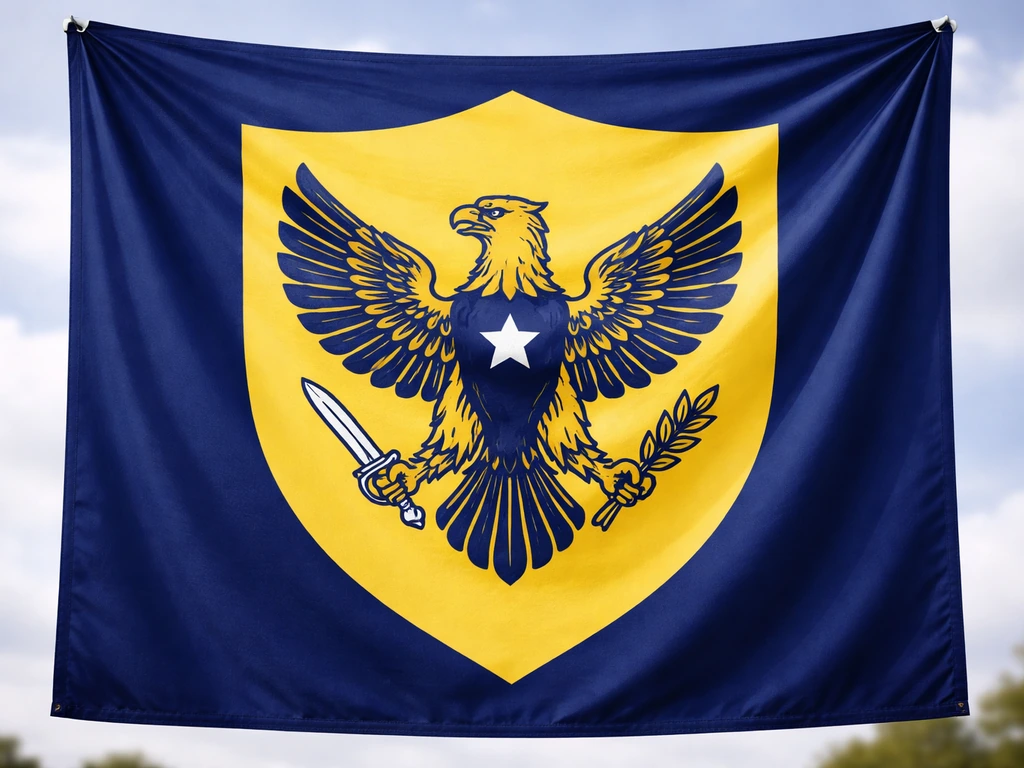
What Flag Has a Bird in the Middle? How to Identify It
Identify flags with a central bird using a step-by-step checklist, likely matches, and meaning of the symbol.