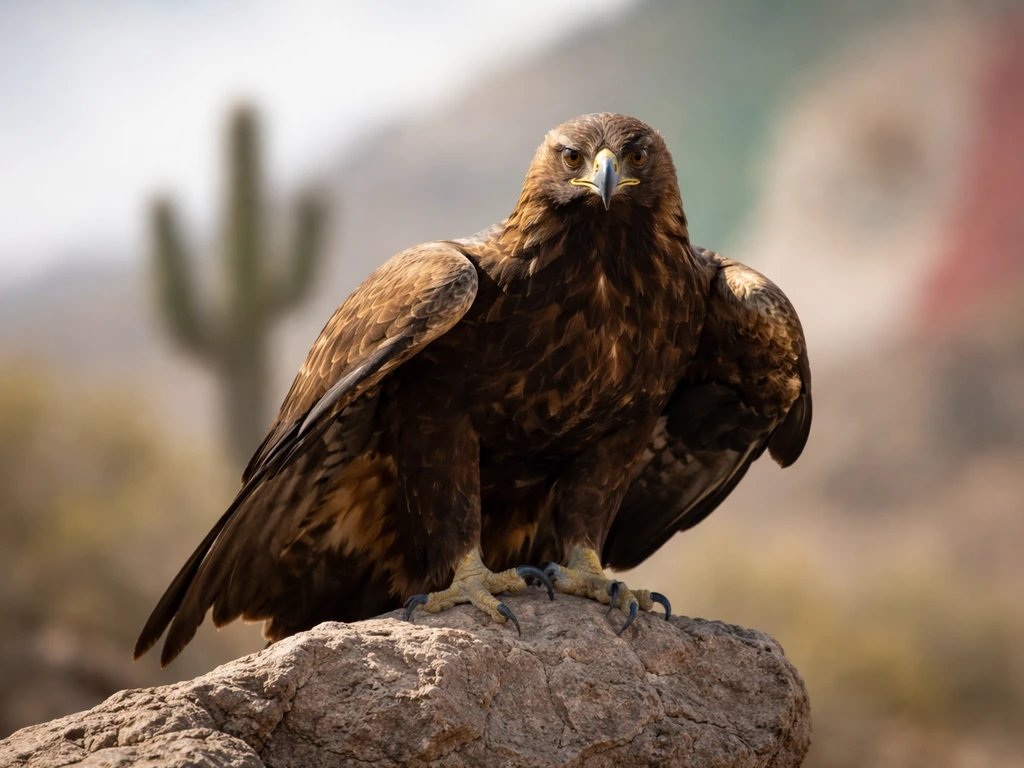
The short answer: Mexico's national bird is the golden eagle
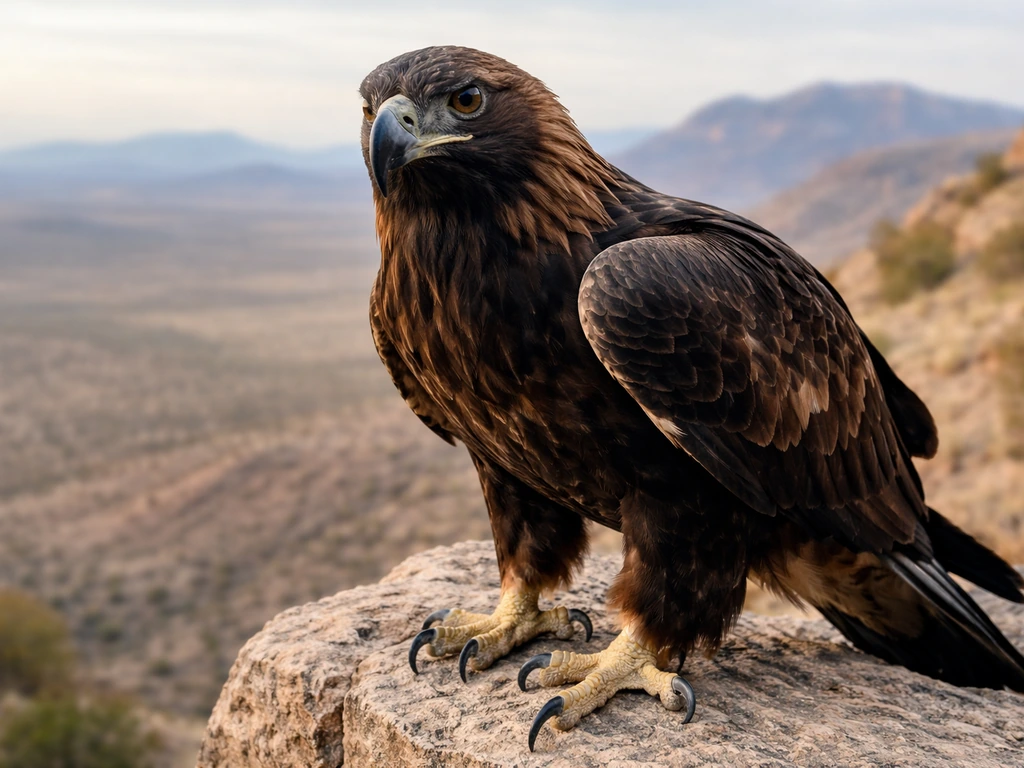
The golden eagle (águila real, or Aquila chrysaetos) is Mexico's national bird. Mexico does not have a single constitutional “national bird” clause, so the official status grew through laws and national-symbol recognition over time The golden eagle is Mexico's national bird. It sits at the center of the Mexican coat of arms, perched on a prickly pear cactus with a serpent in its beak, and that image appears on the Mexican flag. Mexico's government officially recognizes it as a living national symbol, and February 13 is designated as the "Día Nacional del Águila Real" (National Golden Eagle Day). So the bird is not just a decorative choice: it is legally, culturally, and historically embedded in Mexican national identity.
What "national bird" actually means in Mexico (and where people get confused)
Mexico does not have a single constitutional clause that says "the golden eagle is our national bird" in those exact words, which sometimes trips people up. What exists instead is a dense web of official recognition that amounts to the same thing. The "Ley sobre el Escudo, la Bandera y el Himno Nacionales" (the law governing Mexico's national symbols) describes the eagle on the coat of arms in precise physical detail: golden and metallic plumage, long feathers on the tarsi, a black beak. Those traits match the golden eagle (Aquila chrysaetos), which is how researchers and institutions identify the bird in the shield.
On top of that, Mexico's environmental agency PROFEPA formally calls the águila real the "especie emblemática de México" (emblematic species of Mexico), and in February 2020 the Mexican Senate went a step further, approving the placement of golden lettering in the Senate building reading "Águila Real, Símbolo Vivo Nacional" (Golden Eagle, Living National Symbol). The Senate resolution explicitly describes the bird's wings as representing freedom and independence. So even without a single "national bird" article in the constitution, the recognition is comprehensive and official.
One common point of confusion: some people ask whether Mexico's bird is a bald eagle, because they associate eagles with national symbols in North America and think of the United States' bald eagle. The bald eagle is a majestic bird, but Mexico’s national bird is the golden eagle. The two birds are completely different species. Mexico's eagle is the golden eagle, a large raptor found across the Northern Hemisphere, including in Mexican mountain ranges. If you're curious about the American side of eagle symbolism, the bald eagle's history as a national symbol follows its own separate path. That is why people often ask, but the question "why are bald eagles the national bird" comes from a U.S. context rather than Mexico's.
Where it all started: the Aztec eagle and Tenochtitlan
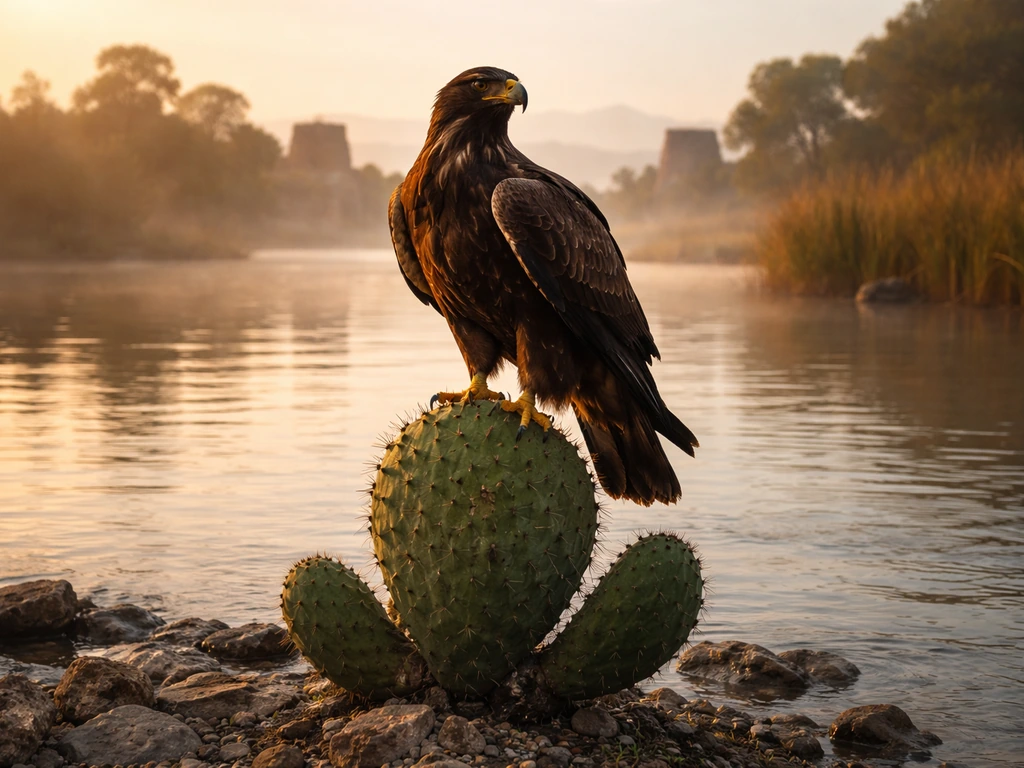
The golden eagle's role in Mexican identity goes back roughly 700 years, to the founding mythology of Tenochtitlan, the Aztec capital that eventually became Mexico City. According to Aztec tradition, the god Huitzilopochtli told the Mexica people to found their city where they found an eagle perched on a nopal cactus, devouring a serpent. That founding vision is preserved in Aztec hieroglyphic records, including the Mendoza Codex, where the glyph for Tenochtitlan shows an eagle on a cactus with an open beak, surrounded by the nopal and its fruit.
In Nahuatl, the eagle was called "cuauhtli," and it carried enormous symbolic weight in Aztec cosmology. Eagles were associated with the sun, with warriors, and with divine power. The "Eagle Warriors" (cuāuhtli) were one of the two elite military orders in Aztec society. The sun itself was sometimes described as an eagle crossing the sky. So when the Mexica saw an eagle at what would become Tenochtitlan, they understood it as a divine sign, not just a bird sighting.
The specific bird in that founding legend is generally identified as the golden eagle based on the physical characteristics that appear in Aztec art and in the codices: a large, powerful raptor with golden-brown plumage, capable of hunting large prey including snakes. Some researchers note a distinction between the iztaccuauhtli (white eagle) and the cuauhtli in Aztec records, but the official Mexican legal and governmental framework settles on the golden eagle as the bird depicted in the national coat of arms.
From Aztec symbol to Mexican flag: the nation-building timeline
The eagle-on-cactus image survived the Spanish conquest and was kept alive in colonial-era maps, codices, and artwork. When Mexico fought for and won independence from Spain in 1821, the new nation's leaders deliberately reached back to pre-colonial Aztec imagery to anchor Mexican identity in something distinctly not Spanish. The eagle on the cactus became the centerpiece of the new coat of arms and appeared on the first Mexican flags.
The coat of arms was updated and refined several times over the 19th and 20th centuries, but the eagle never left it. The current standardized version, with the eagle facing left in profile, wings slightly raised, and a serpent in its beak and talon, was codified in law and is the version you see on the flag today. Each change to the coat of arms was published in the Diario Oficial de la Federación, Mexico's official government gazette, which is why the evolution of the symbol is traceable through legal records.
More recently, institutional recognition has continued to build. February 13 was designated as the National Golden Eagle Day because it marks the anniversary of the founding of Mexico-Tenochtitlan. In 2017, SEMARNAT (Mexico's environment ministry) noted the date explicitly when laying the first stone of a new national center for golden eagle protection and monitoring. The Supreme Court of Justice (SCJN) has also marked the date in its institutional calendar. And in 2020, the Senate's formal recognition of the golden eagle as "símbolo vivo nacional" added another official layer.
| Year / Period | Event | Significance |
|---|
| ~1325 CE | Founding of Tenochtitlan | Eagle-on-cactus vision becomes foundational Aztec/Mexica myth |
| 1821 | Mexican Independence | Aztec eagle imagery adopted for the new nation's coat of arms and flag |
| 19th–20th century | Multiple coat of arms reforms | Design standardized; each change published in the Diario Oficial de la Federación |
| Ongoing (modern law) | Ley sobre el Escudo, la Bandera y el Himno Nacionales | Legally describes the eagle's physical traits, matching Aquila chrysaetos |
| February 13 (annual) | Día Nacional del Águila Real established | Date tied to anniversary of Tenochtitlan's founding |
| 2017 | SEMARNAT founds national eagle protection center | Institutional conservation linked explicitly to the symbolic date |
| February 2020 | Senate recognizes águila real as "Símbolo Vivo Nacional" | Formal legislative acknowledgment of the bird as living national symbol |
What the golden eagle actually represents

The symbolism layered onto the golden eagle in Mexico is specific and comes from multiple sources. It is worth breaking these down rather than just calling it a generic "symbol of power."
- Solar power and the divine: In Aztec cosmology, the eagle was tied to the sun and to Huitzilopochtli, the god of war and the sun. An eagle at the top of the national symbol connects Mexico's roots to that cosmological worldview.
- Military valor: Eagle warriors were an elite class in Aztec society. The eagle represented the courage and skill required for combat, which is why it translates naturally into a symbol of national strength.
- Freedom and sovereignty: The Senate's 2020 resolution explicitly says the eagle's wings represent freedom and independence, a modern reading that connects the pre-colonial bird to Mexico's post-colonial story of self-determination.
- The founding promise: The eagle on the cactus marks the precise spot where the Mexica were told to build their city. It is literally a symbol of home, of a people finding where they belong.
- Natural heritage: The golden eagle (Aquila chrysaetos) is a real, living species in Mexico's mountainous regions. Conservation agencies like PROFEPA and CONABIO monitor its populations. The bird is listed as "Amenazada" (threatened) under NOM-059-SEMARNAT-2010, which gives the symbolism a conservation urgency that keeps it relevant today.
It is worth noting that the serpent in the eagle's beak is also part of the symbolism. In some interpretations, the serpent represents the enemies defeated by the Mexica. In others, the struggle between the eagle and the serpent represents the eternal tension between sky and earth, or between the divine and the earthly. The image was never meant to be purely decorative.
How this compares to other eagle national birds
Mexico is not the only country with an eagle as its national bird, but the golden eagle's story is distinctive in how deeply pre-colonial myth drives the choice. The United States chose the bald eagle for its national symbol through a deliberate political process in the late 18th century, debated in Congress, and rooted in ideas about the New World rather than an indigenous founding myth. The United States chose the bald eagle as a national symbol through a deliberate political process in the late 18th century. The Philippine eagle, by contrast, was chosen for its ecological uniqueness as an endemic species. For the Philippines, you can also ask why the Philippine eagle is our national bird and what makes it significant there why philippine eagle is our national bird. Mexico's golden eagle is unusual because the choice was essentially made 700 years ago by the Aztec people themselves, and every subsequent Mexican government decided to keep it.
How to verify all of this today
If you want to check the primary sources yourself, here is where to look and what to expect from each one.
- Ley sobre el Escudo, la Bandera y el Himno Nacionales: Available on the Cámara de Diputados website (diputados.gob.mx). Article 2o. Bis describes the coat of arms eagle in physical detail. This is the foundational legal text.
- PROFEPA (Procuraduría Federal de Protección al Ambiente): The government's environmental enforcement agency publishes pages on the águila real as Mexico's emblematic species, including the scientific name Aquila chrysaetos and conservation status.
- SEMARNAT (Secretaría de Medio Ambiente y Recursos Naturales): Look for their page on golden eagle conservation actions. It explicitly connects the February 13 date to the anniversary of Tenochtitlan's founding.
- SCJN (Suprema Corte de Justicia de la Nación): Their institutional calendar and memory documents mark the Día Nacional del Águila Real on February 13, useful for confirming the date's official standing.
- Senado de la República / SIL Gobernación: The Junta de Coordinación Política agreement from 2020 formalizing the "Símbolo Vivo Nacional" designation is archived in the Senate's legislative information system.
- Arqueología Mexicana: This specialist publication covers the distinction between the cuauhtli in Aztec sources and the modern legal identification of the coat of arms eagle, which is useful if you want to go deeper on the indigenous side of the story.
- CONABIO (Comisión Nacional para el Conocimiento y Uso de la Biodiversidad): Publishes monitoring program data on golden eagle populations in Mexico, connecting the symbol to the living species.
A few concrete facts worth having in your back pocket
- The golden eagle's scientific name is Aquila chrysaetos. It is a large raptor found across North America, Europe, Asia, and North Africa, but in Mexico it is specifically associated with mountainous terrain.
- February 13 is Mexico's National Golden Eagle Day, chosen because it marks the traditional founding date of Tenochtitlan (modern-day Mexico City).
- The golden eagle is listed as "Amenazada" (threatened) under Mexico's NOM-059-SEMARNAT-2010 environmental standard, meaning the living bird is officially protected.
- The Mendoza Codex, a 16th-century Aztec document, includes a glyph for Tenochtitlan showing an eagle on a nopal cactus with an open beak, which is the same visual that appears on the modern Mexican flag.
- In 2020, the Mexican Senate placed golden lettering in its building reading "Águila Real, Símbolo Vivo Nacional," making the recognition a physical, permanent fixture of the legislative building.
The bottom line is straightforward: the golden eagle is Mexico's national bird because the Aztec people chose it as the divine marker of their capital city roughly 700 years ago, because Mexico's independence-era leaders deliberately kept that symbol to root the new nation in pre-colonial identity, and because every subsequent Mexican government has continued to codify and expand that recognition through laws, institutions, and conservation policy. It is one of the cleaner examples of an unbroken symbolic thread running from ancient history to the present day.