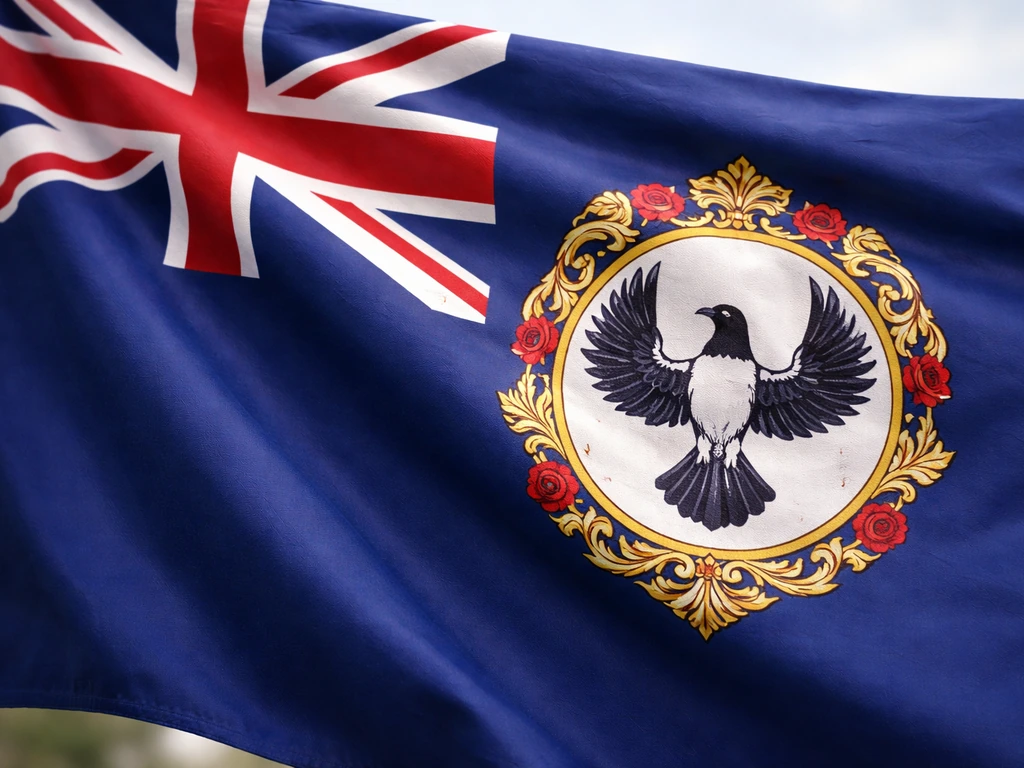
The bird on the South Australian flag is the Piping Shrike, which is the same bird most Australians know as the white-backed magpie. If you're wondering about other flags with birds, the question of which central African country has a bird on its flag is a different but related lookup bird on the South Australian flag. It appears on the state badge at the centre of the flag's fly, shown with wings spread and standing on a gum branch, facing a golden disc representing the rising sun.
What Bird Is on the South Australian Flag? Identification & Meaning

Marcus Chen
4 May 2026
Identifying the bird: Piping Shrike or white-backed magpie?
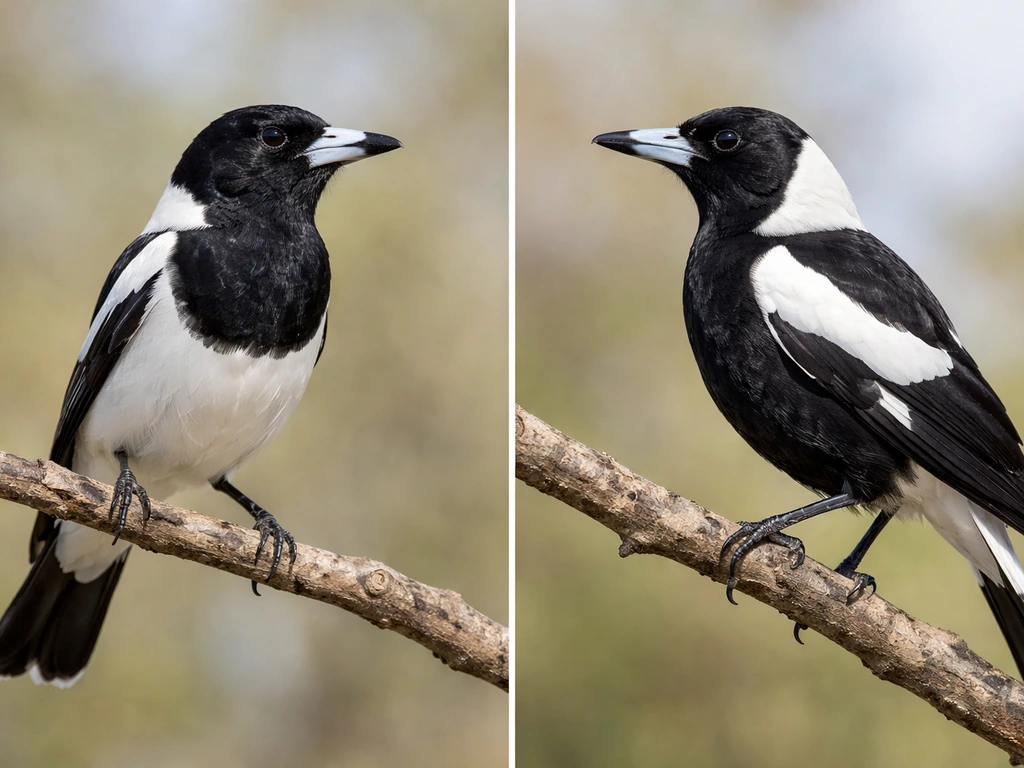
Both names refer to the same bird, and that causes a lot of confusion. Officially, the state badge uses the name 'Piping Shrike' and that's how South Australia's government refers to it on formal documents and insignia. But in everyday Australian language, the same bird is called the white-backed magpie (Gymnorhina tibicen), distinguished from other magpie subspecies by the white patch on its back rather than a black one.
The name 'Piping Shrike' is largely a heraldic and political name for South Australia's purposes, not a widely used field-guide term. The Australian Government's PM&C symbols page spells this out plainly: 'piping shrike' is the official name used for the black-and-white bird most Australians call the white-backed magpie. Once you know that, the two names stop being confusing.
Common look-alike birds to avoid mixing up
If you're trying to visually confirm the bird on the flag, a few other black-and-white South Australian birds sometimes get confused with it. The magpie-lark (also called the mudlark, peewee, or Murray magpie) is one of the most frequently misidentified: it's noticeably smaller than the Australian magpie and has a different body structure, with a white belly that wraps higher up the chest. The pied butcherbird is another, but it has a distinctive black hood around the head and throat that sets it apart. The bird on the flag is clearly larger and more robustly built than either of these, with a clean white back visible in the heraldic depiction.
Why this bird ended up on the flag
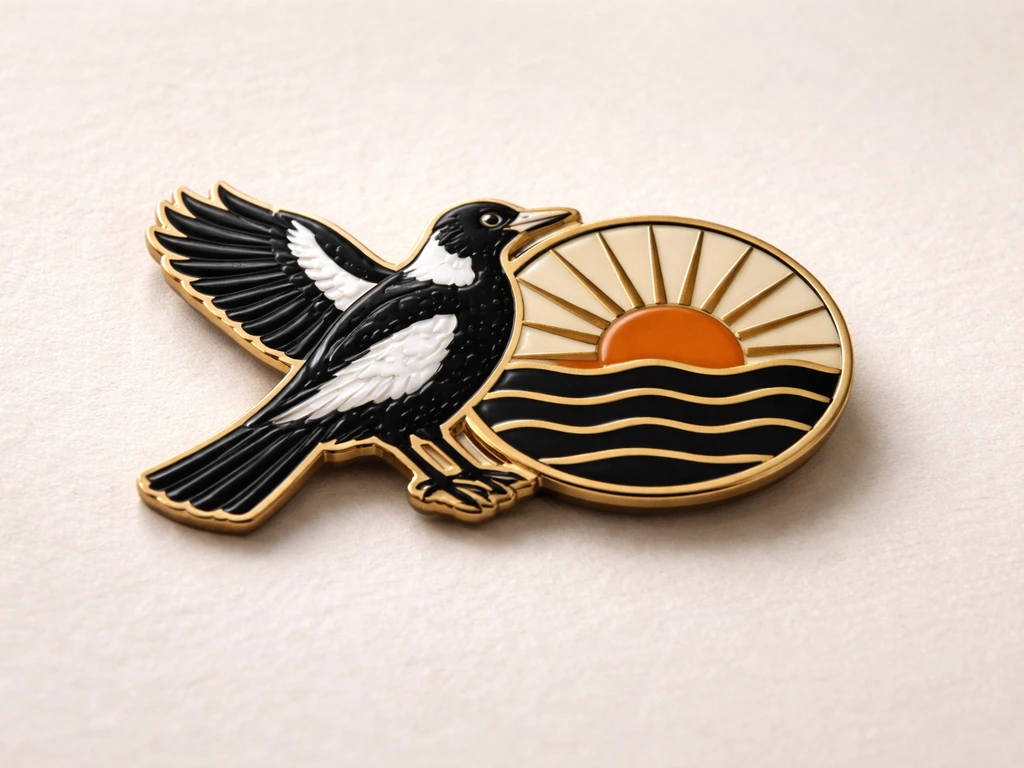
The piping shrike was chosen because it was already deeply associated with South Australia's landscape and identity by the early 1900s. Governor Lord Tennyson is credited with pushing for the bird's use, and historical correspondence shows he used the term 'Piping Shrike' specifically when proposing the design for the state badge. The magpie's carolling call, its widespread presence across the state, and its bold black-and-white colouring made it feel like a fitting representation of South Australia.
The rising sun element next to the bird reinforces a symbolism of new beginnings and prosperity, a common motif in Australian state heraldry of the era. The gum branch the bird stands on grounds the emblem firmly in the Australian natural landscape, making it unmistakably local rather than borrowed from European heraldic traditions.
How the bird is drawn on the flag: what to look for
The state badge on the South Australian flag shows the Piping Shrike in a specific heraldic pose. Here are the key design features to look for when you're examining the flag:
- Wings outstretched and displayed (spread wide, not folded), which is the classic heraldic 'displayed' posture
- Standing on the staff or branch of a gum tree, with feet gripping the branch
- Head turned to its left, facing toward a golden disc representing the rising sun
- White back clearly visible from the rear-facing orientation
- Black-and-white colouring throughout, consistent with the white-backed magpie subspecies
The official wording from South Australia's Department of the Premier and Cabinet describes the badge element as 'an Australian Piping Shrike displayed, standing on the staff of a Gum Tree.' That 'displayed' term is the heraldic shorthand for the wings-spread posture. If you're looking at the flag and see a bird with wings open on a branch, facing a sun disc, you're looking at the right element.
The flag's history and how the emblem changed
South Australia used an earlier flag design from 1876 to 1904, before the current flag and state badge were formalised. The piping shrike as a formal state badge element was proclaimed on 14 January 1904, with the state flag itself adopted the day before on 13 January 1904. Before that, the piping shrike had already appeared on the Governor's ensign from around 1903, so its use in official state iconography slightly pre-dates the formal badge proclamation.
One interesting design detail that changed during the emblem's formation: an early version of the heraldic design included a pomegranate flower above the Piping Shrike. This element was removed, reportedly at the request of either Governor Lord Tennyson or Premier Frederick Holder, and the current, cleaner design without the pomegranate is what appears on the flag today. The pomegranate had no strong local connection, so removing it made the emblem feel more distinctly South Australian.
| Period | Flag version | Key emblem detail |
|---|---|---|
| 1876–1904 | Blue Ensign with earlier state badge | No formal Piping Shrike state badge yet |
| 1903 | Governor's ensign | Piping Shrike first appears on official ensign |
| 13–14 Jan 1904 | Current flag and badge adopted | Piping Shrike formally proclaimed as state badge, pomegranate removed |
| 1904–present | Current South Australian flag | Piping Shrike displayed on gum branch, facing rising sun |
How to verify this for yourself
If you want to confirm the bird's identity with official sources rather than taking anyone's word for it, here are the most reliable places to check:
- SA Memory (samuseum.sa.gov.au): The South Australian government's heritage reference site has a dedicated page on the Piping Shrike as a state emblem, naming it 'Piping Shrike or White Backed Magpie' and confirming its use on the flag and coat of arms.
- Department of the Premier and Cabinet, SA (dpc.sa.gov.au): The 'Using the state insignia and emblems' page provides the official heraldic description, including the 'Australian Piping Shrike displayed' wording used in formal state documents.
- Australian Government PM&C Symbols page: The Prime Minister and Cabinet's Australian Symbols resource links the 'piping shrike' name directly to the white-backed magpie, giving you the plain-language cross-reference.
- Field guide cross-check: Compare the heraldic bird against photos of Gymnorhina tibicen (white-backed magpie) in any Australian bird field guide or the Birds Australia / BirdLife Australia species database. The white back, black head, and robust build should match clearly.
It's also worth noting that Australia's national bird identity is a separate question from South Australia's state emblem, since Australia has its own nationally recognised birds. If you are wondering what Papua New Guinea's national bird is, that country has its own official national bird distinct from Australia's state symbols Australia's national bird identity is a separate question from South Australia's state emblem. If you are wondering about the national bird of Australia specifically, that is a different question from South Australia's state emblem Australia's national bird identity. Similarly, other Australian states and territories have their own bird emblems: Tasmania, for example, has its own distinct bird emblem, just as Papua New Guinea and Uganda use birds on their respective flags for entirely different cultural and historical reasons. If you're also curious about what bird is on the Zambian flag, that's a separate country emblem but can be checked with the same kind of official flag-name sources. If you're wondering what it is, Tasmania's bird emblem is the Tasmanian wedge-tailed eagle what is the bird emblem of tasmania. Papua New Guinea’s flag features a bird that is a different national symbol from South Australia’s state emblem. If you are also wondering about Uganda’s flag, the bird used there is different and has its own cultural meaning. South Australia's piping shrike stands on its own as a state-level symbol rather than a national one.
The bottom line: the bird on the South Australian flag is the Piping Shrike, the local heraldic name for the white-backed magpie. It's been there since 1904, it sits on a gum branch with wings spread facing a rising sun, and it's one of the more straightforward state bird emblems to identify once you know both names refer to the same species.
FAQ
Is the bird on the South Australian flag the same as the white-backed magpie I see in parks and bushland?
Yes. The flag uses the heraldic name “Piping Shrike,” which refers to the species most people call the white-backed magpie (Gymnorhina tibicen). The field-guide names and the flag’s official badge name are different labels for the same bird.
Why do some people say the bird is a “magpie,” but the badge says “piping shrike”?
Because “piping shrike” is the official heraldic wording used for state insignia, while “white-backed magpie” is the common everyday name. In practice, the confusion is mostly between official symbolism language and normal birdwatching terminology.
How can I visually distinguish the flag bird from a magpie-lark (mudlark) if I am comparing at a distance?
The magpie-lark is smaller and has a different body shape, including a white belly that extends higher toward the chest. The flag depiction shows a larger, sturdier bird with a clear white back, consistent with the white-backed magpie look rather than the magpie-lark silhouette.
Could the bird be confused with a pied butcherbird?
Usually, yes only in quick glances, since butcherbirds are also black-and-white. The key distinguishing feature is the butcherbird’s bold black hood over the head and throat, while the flag design does not emphasize that hood-like marking.
What does “displayed” mean in the description of the badge bird?
In heraldry, “displayed” describes the pose, typically wings spread outward. So if you see wings open on a branch in the badge, that matches the heraldic term rather than suggesting a different species.
Does the rising sun on the flag change the identification of the bird?
No. The sun disc is separate symbolism, commonly used to represent new beginnings or prosperity. It does not indicate a different animal, it just frames the bird within the state emblem design.
Has the bird on South Australia’s flag always looked the same since 1904?
The core idea is consistent, but there were early design changes. For example, an earlier version reportedly included a pomegranate flower above the bird, which was removed before the current clean badge design used on the flag.
Where is the bird actually located on the flag design?
It appears within the state badge at the center of the flag’s fly (the main front-facing side). The bird is shown standing on a gum branch and facing a golden disc.
Is South Australia’s “piping shrike” the same as any national bird for Australia?
No. Australia’s national bird identity is separate from state emblems. South Australia’s piping shrike is a state-level symbol, not a national designation for the entire country.
If I want to confirm the official wording, what should I look for?
Look for government descriptions of the state badge that use the heraldic species name and the exact placement/pose wording. The most reliable descriptions will spell out “Piping Shrike” and characterize it using heraldry terms like “displayed” and “standing on” a gum tree staff.
Next Article
What Bird Is on the Papua New Guinea Flag? National Emblem
Identify the bird on Papua New Guinea’s flag: the Raggiana bird-of-paradise and its national emblem symbolism.