
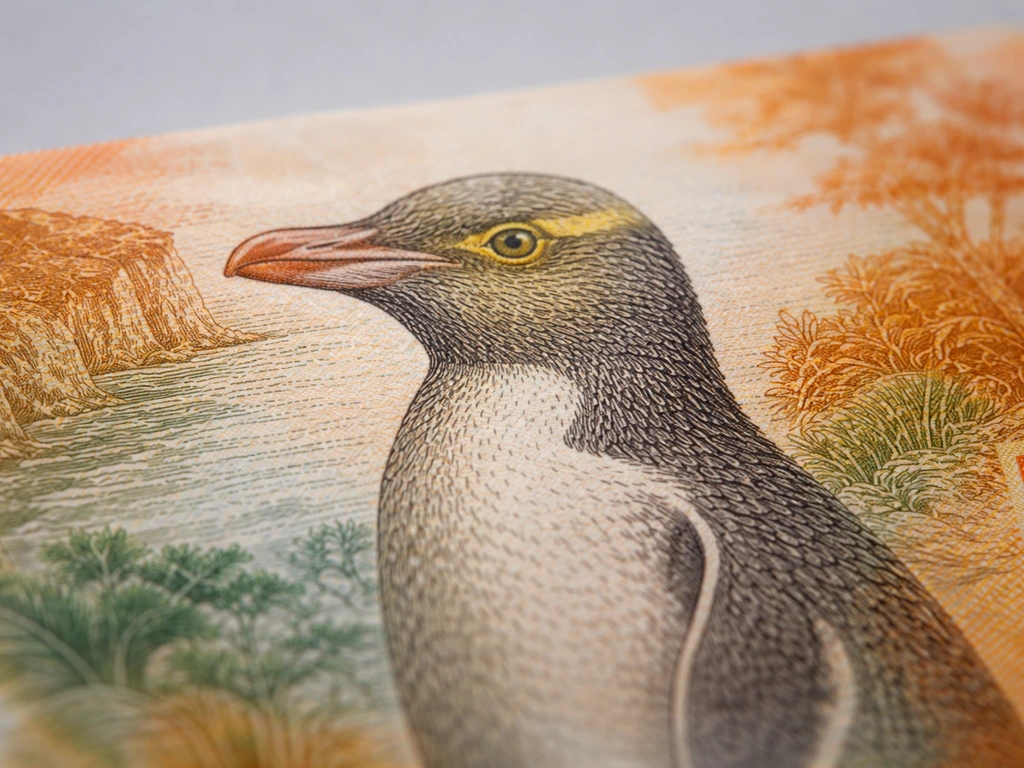
The bird on New Zealand's $5 note is the hoiho, also known as the yellow-eyed penguin (Megadyptes antipodes). It appears on the back of the note, set against a scene from sub-antarctic Campbell Island, and has been the bird associated with the NZD $5 denomination across multiple banknote series.
What Bird Is on the NZ 5 Dollar Note? Identify It

Marcus Chen
30 May 2026
Which banknote series you might be holding
New Zealand has gone through several banknote series over the decades, and it helps to know which one you have. The current design is the Series 7, introduced in 2015-2016 as part of the 'Brighter Money' redesign. It's printed on polymer plastic rather than paper, and it's the version you're most likely to encounter in circulation today. Before that came Series 6, which ran from the late 1990s through to 2015. There's also the older fifth series, which Te Ara (the Encyclopedia of New Zealand) documents in detail.
The good news: across all these series, the $5 note has consistently featured the hoiho on the back. Sir Edmund Hillary has appeared on the front of the $5 note since 1992, so that's a reliable anchor regardless of series. If you see Hillary on the front and a penguin on the back in a Campbell Island landscape, you're looking at the right note.
To pinpoint the exact series, check the serial number prefix. The Reserve Bank of New Zealand publishes official serial number tables for both Series 6 and Series 7, broken down by year and denomination. If you want a definitive series ID, those tables are the most reliable tool.
Visual cues that confirm it's the hoiho
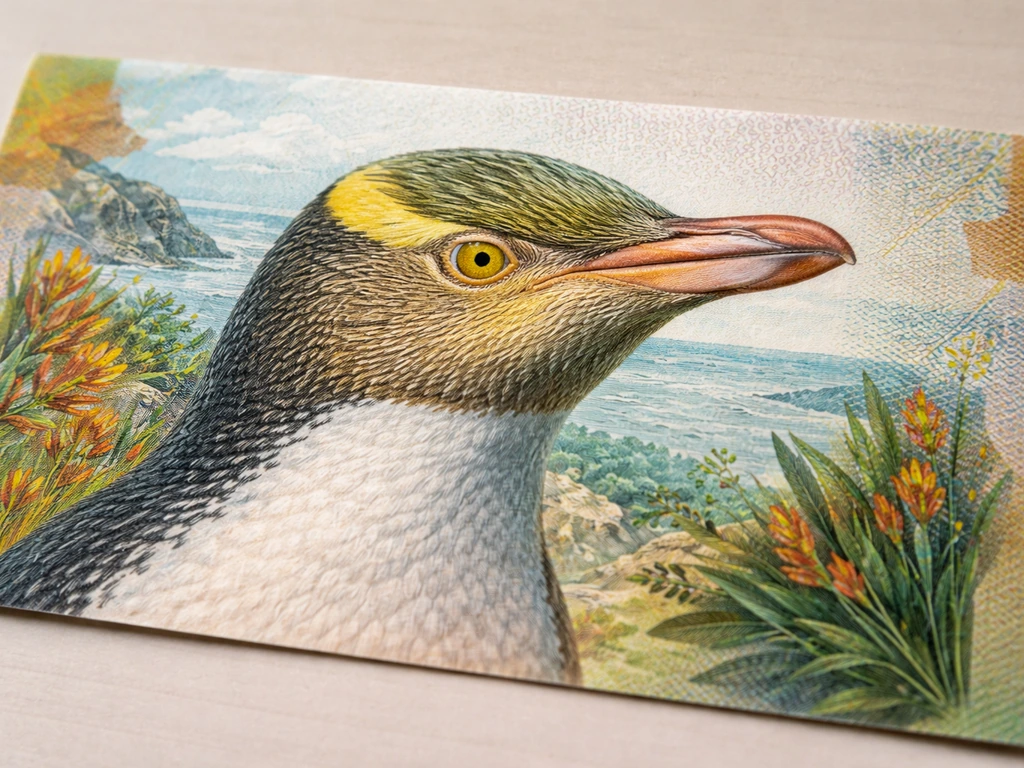
If you're trying to positively identify the species from the note itself, the Reserve Bank's own Series 7 brochure spells out the key visual traits used in the artwork:
- Distinctive yellow iris (the name 'yellow-eyed' is literal and obvious in the artwork)
- A yellow band running across the back of the head
- Grey-blue colouring on the back
- Snow-white belly
- Pink feet
On the Series 7 note specifically, there are also security-feature cues that double as bird-location markers. The Reserve Bank's counterfeit-checking guidance points to a colour-changing bird image and metallic numbers paired with the bird motif. Tilt the polymer note and you'll see the bird's colours shift, which is both a counterfeit check and a clear visual anchor for where the hoiho appears on the note design. There's also a large holographic window where you can see the bird's silhouette when you hold the note up to light.
Why the hoiho: the symbolism behind the choice
The hoiho isn't New Zealand's formally declared national bird in the way some countries have a single official emblem, but it carries enormous symbolic weight. It's unique to New Zealand, found nowhere else on Earth in the wild, and the Department of Conservation describes it as one of the world's rarest penguin species. That combination of endemic status and scarcity makes it a powerful emblem of what makes New Zealand ecologically distinct.
There's also a conservation urgency to the choice. The Reserve Bank's Series 7 brochure notes that hoiho are threatened by habitat destruction and predation of chicks by introduced animals including stoats, dogs, ferrets, and cats. Putting an endangered native species on everyday currency raises awareness every time money changes hands. It's a quiet but constant reminder of what New Zealand stands to lose.
The Campbell Island setting on the back of the note reinforces this. The sub-antarctic islands are among the most remote and ecologically significant places within New Zealand's territory, and they represent the kind of wild, protected habitat that the hoiho depends on. The note effectively tells a conservation story in a single image.
The history behind the artwork and the $5 note
The $5 note's identity has been shaped by two constants since 1992: Sir Edmund Hillary on the front, and native New Zealand wildlife on the back. Hillary was the first person to summit Everest (alongside Tenzing Norgay), and his connection to New Zealand's outdoor and conservation legacy made him a natural fit for the currency. The hoiho on the reverse complements that theme, pairing human achievement with natural heritage. In Canada, people often ask similar questions, like is the loon the national bird of Canada.
The Series 7 redesign in 2015-2016 refreshed the artwork while keeping the core pairing intact. The switch to polymer substrate was part of a broader move to improve durability and security across all NZD denominations. Each denomination in the Series 7 range was assigned a different native bird: the $5 got the hoiho, the $10 features the whio (blue duck), the $20 the kārearea (New Zealand falcon), the $50 the kōkako, and the $100 the mōhua (yellowhead). On the $50 note, the bird is the kōkako the $50 the kōkako. It's essentially a field guide to threatened New Zealand birds spread across the currency.
| Denomination | Bird (English) | Bird (Māori) |
|---|---|---|
| $5 | Yellow-eyed penguin | Hoiho |
| $10 | Blue duck | Whio |
| $20 | New Zealand falcon | Kārearea |
| $50 | Kokako | Kōkako |
| $100 | Yellowhead | Mōhua |
The fifth series, documented by Te Ara, also placed the hoiho on the $5 note's reverse within a Campbell Island scene, so the bird's association with this denomination predates the current polymer design. It's a consistent choice that reflects how central the hoiho is to New Zealand's national identity and conservation story.
How to confirm what you're looking at right now
If you want to verify the species on your specific note, here's a practical checklist:
- Check the front for Sir Edmund Hillary and a reference to Mt Cook (Aoraki). If that's there, you have a $5 note from 1992 or later.
- Flip it over and look for a penguin in a coastal/sub-antarctic landscape alongside plants labeled as Campbell Island daisy and Ross lily.
- On a Series 7 (polymer) note, tilt it to see the colour-changing bird near the denomination numeral, and hold it up to light to see the bird silhouette in the holographic window.
- Cross-reference the serial number prefix against the Reserve Bank's official Series 6 or Series 7 serial number tables to confirm which series you have.
- Go to the Reserve Bank of New Zealand's website (rbnz.govt.nz) and navigate to the $5 banknote page, where they publish front and back images of both Series 6 and Series 7 for direct visual comparison.
The RBNZ website is the most authoritative place to check. Their $5 banknote page shows high-resolution images of both sides, names the hoiho explicitly in the artwork description, and links through to counterfeit-checking guidance if you want to go further. Te Ara's Encyclopedia of New Zealand is a useful secondary source for historical series information if you're looking at an older note.
If you're comparing NZD notes across denominations and want to avoid species confusion, the denomination-to-bird table above is the quickest reference. Each bird is unique to its denomination, so once you know the $5 is always the hoiho, you won't mix it up with, say, the whio on the $10. The question of what bird is on the $2 coin does not apply to these NZD banknotes, since the hoiho is tied to the $5 note instead the $5 is always the hoiho. New Zealand's approach of assigning a different threatened native bird to each note is quite deliberate, and it makes the currency one of the more interesting sets of national bird emblems in the world. It's worth comparing to how other countries, like Canada, handle their currency bird symbolism, where similar questions come up around which bird appears on which coin or note. The blue jay is widely described as Canada's national bird, and it often shows up in the country's bird-related symbolism. In Canada, the bird people often ask about on the currency is the Canadian goose.
FAQ
Does the bird on the NZ 5 dollar note change between Series 5, 6, and 7?
The bird on the back of the NZD $5 note is the hoiho (yellow-eyed penguin), and it stays the same across the different banknote series. The serial number prefix helps you identify the series, but it does not change the bird species used for the $5 denomination.
How can I confirm I have the correct NZ$5 note design, not a similar note?
Look for Sir Edmund Hillary on the front. On the reverse, the bird is shown in the Campbell Island sub-Antarctic scene, and Series 7 also includes polymer security cues like a tilt-responsive color-changing element and a holographic window that helps confirm you are looking at a genuine $5 note.
What if my NZ$5 note looks like a different bird, is it still supposed to be the hoiho?
There should only be one bird type for the $5 denomination. If your note appears to show a different penguin or a bird that does not match the hoiho artwork, it is likely a viewing angle or lighting issue, or you are comparing against a different denomination (for example, the whio is on the $10).
How do I tell whether my NZ$5 note is Series 6 or Series 7?
To identify the series, check the serial number prefix and match it to the Reserve Bank’s published tables for Series 6 and Series 7. Series 7 is the polymer version introduced around 2015 to 2016, while older series can be identified by their dates and design format.
What visual clues on the note can I use to identify the bird without guessing?
If you are trying to verify the species from the note artwork, focus on the bird motif and the Campbell Island context on the reverse. Series 7 includes extra security visuals that can make the bird stand out when you tilt or hold it to light, which is useful if the print looks faded.
Is the hoiho the official national bird on the NZ $5, or is it just a symbolic choice?
No, this does not apply to the NZ$5 note question in the way people sometimes assume from coins. The hoiho is tied to the $5 banknote denomination, and New Zealand’s “national bird” label is not presented on currency as a single formal emblem in the same way some countries do.
Why does New Zealand put a threatened species like the hoiho on everyday money?
Yes. The design choice is connected to conservation messaging because hoiho are threatened by habitat loss and introduced predators that harm chicks. You may notice that the back image ties the penguin to protected sub-Antarctic habitat, reinforcing that conservation theme.
I want to avoid mixing up bird species across NZD banknotes, what’s the fastest way to check?
If you are sorting or collecting NZD wildlife designs across denominations, use the denomination-to-bird mapping rather than remembering species by face value. Each banknote denomination in the newer set is assigned a different native bird, which is the most common reason people mix up the $5 with other notes.
Citations
The Reserve Bank of New Zealand’s artwork description for the current NZD 5 banknote states: the front features Sir Edmund Hillary, and the back features the yellow-eyed penguin (hoiho).
https://www.rbnz.govt.nz/money-and-cash/banknotes-and-coins/banknotes-in-circulation/5-banknote
In the same official NZD 5 banknote artwork description, the hoiho is explicitly named on the back of the note (with other Campbell Island fauna/flora also described).
https://www.rbnz.govt.nz/money-and-cash/banknotes-and-coins/banknotes-in-circulation/5-banknote
For Series 7 (the current “Brighter Money” redesign), the official RBNZ $5 banknote page labels the note as Series 7 and shows both front/back images, and it reiterates that the bird on the back is the hoiho (yellow-eyed penguin).
https://www.rbnz.govt.nz/money-and-cash/banknotes-and-coins/banknotes-in-circulation/5-banknote
RBNZ states Sir Edmund Hillary has featured on the New Zealand $5 note since 1992, which helps anchor identifying which banknote design era you’re holding.
https://www.rbnz.govt.nz/money-and-cash/banknotes-and-coins/banknotes-in-circulation/5-banknote
RBNZ’s Te Ara/Encyclopedia of New Zealand description of the earlier (fifth-series) NZD 5 banknote identifies the reverse scene as including the hoiho (yellow-eyed penguin) on Campbell Island (i.e., the $5 denomination’s bird emblem has historically been hoiho on at least this series).
https://teara.govt.nz/node/213315
Te Ara’s description of the fifth-series $5 banknote specifies the reverse side includes a scene from sub-antarctic Campbell Island, including the hoiho (yellow-eyed penguin).
https://teara.govt.nz/en/diagram/36411/fifth-series-of-banknotes-5
RBNZ’s $5 banknote page shows there are at least two current-to-recent designs shown there: Series 7 and Series 6 (each with front/back images).
https://www.rbnz.govt.nz/money-and-cash/banknotes-and-coins/banknotes-in-circulation/5-banknote
The official RBNZ Series 7 banknote brochure (artwork/theme guide) identifies the hoiho as “Yellow-eyed penguin/Hoiho (Megadyptes antipodes)” and gives specific visual traits used for depiction: distinctive yellow iris and a yellow band across the back of the head.
https://www.rbnz.govt.nz/-/media/project/sites/rbnz/files/notes-and-coins/banknote-upgrade/resources/series-7-notes-brochure.pdf
The same RBNZ Series 7 brochure gives additional depiction cues: adults shown as grey-blue on the back, snow-white belly, and pink feet; also notes hoiho are solitary nesters and can travel inland to nest.
https://www.rbnz.govt.nz/-/media/project/sites/rbnz/files/notes-and-coins/banknote-upgrade/resources/series-7-notes-brochure.pdf
RBNZ’s counterfeit-checking guidance for banknotes states that for Series 7 notes you should look through the holographic “window” where you can see the bird’s silhouette, plus other elements (map of NZ and a 3D feature showing the value).
https://www.rbnz.govt.nz/money-and-cash/banknotes/how-to-spot-a-fake-banknote-or-coin
RBNZ’s “Banknotes — Identifying the real thing” PDF describes Series 7 visual-security checking and includes a note diagram labeling “Metallic numbers and bird” and “Colour changing bird,” helping readers locate the bird emblem area to compare the correct design rather than guessing from lookalikes.
https://www.rbnz.govt.nz/-/media/project/sites/rbnz/files/notes-and-coins/counterfeit-resources---new/1122_banknotes_identifying-the-real-thing.pdf
RBNZ’s Series 7 brochure provides conservation/threat context that supports symbolism: it states hoiho is threatened by habitat destruction and predation of chicks by introduced predators (stoats, dogs, ferrets, cats).
https://www.rbnz.govt.nz/-/media/project/sites/rbnz/files/notes-and-coins/banknote-upgrade/resources/series-7-notes-brochure.pdf
The DOC (Department of Conservation) species account describes hoiho (yellow-eyed penguin) as unique to New Zealand and “thought to be one of the world’s rarest penguin species,” supporting why it can function as a national emblem/icon in public-facing materials.
https://www.doc.govt.nz/nature/native-animals/birds/birds-a-z/penguins/yellow-eyed-penguin-hoiho/
RBNZ’s $5 banknote page states the Series 7 redesign exists as a current banknote design and the bird emblem on the back remains hoiho for the Series 7 $5 note.
https://www.rbnz.govt.nz/money-and-cash/banknotes-and-coins/banknotes-in-circulation/5-banknote
RBNZ’s “note series timeline” graphic places Series 7 as part of the modern polymer-era and includes a marker for 2016 as part of the series timeline, which is useful when correlating series versions with dates of introduction/transition.
https://www.rbnz.govt.nz/-/media/project/sites/rbnz/files/notes-and-coins/resources/note-series-timeline.pdf
RBNZ’s Series 7 serial-number table is an official way to verify the exact Series 7 $5 note population/ranges (useful when matching a physical note’s serial number to a series).
https://www.rbnz.govt.nz/money-and-cash/banknotes-and-coins/banknotes-in-circulation/banknote-series-7-serial-numbers
RBNZ provides an official Series 6 serial-number table that includes the $5 denomination and a year-by-year range listing (e.g., 1999 | $5 | AA–DA | … | Brash), which supports series verification based on a note’s serial-number prefix/format.
https://www.rbnz.govt.nz/money-and-cash/banknotes-and-coins/banknotes-in-circulation/banknote-series-6-serial-numbers
The Te Ara (fifth-series) banknote description supplies a clear “series/version” anchor by describing the fifth-series $5 reverse as Campbell Island scenery including hoiho; this can be used to verify older non-Series-7 versions visually if you’re comparing across history.
https://teara.govt.nz/node/213315
RBNZ’s published $5 banknote “What’s on the $5 banknote” section gives a specific series-independent visual comparison checklist: front should show Sir Edmund Hillary and Mt Cook (Aoraki), and back should show the hoiho plus the Campbell Island scene and named plants (Campbell Island daisy and Ross lily).
https://www.rbnz.govt.nz/money-and-cash/banknotes-and-coins/banknotes-in-circulation/5-banknote
RBNZ describes Series 7 bird emblem checking via security features: look through the holographic window for the bird silhouette and other matched elements, and then tilt the note to reveal changing features tied to the bird image (this is a reliable “this is the correct bird artwork” check rather than relying on superficial resemblance).
https://www.rbnz.govt.nz/money-and-cash/banknotes/how-to-spot-a-fake-banknote-or-coin
RBNZ’s counterfeit identification PDF explains that Series 7 features include a colour-changing bird and a large transparent window; this helps distinguish Series 7 $5 note artwork placement from older/other-series notes.
https://www.rbnz.govt.nz/-/media/project/sites/rbnz/files/notes-and-coins/counterfeit-resources---new/1122_banknotes_identifying-the-real-thing.pdf
A frequently used cross-note confusion prevention tactic is to check the banknote denomination-to-bird mapping: on RBNZ’s $5 page, the $5 bird is the hoiho (yellow-eyed penguin); other denominations have different named native birds (e.g., $10 whio, $20 kārearea, $50 kōkako, $100 mōhua), reducing lookalike confusion when searching/ID’ing notes.
https://www.rbnz.govt.nz/money-and-cash/banknotes-and-coins/banknotes-in-circulation/5-banknote
Next Articles
What Bird Is on the $2 Coin? How to Identify It
Identify the bird on the $2 coin by matching the country and year, then learn the national-bird meaning behind it.
What Bird Is on the Canadian Dollar? The National Symbol Explained
Find the bird on Canadian money, where it appears, how to verify across years, and why it became a national symbol.
What Is the National Bird of Canada? Official Answer
Clear official answer: does Canada have a national bird, which one it is, and why it symbolizes Canada today.