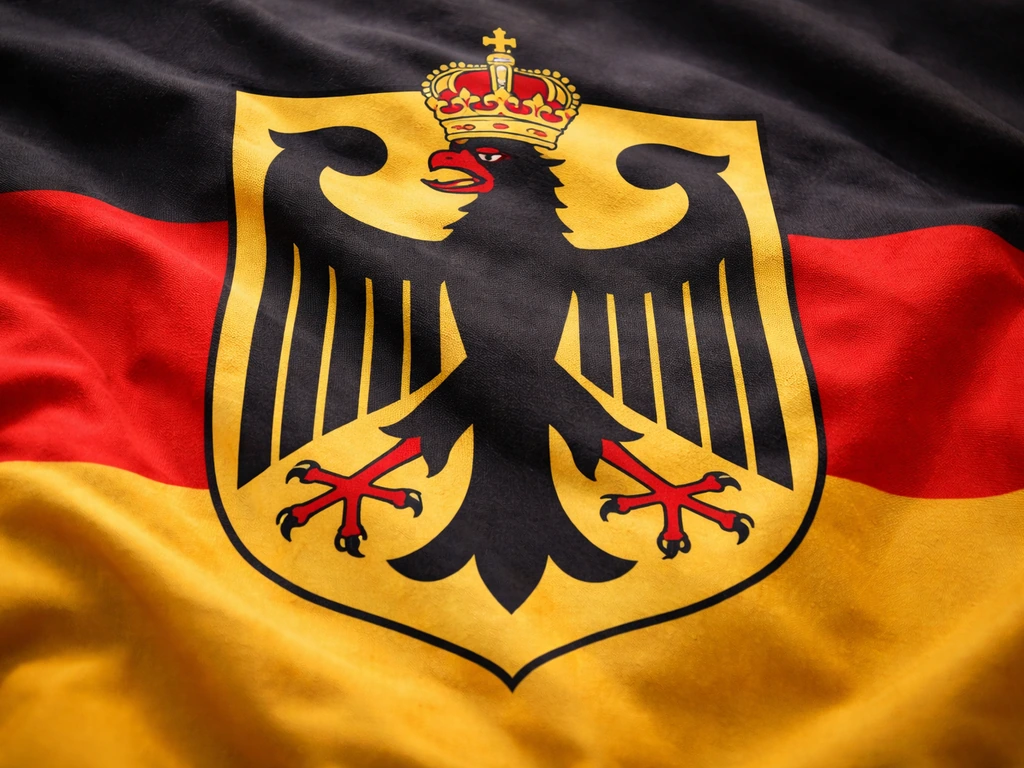
The bird on the Prussian flag is a black eagle, specifically a single-headed black eagle displayed (spread wings) on a white or silver field. This is not the double-headed imperial eagle you might associate with Austria or the Holy Roman Empire. It is one eagle, facing right in heraldic convention, typically crowned and holding royal attributes like a scepter and orb or sword. That is the core answer, and everything else on this page helps you confirm it across different historical versions.
What Bird Is on the Prussian Flag? Identify the Emblem

Marcus Chen
29 Apr 2026
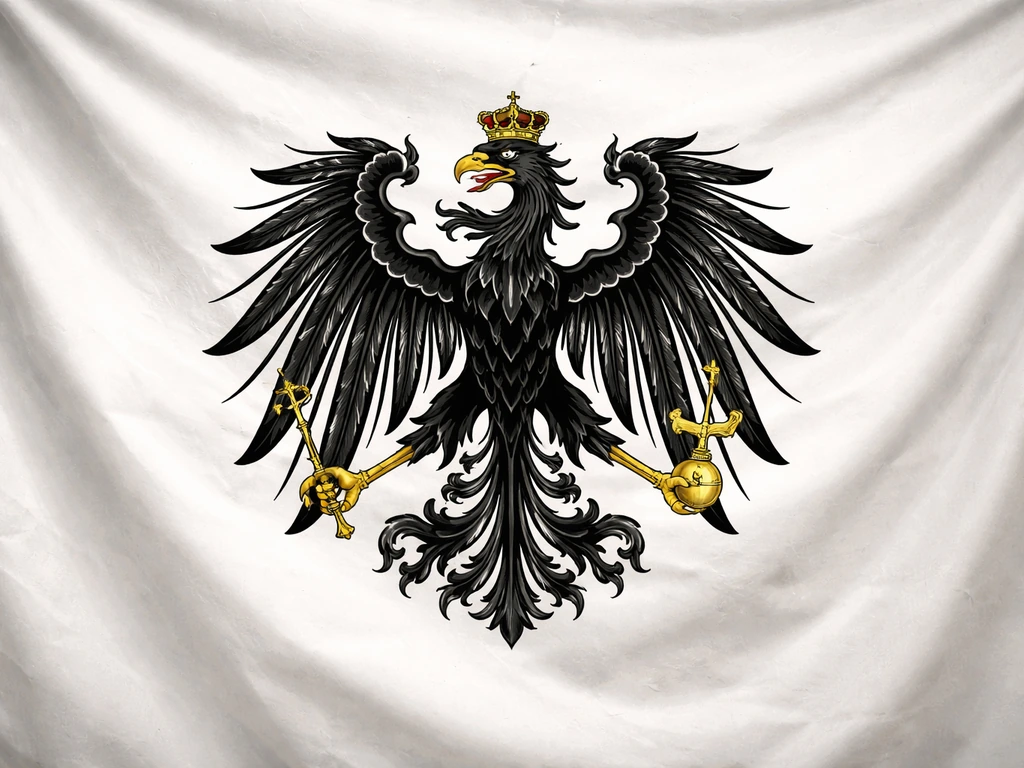
The bird on the Prussian flag: the definitive answer
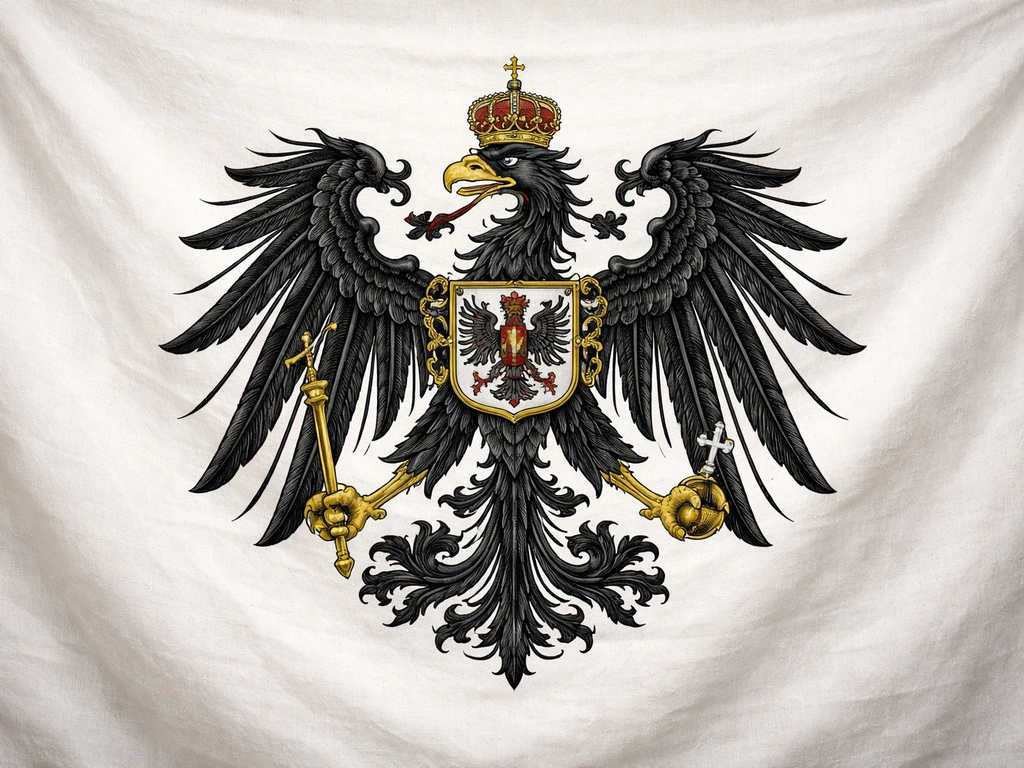
The Prussian coat of arms, which appears on the flag, features a single black eagle on a white (argent) field. In heraldic terms this is described as "a black eagle displayed," meaning wings fully spread and facing the viewer. After Prussia became a kingdom in 1701, royal versions of the eagle gained a crown, a breast shield bearing the monogram "FR" (for Fridericus Rex, King Frederick I), and attributes in the talons such as a scepter and orb. The eagle itself, though, is always the same bird: the black eagle, the defining symbol of Prussian royal identity.
This same eagle appears in Prussia's most famous chivalric honor, the Order of the Black Eagle, founded by Frederick I in 1701. A Cavacopedia reference page on the Order of the Black Eagle describes the badge elements, including the black eagle motif and related royal devices, which can be used as an iconographic cross-check. The order's badge features a black eagle gripping symbols of royal power in its claws, which makes it a reliable cross-reference for what the Prussian eagle is supposed to look like in authentic contexts.
Why it can look different across historical depictions
The Prussian eagle went through meaningful visual changes across roughly two and a half centuries, and that is why you might look at two "Prussian" eagles and think they are different birds. They are not. The Geheimes Staatsarchiv Preußischer Kulturbesitz (Prussia's secret state archive) actually frames this as a research theme, calling the study of these changes "Adlers Fittiche: Wandlungen eines Wappenvogels" (roughly, "Eagle's Wings: Transformations of a Coat-of-Arms Bird"). The core bird stays the same; what changes are the surrounding decorations.
Here are the key moments where the eagle's appearance shifted:
- Pre-1701 (Duchy of Prussia): A simpler black eagle, fewer royal attributes, no crown on the shield.
- After 1701 (Kingdom of Prussia): A royal crown added above the eagle's head, with the "FR" breast shield and scepter/orb in the talons. The style is more elaborate and ceremonial.
- 1871 and the German unification era: A documented revision ("The New Prussian Coat of Arms," August 30, 1871) updated the eagle's talon objects to reflect Prussia's place in the new German Empire.
- Post-1918 (Free State of Prussia): A more stylized, streamlined version of the black eagle, sometimes accompanied by the motto "Gott mit uns," but still unmistakably a single black eagle.
Regimental flags are another source of variation. blank" rel="noopener noreferrer">CRW Flags (Flags of the World) describes the standard Prussian regimental eagle as a "black Prussian flying-type eagle" used since the 18th century, which has a slightly different artistic rendering compared to the formal coat-of-arms version but is still the same heraldic bird.
Visual identification checklist
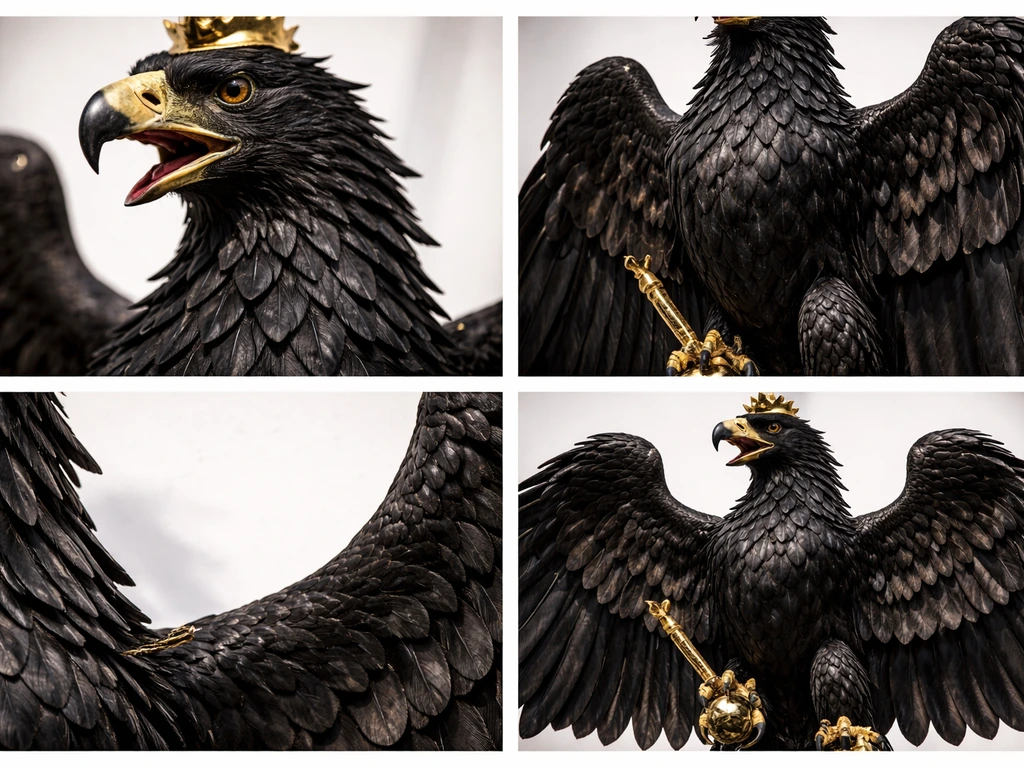
If you are looking at an image and want to confirm it is the Prussian black eagle specifically, check these features one by one:
- Heads: There should be exactly one head. A double-headed eagle is not Prussian; that is an imperial or Austrian tradition.
- Color: The eagle's body should be solid black. The background (field) is traditionally white or silver (argent). A red field with a black eagle points to an earlier variant of the arms but is still Prussian in origin.
- Wings: Fully spread and facing outward (the "displayed" position). The wings are wide and symmetrical.
- Beak and talons: A strong, curved hooked beak typical of an eagle. The talons typically grip a scepter and orb, or a sword and scepter, depending on the period.
- Crown: In royal-era depictions (post-1701), look for a crown above the eagle's head.
- Breast shield: Many common Prussian eagle images show a small shield on the bird's chest with the letters "FR" (Fridericus Rex). This is almost exclusively a Prussian royal marker and helps rule out other eagle traditions.
- Direction: The eagle typically faces to the viewer's left (heraldic right), which is standard for single-headed heraldic eagles.
Where to verify: reliable sources and what to compare
The most authoritative place to verify the Prussian eagle today is the Geheimes Staatsarchiv Preußischer Kulturbesitz in Berlin. Their digitized archival collections include cataloged depictions of the heraldic eagle across different periods. One cataloged item is specifically described as a "Heraldischer Adler, mit Schwert und Zepter, mit Brustschild: FR, darüber Krone" (heraldic eagle with sword and scepter, with breast shield FR, topped with crown), which is essentially the checklist in a single image label.
For a practical online starting point, compare these three sources side by side:
- The Wikipedia article on the "Coat of arms of Prussia" shows the formal blazon and multiple period variants with clear labels.
- CRW Flags (crwflags.com) has a dedicated page on "Kingdom of Prussia 1701-1918" that shows flag variants and describes the eagle attributes in plain English.
- The German History in Documents and Images (GHDI) project includes a primary source entry dated August 30, 1871, describing the updated Prussian coat of arms in detail, which is useful for the post-unification eagle.
When comparing images, always look at the breast shield and the number of heads first. Those two features eliminate most misidentifications immediately.
Prussian symbolism: why the black eagle and what it meant
The black eagle did not appear out of nowhere. Eagles have been associated with German-speaking royal and imperial power since the Holy Roman Empire, where the eagle (Reichsadler) symbolized the emperor's authority derived from ancient Roman tradition. Prussia inherited and adapted this tradition, but made the black eagle specifically its own dynastic symbol tied to the Hohenzollern family.
When Frederick I crowned himself King in Prussia in 1701, he founded the Order of the Black Eagle on the same day, deliberately linking the eagle to Prussian royal identity at the moment of the kingdom's birth. The message was clear: this eagle was not just a generic heraldic bird; it stood for Prussian sovereignty, distinct from both the Holy Roman Empire's imperial eagle and the other German states.
The eagle also carried martial associations. Prussia's military reputation meant the eagle on regimental standards was a symbol of disciplined power. The scepter and orb in the talons balanced that military image with symbols of civil authority, presenting Prussia as both a warrior state and a legitimate kingdom.
This connects to the broader pattern you see across national and state bird symbolism globally. Eagles are almost universally chosen to project strength and authority, but the specific design choices, the color, the attributes, the number of heads, turn a generic eagle into a precise national identity marker. Prussia's single black eagle is as specific and deliberate as the bald eagle of the United States or the white-tailed eagle associated with Polish heraldry. If you are trying to identify the bird on the Polish flag, look for a white eagle on a red field instead of the Prussian black eagle what bird is on the polish flag.
Common mix-ups and how to avoid them
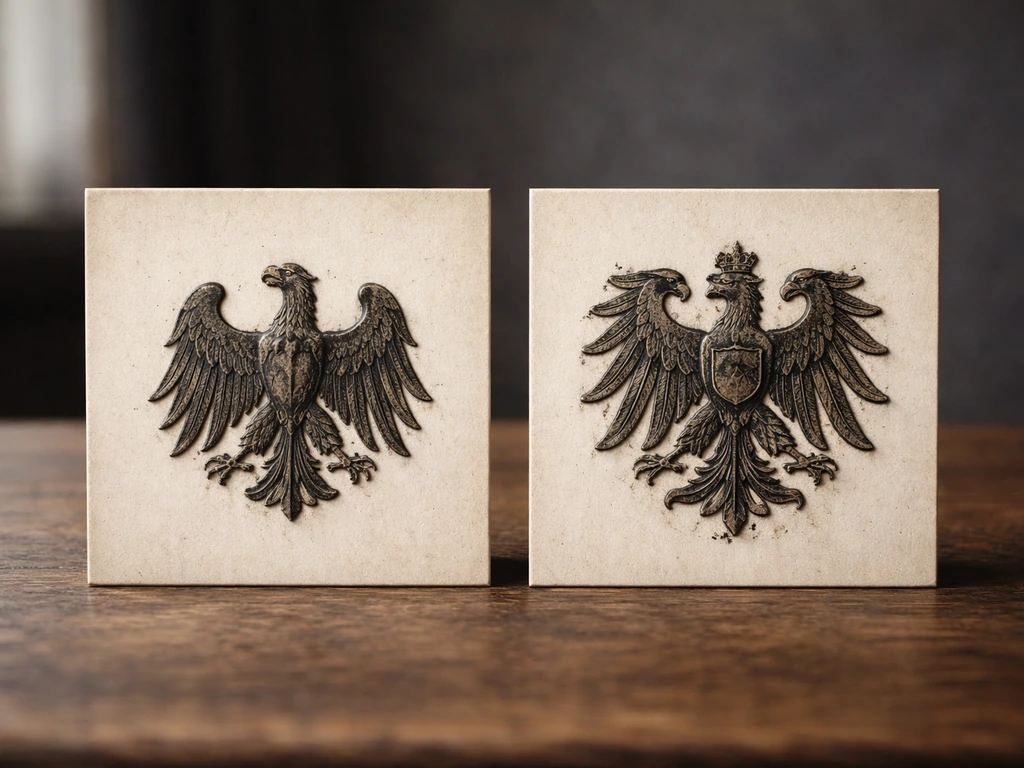
Three mix-ups come up repeatedly when people try to identify the Prussian eagle, and they are all understandable given how many black eagles appear in German and Central European heraldry.
| What you might see | What it actually is | How to tell the difference |
|---|---|---|
| Double-headed black eagle | Imperial eagle (Reichsadler) or Austrian tradition, NOT Prussian | Count the heads. Prussian = one head only. |
| Red eagle on white or silver field | Brandenburg coat of arms (red eagle tradition) | Prussian eagle is black. A red eagle points to Brandenburg, not Prussia proper. |
| Single black eagle without FR breast shield or crown | Could be Prussian (early or simplified) or another German state | Check the period and compare talon attributes. Post-1701 Prussian eagles nearly always have a crown and often the FR shield. |
| Black eagle in the context of the German Empire flag | Reichsadler or Bundesadler tradition, related but distinct | The Prussian eagle has specific royal attributes (FR, scepter/orb). The imperial/federal German eagle is a different named design with its own lineage. |
The Brandenburg red eagle is worth a special mention because Brandenburg-Prussia was the predecessor state to the Kingdom of Prussia, and you will often see both eagles in the same historical document or coat of arms. When Prussia's arms were quartered with other territories, the red Brandenburg eagle appears alongside the black Prussian eagle. That does not make the red eagle "Prussian." The black eagle is the Prussian identifier.
It is also worth knowing that this same confusion between Prussian and broader German heraldic eagles comes up when people look at German national symbols. If you are comparing this with broader German symbolism, you might also be asking what is Germany's national bird and what that would look like.
Germany's own relationship with eagle symbolism is its own topic, as is the question of what appears on the Polish flag, which features a white eagle on a red field, a completely different tradition. If you are asking specifically what bird is on the Serbian flag, that is a different eagle tradition than the Prussian black eagle described here what appears on the Polish flag.
Germany's own relationship with eagle symbolism is its own topic, and you can also look up what is the national bird of Poland to compare how different countries use eagles.
Quick next steps to confirm for yourself today
If you want to lock in the identification right now, here is a straightforward process:
- Pull up the Wikipedia page for "Coat of arms of Prussia" and look at the main image. Note: single head, black eagle, white field, crown, FR breast shield.
- Open CRW Flags and search for "Kingdom of Prussia." Compare the formal coat of arms image with the regimental flag eagle to see how style varies while the core bird stays the same.
- If you have a specific image you are trying to identify, run through the visual checklist above: one head, black body, spread wings, crown (if post-1701), FR shield on chest, scepter/orb or sword in talons.
- If the image fails any of these checks, especially if it has two heads or a red eagle, look up Brandenburg or the Reichsadler instead.
- For archival or museum-quality verification, search the Geheimes Staatsarchiv Preußischer Kulturbesitz digitized collections for "Wappenadler Preußen" to find period-accurate reference images.
The Prussian black eagle is one of the most consistently documented heraldic birds in European history. Once you know what to look for, it is distinctive enough that you will recognize it immediately and stop second-guessing whether you are looking at the right bird.
FAQ
How can I tell the Prussian eagle apart from other black eagles in German heraldry?
Most versions show a single-headed black eagle with fully spread wings, facing right. If you see a black eagle that is double-headed, topped with an imperial-style crown, or holding different power symbols than scepter and orb (or sword), it is likely a different eagle tradition rather than the Prussian one.
Do Prussian regimental flags use the exact same eagle design as the coat of arms?
Yes. In some regimental or artistic depictions the same heraldic eagle looks more like a “flying” eagle, with proportions and wing angles that vary. The safest check is still the breast shield with the FR monogram and the single head.
What role does the field color (white or silver) play in confirming it is the Prussian flag eagle?
Check the background color and what kind of field it is on. The core heraldic version uses a white (argent) or silver field, so if the eagle is on a very different colored field, you may be looking at a later adaptation, quartering, or a non-Prussian use of an eagle motif.
If the eagle’s crown or weapons look different, does that mean it is not the Prussian bird?
The crown, sword, scepter, orb, and breast shield often change between royal, kingdom-era, and later decorative uses. These elements can confirm period and authority style, but they are not the “bird identity” itself, which stays a single-headed black eagle displayed.
When both Brandenburg and Prussia eagles appear in the same artwork, which one is the “Prussian” bird?
Yes, especially in family-quartering and compound arms. If you see both a black eagle and a red eagle together, the red Brandenburg eagle is the separate identifier. The Prussian bird is the black eagle, typically displayed and identifiable by the Prussian heraldic context (often with FR in the breast shield in kingdom-era versions).
What are common mistakes when identifying the bird from blurry or stylized images?
Not always. If the flag or crest is low resolution, the head count can be hard to see, and the difference between “displayed” (wings spread) and a “standing” or “perched” pose can be unclear. In that case, zoom in on the breast area and wings, confirm it is single-headed, then verify any FR breast shield details.
Is there a quick checklist I can use on an unfamiliar image to verify the Prussian eagle?
When the depiction includes a sword and scepter and a crown, that points strongly to a formal heraldic rendering tied to the kingdom-era authority symbols. If you only see a generic eagle silhouette with no consistent Prussian markers, treat it as uncertain until you can confirm the breast shield and head count.
Could the eagle on the Prussian flag be confused with the bird on the Polish flag, and how do I avoid that?
If you are looking at the wrong country symbol, the quickest indicator is the flag’s base color and the bird’s color pattern. The Prussian eagle is a black eagle on a light (white or silver) field, while the Polish emblem is a white eagle on a red field, with a different heraldic tradition.
Next Article
What Bird Is on the German Flag? Eagle Explained
Discover what bird is on the German flag, the heraldic eagle, plus how to confirm it and its symbolism history.