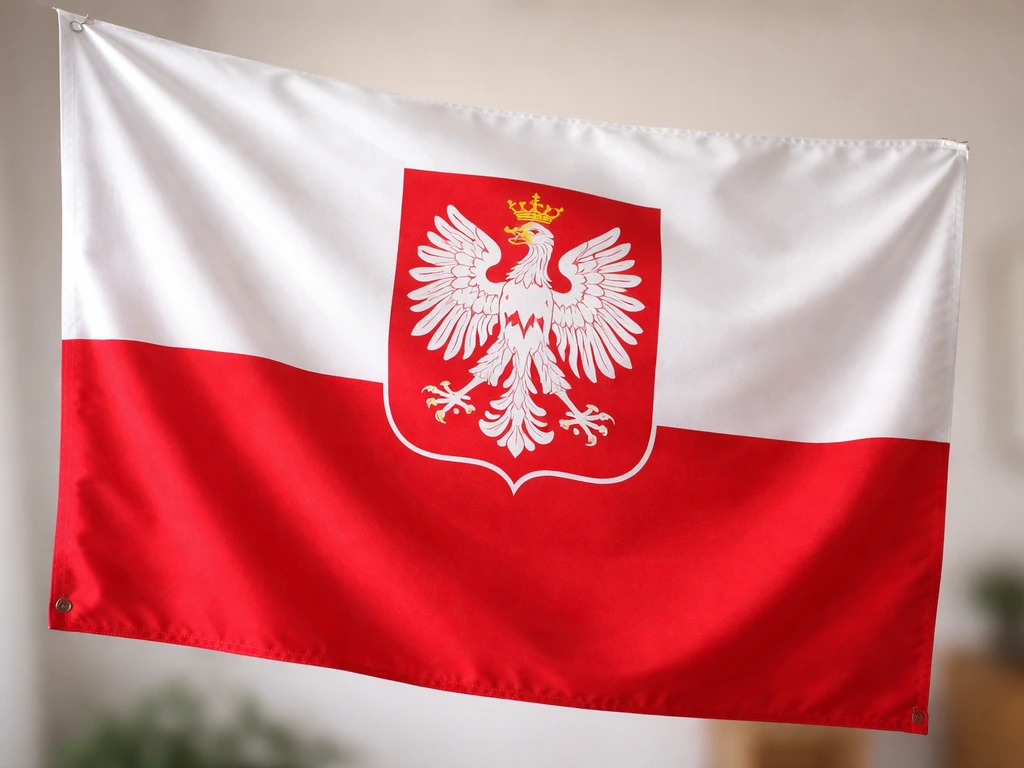
The bird on the Polish flag is a white eagle
The bird on the Polish flag is a white eagle, known in Polish as the "Orzeł Biały" (literally "White Eagle"). It appears not on the plain white-and-red horizontal bicolor that most people picture as "the Polish flag," but on the state flag and official emblem (godło) of Poland. The eagle is depicted in white against a red shield, and that red shield sits at the center of the state version of the flag. If you're looking at a Polish coat of arms, a passport, a government building, or a ceremonial flag, this is the bird you're seeing.
How the emblem works on the flag
Poland actually has two official flags. The civil flag used by ordinary citizens is a plain bicolor: white on top, red on the bottom. The state flag, flown by government institutions and used in official contexts, adds the national emblem to the center of the white stripe. That emblem is a red heraldic shield bearing a white eagle. So the bird doesn't appear on every Polish flag you'll ever see, only on the state version.
The law that governs Poland's national symbols spells out the emblem in precise terms. The official description is: a white eagle with a gold crown on its head turned to the right, with unfolded wings, a gold beak, and gold claws, set on a red shield. "Turned to the right" in heraldic language means the eagle faces the viewer's left (heraldic right is the shield-bearer's right). Every detail, the crown, the color, the direction of the gaze, is legally defined and cannot be casually changed.
Who this eagle is: history and cultural roots
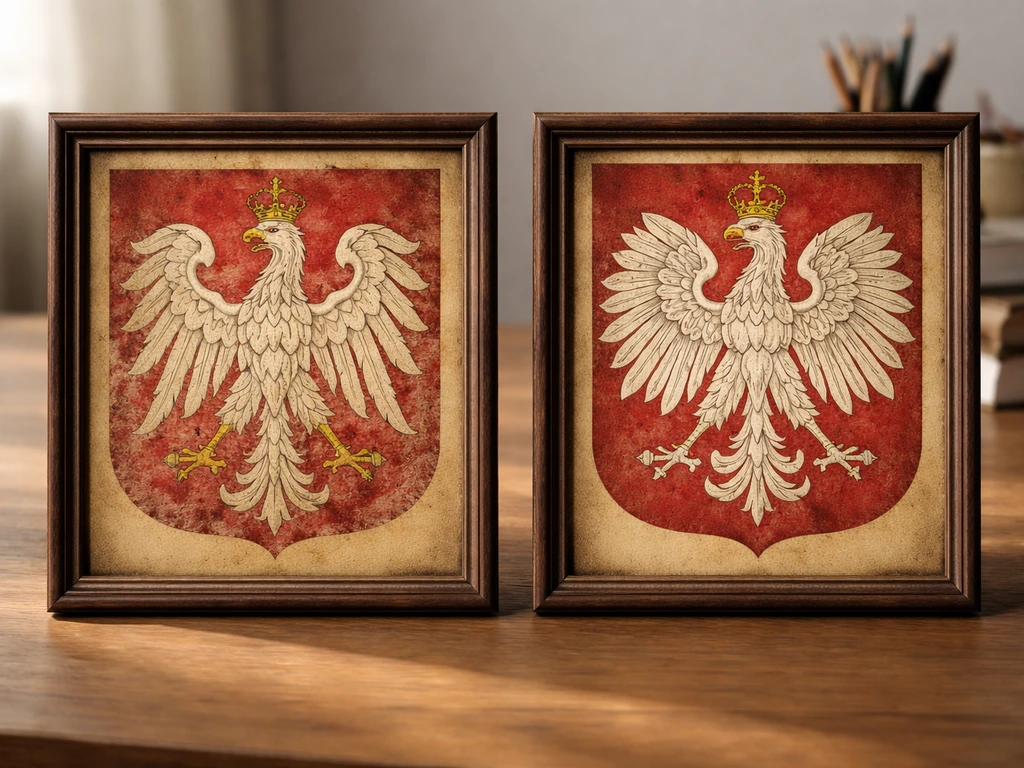
The White Eagle is one of the oldest national symbols in Europe. It has been connected to Polish statehood since at least the 13th century, when it appeared on the blank" rel="noopener noreferrer">seals of the Piast dynasty rulers. blank" rel="noopener noreferrer">The legend most commonly told says that the founder of the Polish state, Lech, came across a white eagle's nest with the bird spreading its wings against the setting sun, the white bird against a red sky, and took it as an omen to build his settlement there. That settlement supposedly became Gniezno, the first capital of Poland.
Whether the legend is historical fact or not, the symbolism stuck. Polish rulers used the eagle on their seals and coins for centuries. Poland's national bird and its emblematic eagle are deeply intertwined, representing sovereignty and continuity across a history that includes long periods when Poland was erased from the map entirely. When Poland was partitioned between Russia, Prussia, and Austria from 1795 to 1918, the White Eagle remained a defiant symbol of Polish national identity. Bringing it back on official emblems at independence in 1918 was a deliberate, powerful statement.
Visual traits that confirm this is an eagle (not another bird)
Heraldic birds can look stylized and unfamiliar, so it helps to know what to look for. The Polish White Eagle has several features that distinguish it from other heraldic birds and from real-world species that people sometimes confuse it with.
- Body shape: broad, powerful chest and thick legs typical of a large raptor, not a slender or long-necked bird
- Wings: fully spread ("displayed" in heraldic terms), with individual feathers often visible at the tips
- Crown: a stylized gold crown sits on the head, a feature unique to the Polish eagle and absent from most other national eagle emblems
- Color: the body is white (or very light), the beak and talons are gold or yellow, and the shield background is red
- Head orientation: the head turns to the viewer's left (heraldic right), a consistent detail across all official versions
- Tail: fanned out at the base, with visible tail feathers
People sometimes confuse the Polish eagle with the double-headed eagles found on other European emblems, including historical German and Russian heraldry. The Polish eagle has one head, not two. It also differs from the black eagle used in German heraldry. If you're curious about that comparison, the bird on the German flag is a black eagle on a yellow background, visually quite different from Poland's white eagle on red. Similarly, the bird on the Prussian flag was also a black eagle, reflecting the shared Germanic heraldic tradition, not the Polish one.
When the design looks different: versions across time and context
One of the most common sources of confusion is that the Polish eagle's design has changed meaningfully across different historical periods and political regimes. If you're looking at an old image and it doesn't quite match what you expected, here's why.
| Period / Version | Key visual difference |
|---|
| Medieval Piast dynasty (13th–14th c.) | Simpler, more naturalistic eagle; crown sometimes absent or minimal |
| Royal Poland (15th–18th c.) | Crown present; more elaborate feather rendering; shield shape varies |
| Second Polish Republic (1919–1939) | Sleeker, more stylized Art Deco-influenced design; crowned |
| People's Republic of Poland (1944–1989) | Crown removed entirely as a deliberate secular-communist decision; eagle looks plainer |
| Third Polish Republic (1989–present) | Crown restored; current legally defined design based on the interwar version |
| Regional and sports uses | Simplified or modernized eagle silhouettes, sometimes without the crown or shield |
The removal of the crown during the communist era is the change that trips people up most often. If you find a Polish eagle without a crown on an older image, that's a communist-era version. The crown was restored in 1990 when Poland re-established its democratic government, and every official version since then includes it. This is also a useful detail if you're comparing Poland's emblem to neighboring countries: Serbia's flag also features a white eagle, but the Serbian eagle is double-headed and styled in a very different heraldic tradition.
Why Poland chose an eagle, and why a white one
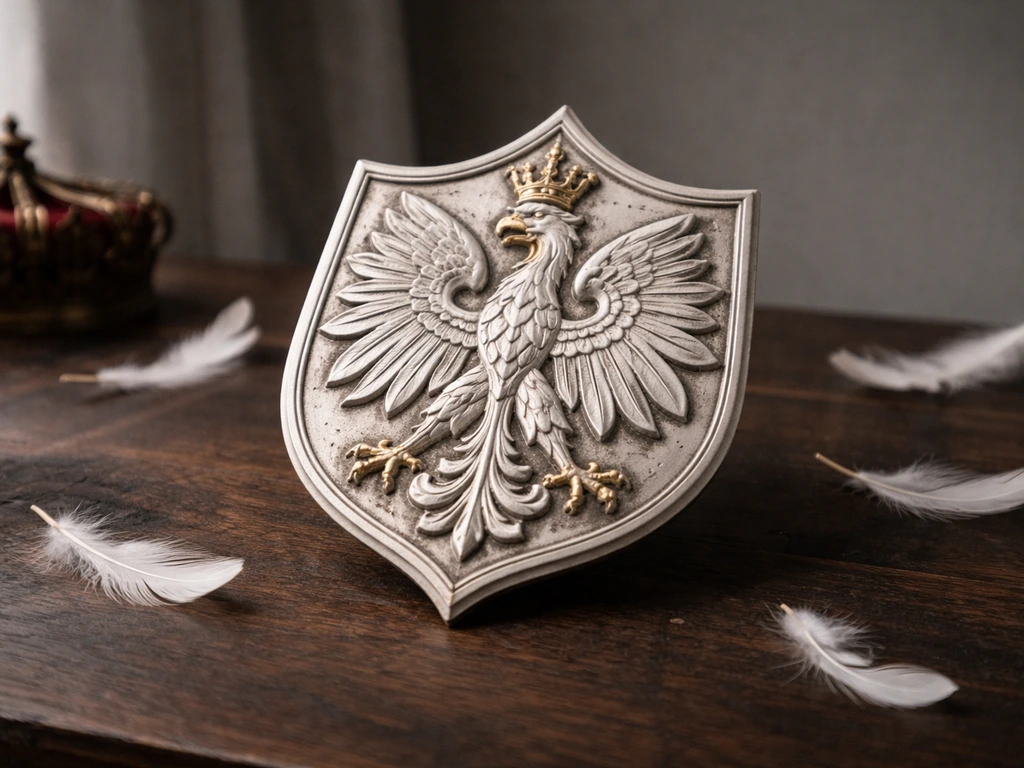
Eagles are ancient symbols of power, sovereignty, and courage across cultures, so the choice of an eagle as a national emblem isn't surprising. What makes Poland's choice distinctive is the specific combination: white body, gold crown, red background. In European heraldry, color combinations carry meaning. White (argent in heraldry) represents purity and peace. Red (gules) represents courage and strength. Gold (or) on the crown signals sovereignty and royal authority.
The eagle as a symbol also fit the political moment of the early Polish kingdom. Eagles were associated with imperial and royal authority across medieval Europe. By adopting a crowned eagle as their central symbol, Polish rulers were placing Poland among the major European kingdoms and asserting their legitimacy. Compared to other countries that use eagles, Poland's eagle has one of the longest continuous (if interrupted) histories as a national symbol.
It's worth noting how Poland's choice compares regionally. Germany's national bird is also an eagle, but black rather than white, and without a crown. The symbolism diverges significantly even though both countries landed on the same species. Poland's white eagle is explicitly royal and Christian in its symbolism; the crown ties it to the tradition of the Polish kings and, in some interpretations, to a Christian worldview where the eagle represents divine protection.
How to verify this yourself right now
You don't need to take anyone's word for it. Here are the most direct ways to confirm what you're seeing and make sure you're looking at an authentic, current version of the Polish emblem.
- Search for "godło Polski" (Polish for "emblem of Poland") in Google Images. This pulls up official and semi-official renderings of the current emblem, making it easy to cross-reference any image you have.
- Check the official website of the Polish Sejm (parliament) or the Polish government portal (gov.pl). Both publish the legally correct version of the emblem alongside its statutory description.
- Look up the Polish Act on the coat of arms, colors, and anthem (Ustawa o godle, barwach i hymnie Rzeczypospolitej Polskiej). The full legal description of the emblem, including every heraldic detail, is available in Polish law databases like ISAP (the Polish legal information system).
- If you're checking a historical image, identify the period first. A crownless eagle almost always means a post-World War II communist-era version, while a crowned eagle is either pre-war or post-1990.
- For a side-by-side comparison of similar eagle emblems across Europe, search for "heraldic eagle comparison Poland Germany Serbia" to immediately see how the Polish white eagle differs from its neighbors.
The bottom line: the bird on the Polish flag is a white eagle, specifically a heraldic eagle depicted in white on a red shield, crowned in gold, with wings spread and head turned right. That description has been legally locked in since 1990 and traces its roots back over 700 years of Polish history. If you see a Polish flag or emblem and you're wondering about the bird, that's your answer.