Jamaica's national bird: the Doctor Bird
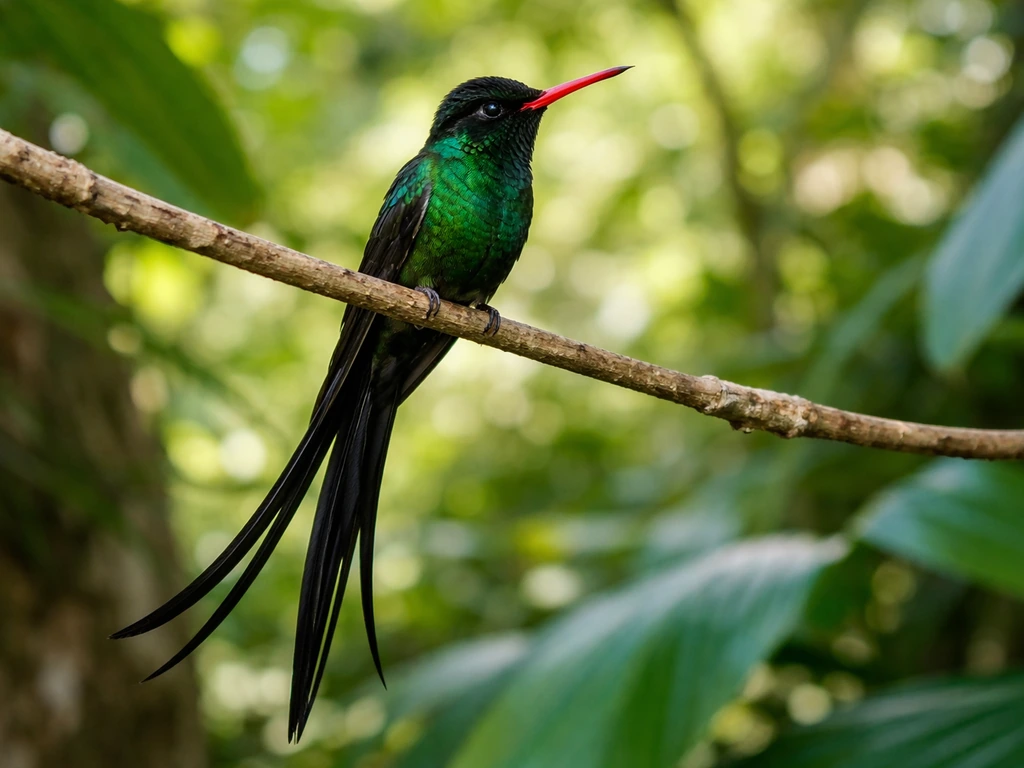
Jamaica's national bird is the Doctor Bird, also known as the Swallow-tail Hummingbird or red-billed streamertail. Its scientific name is Trochilus polytmus. It is one of the most visually striking hummingbirds in the Caribbean, and it lives only in Jamaica, which makes it a genuinely fitting symbol for the island nation.
Why Jamaica picked the Doctor Bird
The Doctor Bird wasn't chosen through a public vote. Unlike Jamaica's national anthem, which came out of a competition held at the end of September 1961, the national bird was selected by a National Flower Committee (a government select committee) whose recommendations were then approved by Cabinet. The committee accepted the Doctor Bird, formally listed as the 'Doctor Bird or Swallow-tail Humming Bird,' as the national bird through that process.
The reasoning behind the choice is easy to understand once you see the bird. It is found nowhere else on earth, it has a look unlike anything else in the hummingbird family, and it had already been woven into Jamaican culture for generations before independence. Choosing it as a national symbol was really just making official what Jamaicans already felt.
What the Doctor Bird means to Jamaican culture
The Doctor Bird has been immortalized in Jamaican folklore and song for decades. That cultural presence predates any formal designation, which is part of what made it such a natural choice for the national symbol role. The bird doesn't just appear on government pages; it shows up in stories and music that ordinary Jamaicans grew up with.
Its symbolism is also tied to freedom and resilience. Jamaican writers and commentators have connected the Doctor Bird to Jamaica's journey to independence, using the image of a bird that escapes traps as a metaphor for Jamaican tenacity and resourcefulness. That kind of layered meaning, rooted in real cultural history rather than invented for a logo, is what gives a national symbol real staying power.
The bird's iridescent feathers play into this symbolism too. The colors it produces have no real counterpart across the broader bird population, which reinforces the idea of Jamaica as something singular and brilliant. You're not looking at a generic tropical bird; you're looking at something that exists only there.
How to identify the Doctor Bird and what makes it interesting
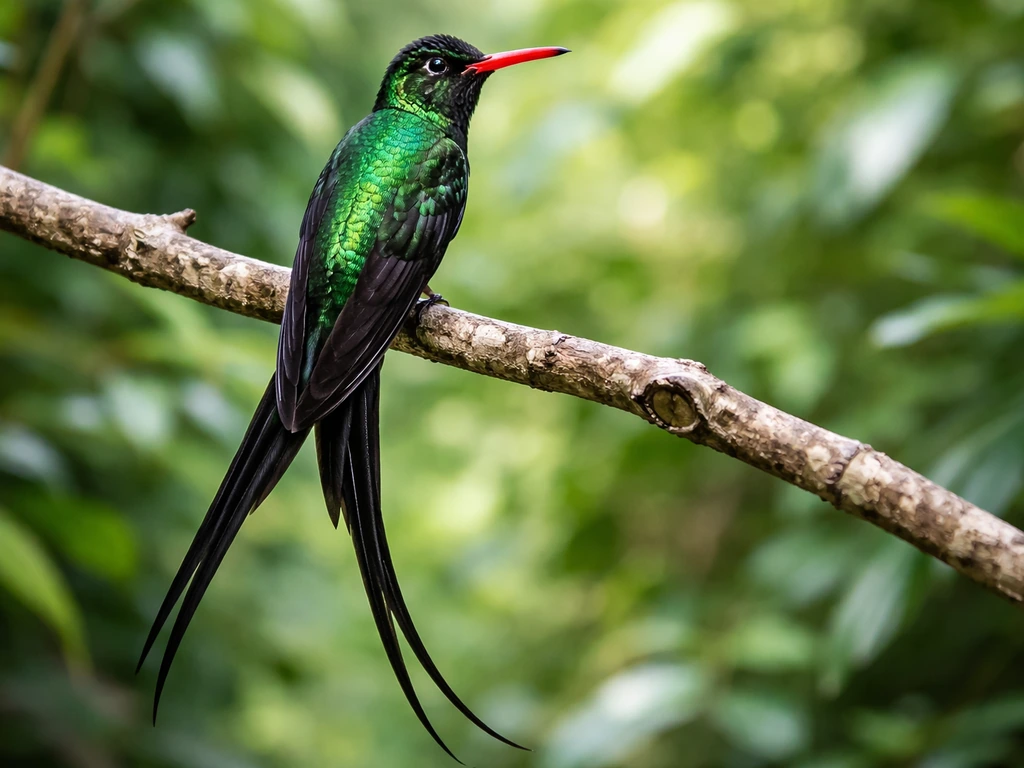
If you're trying to spot one, the male Doctor Bird is not hard to pick out. It is a shiny green hummingbird with a striking black tail and a red bill. What really sets it apart is the length of those tail feathers, which extend well beyond the body and give the bird an elongated, elegant silhouette in flight. That long tail is exactly where the 'swallow-tail' part of its name comes from.
The female looks noticeably different. She lacks the dramatic long tail and usually shows a pink tinge at the base of the lower bill. This is worth knowing if you're trying to identify the species in the field, because without the tail, you need to look at bill color and body shape more carefully.
| Feature | Male | Female |
|---|
| Tail | Very long, streamer-like | Short, no streamers |
| Body color | Shiny green | Shiny green |
| Bill | Red | Red with pink tinge at base of lower bill |
| Overall impression | Dramatic and elongated in flight | More compact, typical hummingbird shape |
Trochilus polytmus is one of around 320 hummingbird species, and it is endemic to Jamaica, meaning you will not find it anywhere else in the world. It is widespread across humid forests on most of the island. A closely related species, T. scitulus, is restricted to the far eastern tip of Jamaica, so if you're birding anywhere outside the extreme east, the Doctor Bird is the one you'll encounter.
A few facts worth knowing
- Scientific name: Trochilus polytmus
- Common names: Doctor Bird, Swallow-tail Hummingbird, red-billed streamertail
- Found only in Jamaica (endemic species)
- The male's long black tail feathers are the most distinctive field mark
- The species is widespread in humid forest across most of the island
- It has appeared in Jamaican folklore and music for many decades
- Selected as national bird by Cabinet-approved committee recommendation
How the selection fits into Jamaica's broader national symbols story
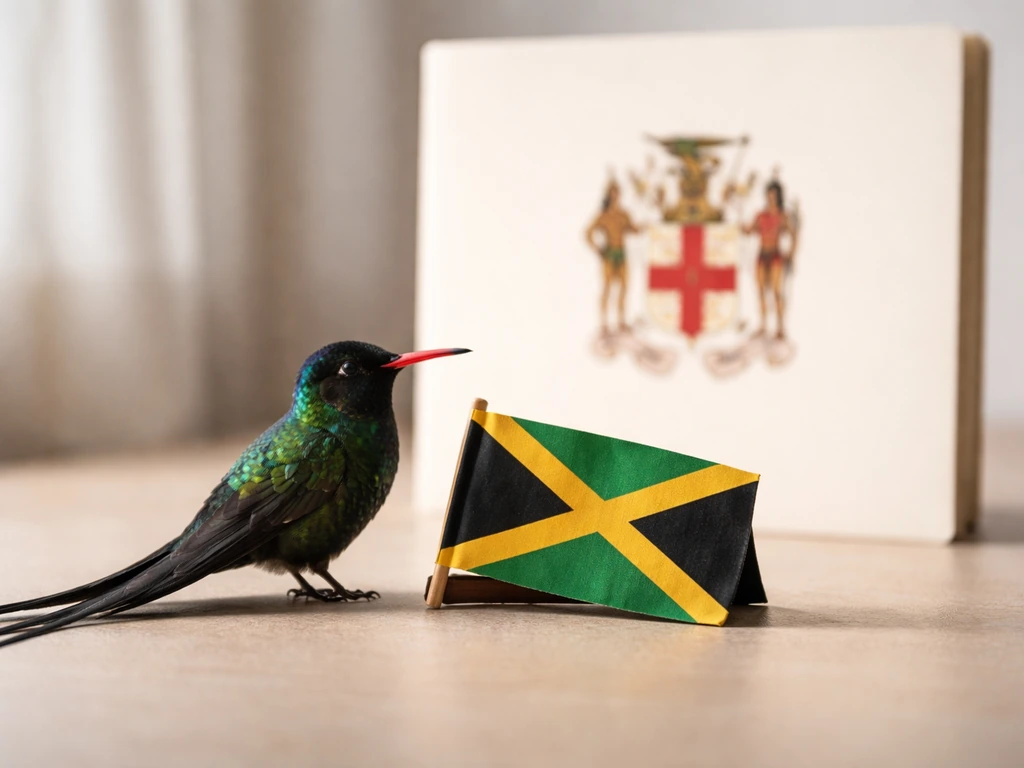
Jamaica's national symbols were established around the time of independence, and the process varied by symbol. The anthem came from a public competition. The flag was designed by a bipartisan committee. But the national bird, flower, tree, and fruit all came through the quieter route of a select committee making formal recommendations to Cabinet. The Doctor Bird's inclusion was accepted as part of that package.
That committee-based process is common across the Caribbean. If you look at how other island nations picked their national birds, you'll see similar patterns. Cuba's national bird, for example, was tied to the country's own identity-building process, and the criteria for selection almost always combine uniqueness, cultural presence, and visual distinctiveness. The Doctor Bird hits all three.
Where to go next if you want to learn more
If the Doctor Bird sparked your curiosity about Caribbean national birds more broadly, there's a lot of interesting ground nearby. Haiti's national bird is another great example of how island nations in the region use birds to express national identity, and the story behind it is worth reading. Similarly, if you want to see how the selection process played out on a neighboring island, learning about the national bird of the Dominican Republic gives a useful comparison, since Hispaniola sits just west of Jamaica's region of influence.
The wider Caribbean picture includes some genuinely fascinating choices. Puerto Rico's national bird has its own layered history involving legislative debate and questions of scientific naming, which is a different angle on how these symbols get formalized. And if you're interested in how smaller island nations make these decisions, the national bird of the Bahamas is another entry point into that conversation.
For the Doctor Bird specifically, the Office of the Prime Minister of Jamaica maintains an official national symbols page that covers the cultural and identifying details of the bird. If you want to go deeper on field identification, species accounts that cover the red-billed streamertail include both photo references and habitat notes that are useful whether you're planning a trip to Jamaica or just trying to understand the species better.