Colombia's national bird: the Andean condor
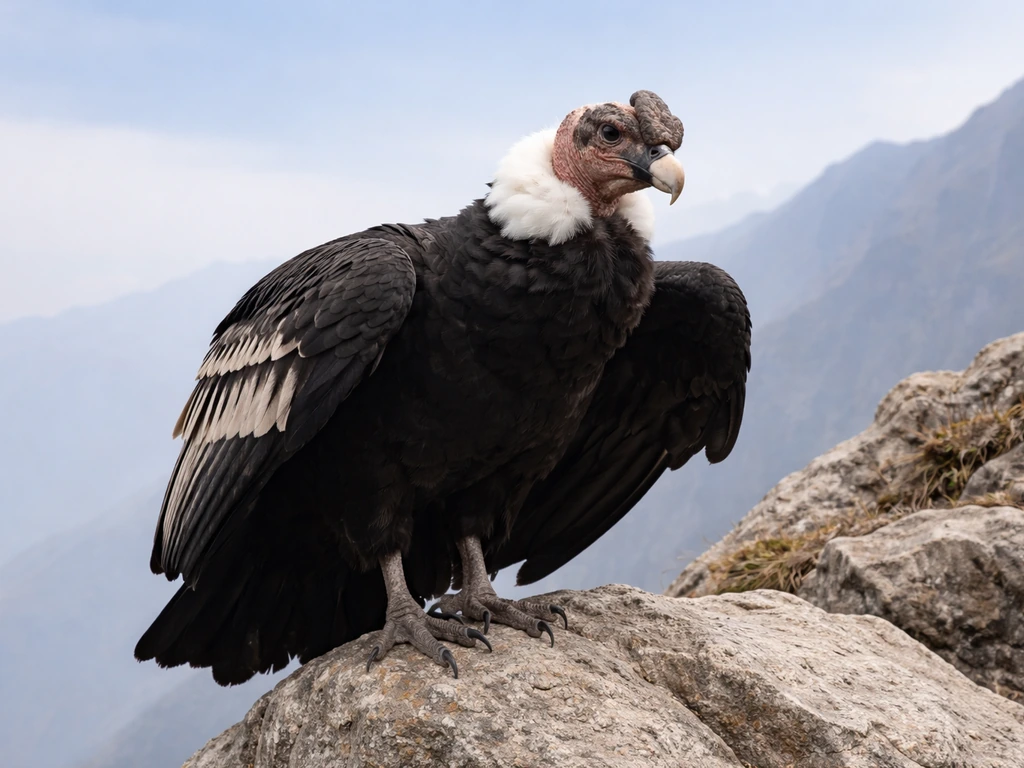
Colombia's national bird is the Andean condor (Vultur gryphus). This is confirmed by Colombia's own Ministry of Foreign Affairs (Cancillería), which lists the Andean condor as one of the country's official national symbols. There is no ambiguity here: the condor is the bird.
If you just needed the name, there it is. But the more interesting question is why Colombia chose this particular bird, what it means to Colombians, and how it fits into the country's broader identity. That's what the rest of this article covers.
Where the condor sits in Colombia's national symbols

The Andean condor doesn't just get a label as the national bird and stop there. It actually appears on Colombia's coat of arms, perched at the top of the national shield. That makes it one of the few national birds that is literally embedded in a country's official government emblem, not just named in a decree. Every time you see an official Colombian government document bearing the national seal, the condor is right there at the crest.
Colombia's national symbols are governed by Decree 1967 of 1991, which outlines how the flag, coat of arms, and national anthem are to be used. The condor's place in the coat of arms gives it a level of official visibility that goes beyond most national bird designations around the world.
Why the condor? Symbolism and cultural meaning
The Andean condor has been tied to ideas of freedom ("libertad") and sovereignty ("soberanía") in Colombian symbolism. Those are not accidental choices. The condor soars at extreme altitudes over the Andes, appearing to move freely above everything else. For a country that fought hard for independence in the early 19th century, that image carried real meaning.
The condor's cultural weight also runs much deeper than Colombian nationhood. It has been a powerful symbol in Andean mythology for centuries, associated with health and immortality across indigenous Andean cultures, including Inca mythology. The Universidad Nacional de Colombia's natural history museum connects this long indigenous symbolism to the condor's modern role as a national emblem. When Colombian national identity was being constructed after independence, drawing on a bird that already meant something profound to the people of the Andes made cultural sense.
Colombia's Ministry of Environment also frames the Andean condor as an "especie emblemática" (emblematic species), meaning its status as a national symbol reinforces the country's connection to its natural landscape, especially the Andean region. The bird is not just a flag-waving symbol; it represents the ecological and geographic heart of the country.
How and when Colombia chose the condor

The commonly cited story is that the Andean condor was proposed as a national symbol ("símbolo patrio") in 1834, connected to the political leadership of Francisco de Paula Santander. Several sources, including Colombian news reporting from El Tiempo, reference this 1834 timeframe, and it lines up with the broader period when Colombia's new republic was formalizing its national identity and symbols.
It's worth being honest about the historical record here: the 1834 date is widely cited and commonly accepted in Colombian public discourse, but the official Cancillería national symbols page does not spell out a specific legislative act or date for the condor's designation as national bird. What Cancillería does clearly state is that the Andean condor has been adopted as the national bird. The condor's prominent placement on the coat of arms, which has deep historical roots, is the most concrete and unambiguous evidence of its official status.
Quick facts: recognizing the Andean condor
| Feature | Detail |
|---|
| Scientific name | Vultur gryphus |
| Wingspan | Up to 3.2 meters (10.5 feet), one of the largest wingspans of any flying bird |
| Plumage | Mostly black with white patches on the wings; bare head and neck (pinkish-red in adults) |
| Size | Among the heaviest flying birds; males are noticeably larger than females |
| Habitat | High Andean mountain ranges; less common in the northern Andes, including Colombia |
| Conservation status | Vulnerable; population in Colombia has declined significantly |
| Shared national symbol | Also the national bird of Bolivia, Chile, Ecuador, and Peru |
One thing worth knowing: the condor is not easy to spot in Colombia anymore. Its population in the northern Andes, which includes Colombia, has declined significantly compared to its strongholds further south. There are active conservation programs run by the Colombian government specifically to protect and restore condor populations. Colombia's Ministry of Environment has a dedicated national conservation program for the species, treating it as a priority partly because of its emblematic status.
The condor as a shared Andean symbol
Something that surprises a lot of people: Colombia is not the only country that claims the Andean condor as its national bird. Bolivia, Chile, Ecuador, and Peru all share this symbol. That makes it one of the most "shared" national bird choices in the world. Each country frames the condor's meaning slightly differently through its own national history and culture, but the underlying symbolism of freedom, power, and Andean identity runs through all of them.
Not every South American country went with the condor, though. Peru's national bird situation is interesting because while the condor is sometimes cited for Peru, the Andean cock-of-the-rock (Rupicola peruvianus) is also recognized as a national symbol there. And if you look at Chile's national bird, you'll find the condor again, but framed through a distinctly Chilean cultural lens. The regional pattern is worth exploring if you want to understand how Andean countries constructed their national identities after independence.
Where to go next
If you want to dig deeper into Colombia's national bird and related symbolism, here are practical next steps:
- Start with Colombia's official Cancillería national symbols page (cancilleria.gov.co). It's the most authoritative source for how the Colombian government presents its national symbols, including the condor.
- Check Colombia's Ministry of Environment (MinAmbiente) national conservation program for the Andean condor (Vultur gryphus). The 2006 program document is detailed and covers both the species' ecological status and its cultural importance as an emblematic species.
- The Universidad Nacional de Colombia's natural history museum has accessible content connecting Andean mythology and the condor's cultural history, which is useful if you want the deeper cultural background.
- For species identification and behavior, the Peregrine Fund and RaptorTAG both maintain species profiles with solid scientific grounding.
- For broader regional context, explore how neighboring countries use the condor or other birds as national symbols.
On the regional comparison front, it's worth looking at how other South American countries have approached their national bird choices. Brazil's national bird is a completely different story from the condor-heavy Andean tradition, and so is Argentina's national bird, which gives you a sense of just how differently these neighboring nations have chosen to represent themselves through avian symbols.
The Andean condor is one of the most powerful and recognizable national bird choices anywhere in the world. For Colombia, it connects national pride to geography, indigenous heritage, and the hard-won independence of the early 19th century, all in a single image of a massive bird riding thermals above the Andes.