
The national bird of the Maldives is the white-breasted waterhen, known locally in Dhivehi as 'Kan'bili' or 'Dhivehi Kan'bili. In the Live & Learn Maldives bird guide, the national-bird entry is listed as “White-breasted Waterhen / Maldivian Waterhen,” with scientific name Amaurornis phoenicurus maldivus and Dhivehi name “Dhivehi Kan’bili.”. ' Its scientific name is Amaurornis phoenicurus maldivus, a subspecies specific to the Maldives. This designation is confirmed by the Maldives government's own environmental documents and the country's Protected Areas species pages.
What Is the National Bird of Maldives? Answer and Meaning

Marcus Chen
15 May 2026
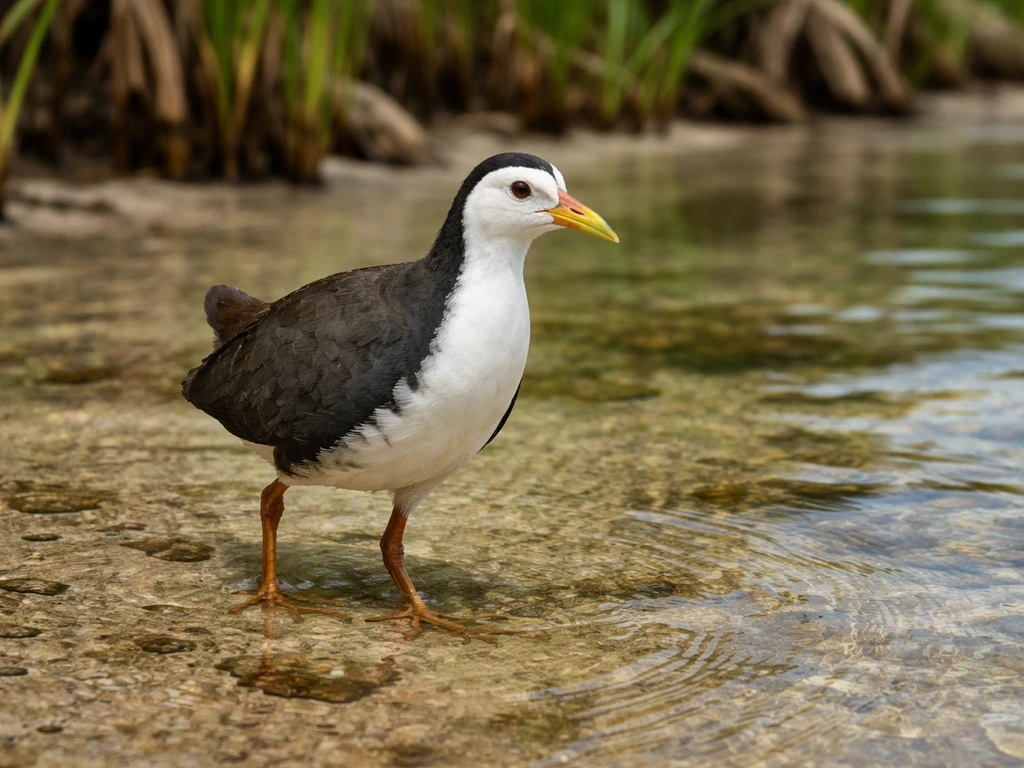
What exactly is the white-breasted waterhen?
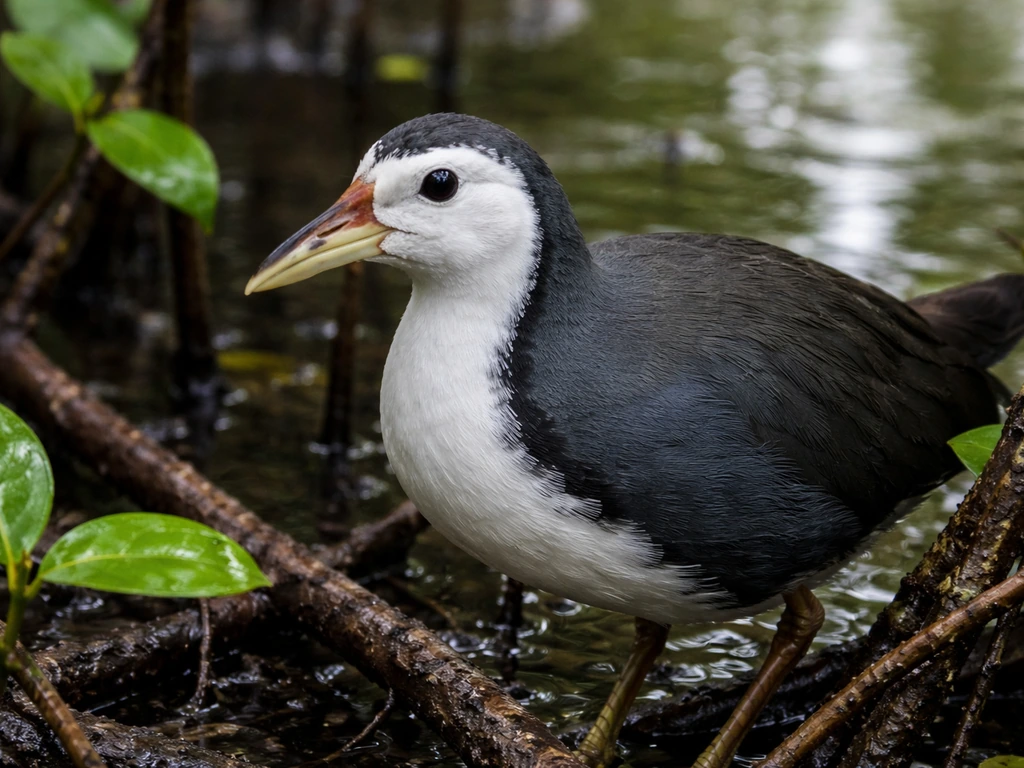
The white-breasted waterhen belongs to the rail and crake family, a group of birds associated with wetlands and dense undergrowth. The Maldivian subspecies, Amaurornis phoenicurus maldivus, is a medium-sized bird measuring around 33 cm in length. It has a distinctive look that makes it easier to identify than most waterbirds.
- White face and belly, contrasting sharply with a dark greyish-black nape, back, and wings
- A chestnut-red or rusty patch under the tail (the undertail coverts)
- A yellow-green bill and legs
- Long toes and a short tail; when it flies, its legs dangle loosely below its body
- Juveniles look similar to adults but noticeably duller in color
In terms of behavior, the Kan'bili is a ground forager but it can also move into bushes and small trees. On land it flattens its body to squeeze through dense undergrowth, which is a neat adaptation for navigating the thick vegetation around Maldivian wetlands. Its diet is varied: small insects, fish, molluscs, and plant matter all feature on the menu.
Why the Kan'bili was chosen as the national bird
The most compelling reason the Maldivian waterhen holds national bird status comes down to presence. An environmental research report on breeding and migratory birds in the Maldives notes that the white-breasted waterhen blank" rel="noopener noreferrer">occurs on almost every island throughout the archipelago, and that widespread presence is directly cited as part of the rationale for its recognition as the national bird. A bird that shows up consistently across hundreds of islands, from the northernmost atolls to the southernmost, carries a natural claim to represent the nation.
Beyond sheer distribution, the Kan'bili is embedded in the local identity of island communities. Its Dhivehi name reflects a longstanding familiarity, and its connection to the mangroves and wetlands that define so much of Maldivian natural life makes it a genuinely fitting emblem. Unlike birds chosen for dramatic plumage or mythological associations alone, the Kan'bili earns its status by being a real, present part of everyday Maldivian island ecology.
Where it lives and what life looks like for it in the Maldives
The Maldivian waterhen thrives in dense undergrowth near fresh and brackish water. Mangroves are a core habitat, along with grass and shrub lands at the edges of wetlands. If you spend time in the vegetated interior of Maldivian islands rather than just the resort beaches, there is a good chance you will hear one before you see it. Rails and waterhens are notoriously secretive in thick cover.
One interesting aspect of this bird's life in the Maldives is that it breeds throughout the year, which is uncommon among birds in temperate regions. It builds its nest from twigs, stems, and leaves, typically positioned one to two meters above the ground among reeds or dense undergrowth. Year-round breeding aligns well with the Maldives' consistent tropical climate, where the concept of a distinct breeding 'season' is much looser than in cooler latitudes.
How the designation was established and how to verify it

The Maldives government's Protected Areas species page explicitly identifies Amaurornis phoenicurus maldivus as 'the national bird of the Maldives,' complete with the local name and a summary of its physical traits. A separate government-hosted PDF titled 'Initial Environmental Examination,' produced under the environment.gov.mv domain, states the same designation plainly: 'The national bird of the Maldives is the white-breasted waterhen (Dhivehi: Kanbili).' These are official government sources, not just third-party claims.
The bird is also protected under Law 4/93, the Maldives Environment Protection and Preservation Act. Under this law, capturing, selling, or keeping the Kan'bili is forbidden. That legal protection reinforces its status as a nationally significant species, not just an informally recognized one. If you want to cross-check further, the Maldives National Red List of Threatened Species, also hosted by environment.gov.mv, provides the formal taxonomy and conservation status for the subspecies.
| Source type | What it confirms |
|---|---|
| Maldives Protected Areas species page (government) | Names Amaurornis phoenicurus maldivus as the national bird with local name and trait description |
| Initial Environmental Examination PDF (environment.gov.mv) | States explicitly: 'The national bird of the Maldives is the white-breasted waterhen (Kanbili)' |
| Live & Learn Maldives bird guide (field guide) | Lists Dhivehi name, scientific name, ID features, habitat, and protection under Law 4/93 |
| Ocean Country Partnership / ERA report | Notes occurrence on almost every island and links that to the national-bird recognition |
| Maldives National Red List (environment.gov.mv) | Useful for verifying taxonomy and conservation status of the subspecies |
Quick facts and mix-ups worth knowing
One confusion that comes up: the Maldivian waterhen is a subspecies, not the full species. When people search for the white-breasted waterhen in general, they land on the broader species Amaurornis phoenicurus, which is found across a wide range of South and Southeast Asia. The Maldives' national bird is specifically the Maldivian subspecies, Amaurornis phoenicurus maldivus. The size, plumage, and behavioral descriptions in the local guides help confirm which one you are looking at.
Another common mix-up: people sometimes wonder whether the Maldives has a 'national emblem bird' versus a 'national bird,' thinking these might be different things. In the Maldivian context, the white-breasted waterhen is consistently referenced across government and field sources as the national bird, full stop. There is no separate 'state bird' distinction as you might find in a federal country.
- Common name: White-breasted waterhen / Maldivian waterhen
- Dhivehi name: Kan'bili (also written as Dhivehi Kan'bili)
- Scientific name: Amaurornis phoenicurus maldivus
- Size: approximately 33 cm
- Key field marks: white face and belly, dark back, chestnut undertail, yellow-green bill and legs
- Habitat: mangroves, wetlands, dense undergrowth near fresh or brackish water
- Breeds year-round in the Maldives
- Found on almost every island in the archipelago
- Protected under Law 4/93 — capturing or selling the bird is illegal
If you enjoy comparing national birds across Asia, it is worth noting that neighboring countries in the broader region have made very different choices. Nepal, Thailand, Vietnam, Afghanistan, and Myanmar each have their own national bird with distinct cultural reasoning behind the selection. If you are looking for Myanmar specifically, its national bird is the Bengal florican Myanmar each have their own national bird. Afghanistan’s national bird is the Afghan snowfinch (Montifringilla theresae). If you are specifically looking for Vietnam, its national bird is the red junglefowl what is the national bird of vietnam. Thailand’s national bird is the Siamese fireback, a colorful forest bird native to the region. Nepal’s national bird is the Danphe (the Himalayan monal). The Maldives stands out because its choice is tied so directly to a bird that is genuinely native and endemic at the subspecies level, rather than a more charismatic or mythologically loaded species. That grounded, practical logic is part of what makes the Kan'bili an interesting case in the world of national bird designations.
FAQ
Is the national bird of Maldives the same as the general white-breasted waterhen species found in other countries?
In the Maldives, the national bird designation specifically refers to the Maldivian subspecies of the white-breasted waterhen (Amaurornis phoenicurus maldivus), not the broader South and Southeast Asian species.
Can I legally keep or sell the national bird of Maldives if I find one?
It is commonly protected, but the practical rule is that you should not capture, sell, keep, or trade the Kan'bili. If you see “rehoming” or “pet” listings online, treat them as a red flag because possession is covered by the environment protection law.
Where in the Maldives is the Kan'bili most likely to be found (and is it only on certain islands)?
The Maldives’ national bird is not an island-only visitor. It is reported as occurring across almost every island in the archipelago, so you are more likely to encounter it on a day trip inland or near vegetated wet areas than only at specific hotspots.
Why is it hard to spot the Kan'bili, even if it is supposedly common?
Because it lives in thick reeds, mangroves, and dense undergrowth, it is often easier to detect by sound first. The bird can “go flat” and move through cover, so brief scans of movement and listening near wet edges can work better than relying on sightings alone.
How can I avoid misidentifying the Kan'bili when using generic bird guides?
“Kan'bili” and the scientific name refer to the Maldivian subspecies. If you use field guides that show the wider species, you can misidentify it, so match the bird’s size and plumage notes from Maldivian sources rather than only the genus or family.
Does the national bird of the Maldives breed only in a specific season, and when is nesting likely?
The bird breeds year-round, and nests are typically placed around 1 to 2 meters above ground in reeds or dense undergrowth. If you visit in any month, assume nesting may be possible, and avoid disturbing vegetation in likely nest areas.
What habitat should I target if I want the best chance to hear or see the Kan'bili?
For birders, focus on fresh and brackish water edges, mangroves, and scrubby wetland margins, especially away from busy resort shorelines. If you are only scanning open beaches, you are likely to miss the rail-like behavior of staying concealed in cover.
Is there a separate national emblem bird in the Maldives, or is it the same as the national bird?
National bird vs national emblem bird is not treated as a separate category in the Maldives’ official references. The white-breasted waterhen is consistently described as “the national bird,” without a distinct “state emblem bird” alternative.
Next Articles

What Is the National Bird of Myanmar? (Answer + Meaning)
Discover Myanmar’s national bird, its meaning and symbolism, plus tips to verify the official name online.
What Is the National Bird of Afghanistan? Facts and Story
Discover Afghanistan’s national bird, its official and common names, plus the history and symbolism behind its emblem.
What Is the National Bird of Vietnam? Meaning and Facts
National bird of Vietnam is the red-headed crane, symbolizing longevity and peace, with history and verification tips.