New Zealand's national bird: the kiwi
New Zealand's national bird is the kiwi. That's the short answer, and virtually every major New Zealand cultural and educational institution agrees on it. Te Ara (the Encyclopedia of New Zealand) explicitly frames the kiwi as "New Zealand's national bird," and Te Papa, the country's national museum, uses the phrasing "Kiwi – the national bird of Aotearoa New Zealand." If you've seen conflicting or hedged wording across sources, there's a good reason for that, which I'll explain below.
What "national bird" actually means here
This is where things get a little nuanced. New Zealand does not appear to have a formal statutory declaration, meaning no single government act has legally designated the kiwi as the official national bird in the way some countries do. What the kiwi has is something arguably more powerful: near-universal symbolic recognition. NZ History (Manatū Taonga, the Ministry for Culture and Heritage) documents the kiwi's history as an "unofficial national symbol" rather than pointing to any legislative act. So when you see sources call it the national bird, they're reflecting a deeply embedded cultural reality, not a legal title.
This distinction matters if you're doing research or writing a school report. The kiwi is safe to call New Zealand's national bird, just understand that the designation is emblematic rather than statutory. Think of it like many national symbols around the world: widely recognized, institutionally endorsed, and culturally definitive, but not always backed by a specific law.
How the kiwi became a national symbol

The kiwi's rise as a national emblem is a relatively recent story. Te Ara traces one of its earliest formal uses as a symbol to after 1911, when the kiwi appeared in the badge of the 2nd South Canterbury (Territorial) Regiment. That military connection turned out to be a launching pad for much wider recognition.
The real turning point came during World War I. New Zealand soldiers serving overseas became known as "Kiwis," and the bird's image traveled with them. One of the most vivid examples is a giant kiwi carved into the chalk hillside above Sling Camp in England by New Zealand troops. That carving, visible from a distance, became a striking piece of living national identity planted on foreign soil.
From there, the symbol kept growing. New Zealand's national bird that cannot fly had become, somewhat paradoxically, one of the most recognizable emblems of a proud, far-traveling people. By the 1940s through the 1980s, the kiwi was firmly confirmed as a symbol not just of the country but of its people. Today the image appears on everything from coins and passports to sports logos and conservation campaigns.
Why the kiwi? Symbolism and cultural meaning
Te Ara acknowledges that the kiwi is an "unlikely choice" for a national emblem. It's nocturnal, flightless, and you'd rarely spot one in the wild without serious effort. So why did it resonate so deeply?
Part of the answer is that the kiwi is genuinely unique to New Zealand. It exists nowhere else on Earth, which makes it a natural stand-in for the idea of a distinct national identity. If you want to understand the full depth of that connection, why the kiwi bird is so important to New Zealand goes into the cultural and ecological dimensions in real detail.
There's also something appealing about a bird that thrives on its own terms. The kiwi doesn't need to fly. It's built for its own environment, quietly persistent, and surprisingly tough. For New Zealanders, that image maps neatly onto a national self-perception of resilience and independence. The kiwi became shorthand for the people themselves, which is why a New Zealander abroad is still commonly called a "Kiwi."
Key facts about the kiwi

Species and identity
"The kiwi" isn't a single species but a group of related flightless birds in the genus Apteryx. There are several distinct species, and it's worth knowing the differences if you're going beyond surface-level research. The great spotted kiwi (Apteryx haastii), also called roroa, is the largest of the group, standing about 45 cm tall, and lives in subalpine conditions. The Northland brown kiwi occupies a very different habitat, with its likely range running through Northland from the Aupōuri Peninsula south toward the Auckland region.
Biology and behavior
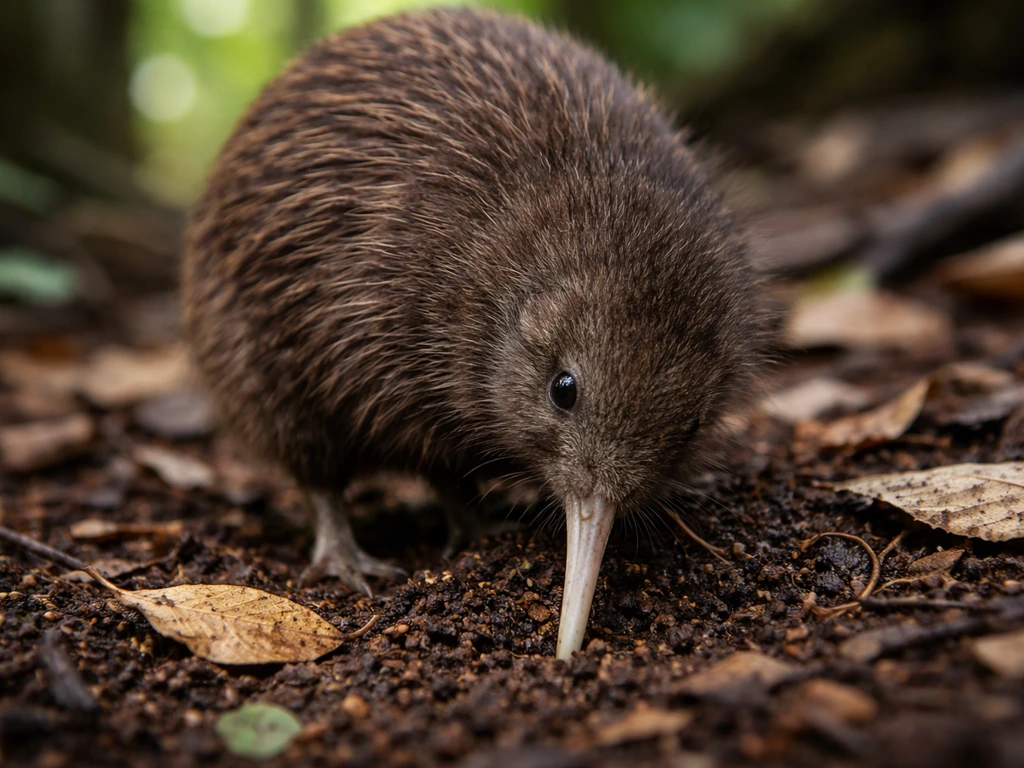
Kiwi are nocturnal and territorial. Their diet consists predominantly of invertebrates: insect larvae, wētā, crickets, and centipedes, which they locate using a long, sensitive bill that has nostrils at the tip, a feature unique among birds. They're also one of the few birds with a strong sense of smell. Because they're active at night, the New Zealand Department of Conservation (DOC) notes that for many people, the only practical way to see a kiwi is in a nocturnal house at a captive wildlife facility.
Where kiwi live
Kiwi are found across New Zealand's two main islands and several offshore islands, with different species occupying different zones. DOC runs active kiwi recovery programs including habitat restoration and distribution monitoring. Kiwi sanctuaries exist across the country, and if seeing one in person is on your list, checking DOC's current kiwi recovery page will point you to the best options.
| Species | Common name | Key habitat | Approx. size |
|---|
| Apteryx haastii | Great spotted kiwi / roroa | Subalpine zones | Largest; ~45 cm tall |
| Apteryx mantelli | North Island brown kiwi | Northland to Auckland region | Medium |
| Apteryx australis | Southern brown kiwi / tokoeka | Fiordland and Stewart Island | Medium to large |
| Apteryx owenii | Little spotted kiwi | Offshore island sanctuaries | Smallest |
Where to verify and keep learning
If you need to confirm the kiwi's national bird status for a project or just want to go deeper, these are the sources worth going to directly. Te Ara's encyclopedia entry on the kiwi covers both the national emblem history and natural history in one place. Te Papa's public-facing page on the kiwi as national bird is clear and well-sourced. NZ History (Manatū Taonga) is the best place to explore how and when the kiwi entered public use as a national symbol. For species ecology, conservation status, and where to find kiwi in the wild or in captivity, DOC's kiwi recovery pages are the definitive current source.
It's also worth knowing how New Zealand's choice compares to other countries. Israel, for example, has its own fascinating national bird story: Israel's national bird was chosen through a public vote in 2008, a process quite different from the organic, military-driven adoption seen in New Zealand. And if you're curious about the reasoning behind Israel's specific pick, why the hoopoe became Israel's national bird is a good parallel read alongside the kiwi's story. Comparing how different nations arrived at their emblems makes each choice feel more meaningful.
The bottom line: the kiwi is New Zealand's national bird by every meaningful measure. It's symbolic rather than statutory, but no less real for that. The bird is unique, endemic, deeply tied to national identity, and backed by over a century of cultural use. For anyone curious about national bird designations more broadly, the kiwi's story is one of the most interesting out there.