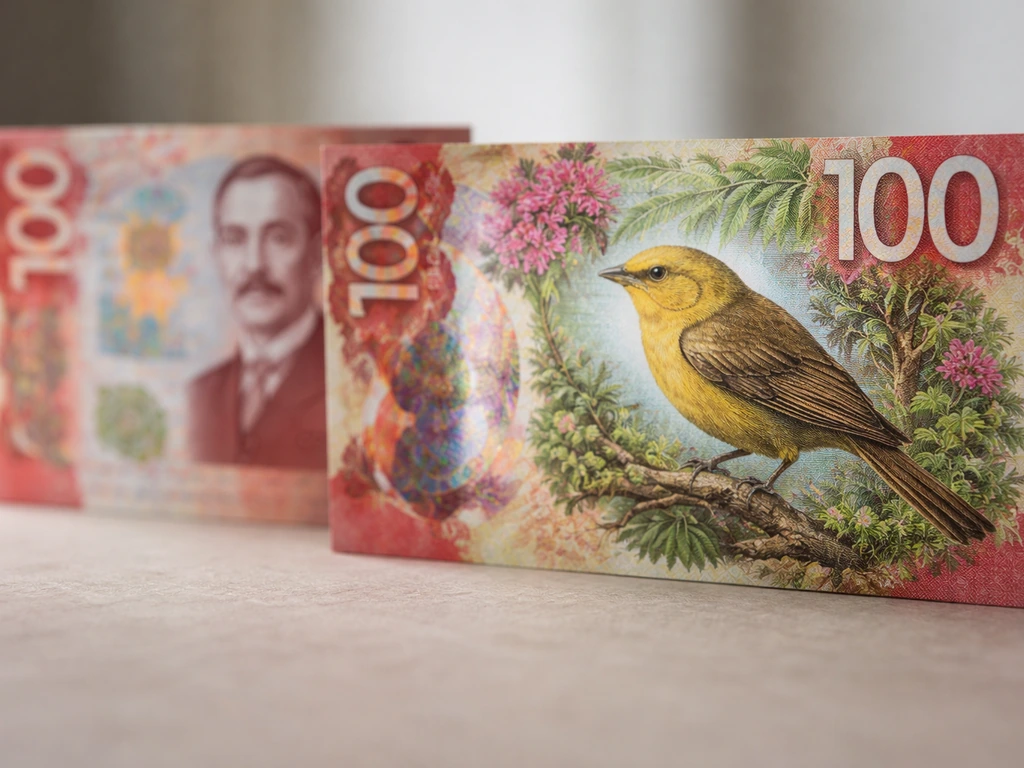
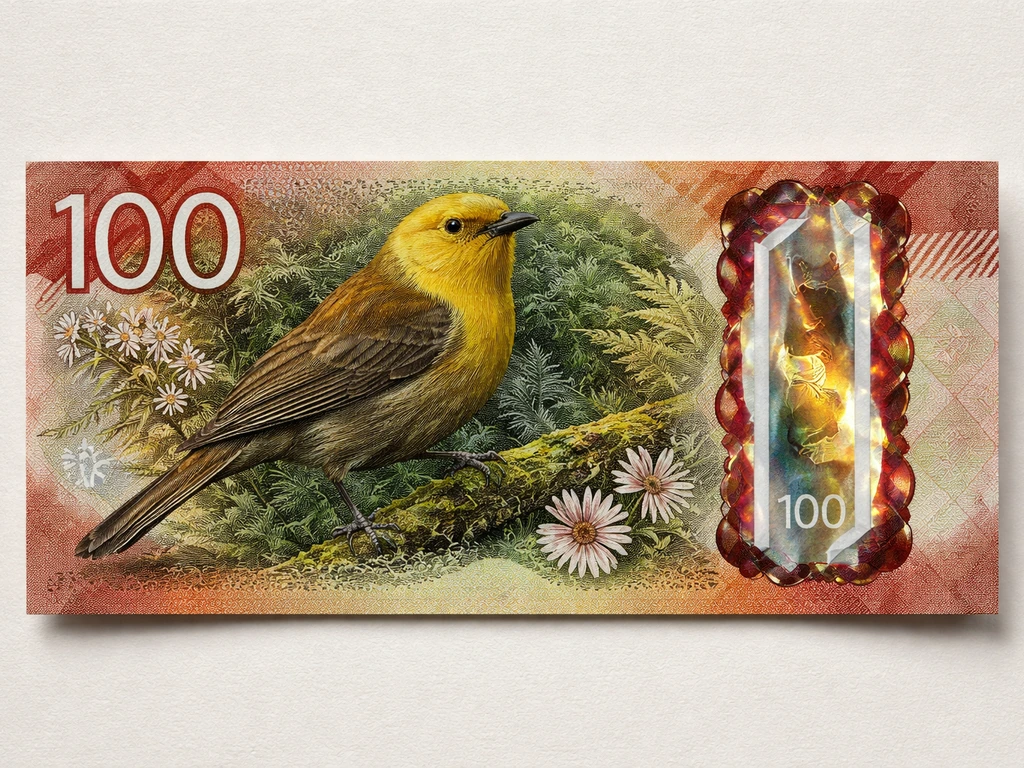
The bird on the NZ $100 note is the yellowhead, known in te reo Māori as mōhua. It appears on the back of the note, and that has been the case across multiple design series. The $5 note uses a different bird, so check your denomination first to confirm which species appears. If you're holding a $100 note right now, flip it over and you'll find the mōhua featured prominently on the reverse.
What Bird Is on the NZ $100 Note? Identify It Fast

Marcus Chen
9 Jun 2026
Where to find the mōhua on the note
The front of the $100 note features Lord Rutherford of Nelson, the famous New Zealand physicist. The bird is on the back. The mōhua is depicted as part of the reverse design, alongside other natural New Zealand imagery. If you're looking at the front and wondering where the bird is, just turn it over.
One of the most useful visual cues is the holographic window built into the note. When you tilt the note, a bright shining bar moves across a bird silhouette inside that window, and the colours shift as you change the angle. That silhouette is the mōhua. This tilt-to-verify feature works for both the Series 6 and Series 7 versions of the $100 note, though the exact security features differ slightly between the two series.
Current vs older note designs: what's changed
New Zealand has had multiple series of banknotes in circulation at the same time, which can cause confusion. The Reserve Bank of New Zealand (RBNZ) introduced Series 7 $100 notes in May 2016 as part of its 'Brighter Money' upgrade. Before that, Series 6 notes were the standard. Both series show the mōhua on the reverse, so the bird itself hasn't changed between these versions.
Going back even further, the fifth series $100 note also featured the mōhua (yellowhead) on the reverse, along with other South Island imagery including red beech, a South Island lichen moth, and a Fiordland valley scene. So if you're looking at an older note still in circulation, the yellowhead has been a consistent feature across series. Banknotes typically last around six years before wearing out, so it's quite possible to encounter more than one series in everyday use.
| Series | Approximate circulation start | Bird on reverse | Front portrait |
|---|---|---|---|
| Series 5 | Pre-1999 | Mōhua (yellowhead) | Lord Rutherford |
| Series 6 | 1999 onwards | Mōhua (yellowhead) | Lord Rutherford |
| Series 7 | May 2016 | Mōhua (yellowhead) | Lord Rutherford |
The mōhua and New Zealand's national bird symbolism
Here's something worth knowing: the mōhua is not New Zealand's national bird. The national bird of Aotearoa New Zealand is the kiwi. You might expect the $100 note to feature the kiwi given its status, but the banknote bird selection works differently. When the Reserve Bank redesigned notes in 1991 to give them a distinctly New Zealand character, different native birds were assigned to different denominations. The goal was to celebrate New Zealand's unique birdlife broadly, not to use a single emblem repeatedly.
The mōhua was chosen for the $100 note as a representative of New Zealand's endemic forest birds. Each denomination tells a different native bird story, which is why you'll see different species across the $5, $10, $20, $50, and $100 notes. If you've been looking at what's on the $50 note NZ or the $5 note, you'll have noticed this pattern.
How to verify you have the right note
If you want to be completely sure you've correctly identified the bird and the note denomination, run through these steps:
- Check the denomination printed on the note. It should clearly read '100' or '$100' in multiple places.
- Confirm the front shows Lord Rutherford of Nelson, not another figure.
- Flip to the back and look for the mōhua (yellowhead) bird in the design.
- Find the holographic or clear window on the note and tilt it. A bird silhouette should appear with a shining bar moving through it and colour-shifting behaviour as you change angle.
- Cross-check against the RBNZ's official $100 banknote page if you have internet access, which shows labelled images of both Series 6 and Series 7 designs.
If you're trying to authenticate a note rather than just identify the bird, the holographic window check is the most practical step. A smooth-edged window with a clear bird silhouette, a map of New Zealand, and a 3-D value feature are all things to look for on a genuine note. Behaviour that doesn't shift when tilted is a red flag.
What makes the mōhua worth featuring on a banknote
The mōhua (Mohoua ochrocephala) is a small, insect-eating passerine bird that is entirely endemic to New Zealand. It lives only in the forests of the South Island and Stewart Island, which makes it one of those species that exists nowhere else on Earth. DOC states that the yellowhead/mōhua is a small, insect-eating bird that lives only in the forests of New Zealand’s South Island and Stewart Island and is endemic. That endemism alone makes it a strong candidate as a national symbol.
But the mōhua also carries a conservation story. Its populations declined dramatically following European settlement, largely because of introduced predators like stoats and rats. The species became fragmented into isolated patches, and it's now considered at risk. Featuring it on the $100 note brings visibility to a bird that many New Zealanders might never see in the wild, given how restricted its range has become compared to its pre-human distribution across both islands.
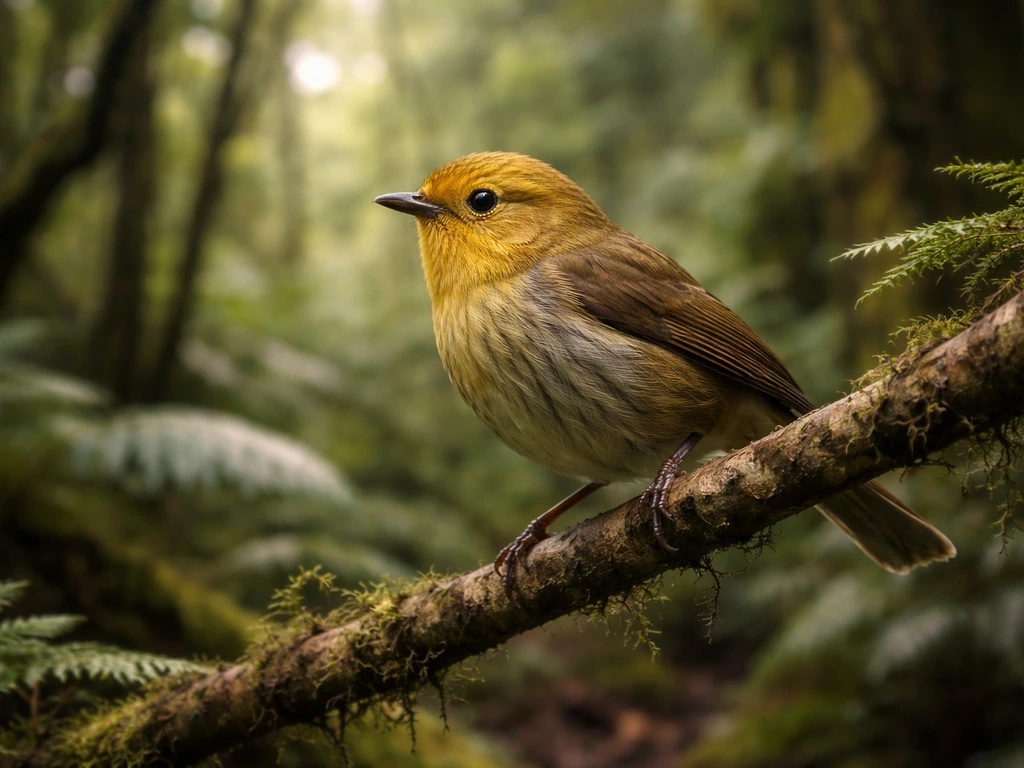
The name 'yellowhead' is a straightforward description: adult birds have a distinctly yellow head and breast, making them visually striking against the green forest understory. The te reo name mōhua is what you'll see used most often in conservation and official contexts today, including on the RBNZ's own banknote pages.
Quick facts about the mōhua
- Scientific name: Mohoua ochrocephala
- Common names: Yellowhead (English), mōhua (te reo Māori)
- Habitat: Old-growth forests of the South Island and Stewart Island, New Zealand
- Diet: Insects and other invertebrates; forages along tree branches and bark
- Conservation status: At risk, with populations significantly reduced from historical range
- Distinctive feature: Bright yellow head and underparts on adult birds
- Featured on the NZ $100 note since the 1991 banknote redesign
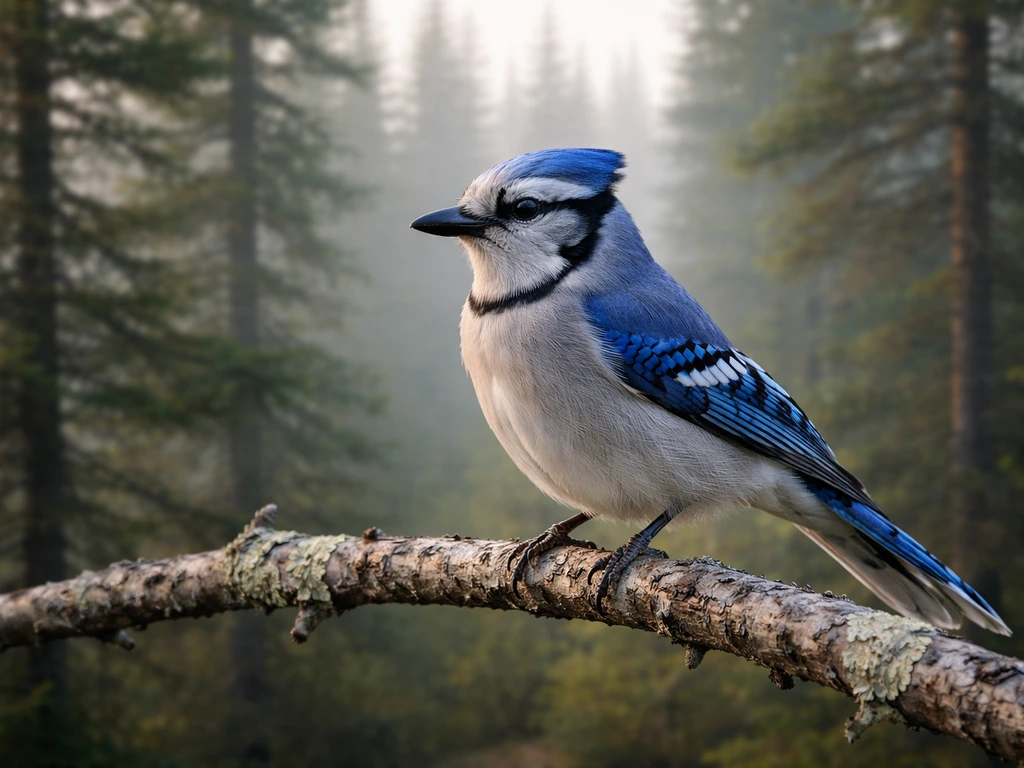
New Zealand's banknote birds are a fascinating window into how a country chooses to represent its natural identity. The kiwi may be the national bird and a global shorthand for New Zealand identity, but the $100 note tells a more specific story about an endemic forest species that deserves attention in its own right. If you are wondering whether is the loon the national bird of Canada, that is a separate example of how different countries choose national bird symbols. If you're wondering about other Canadian national bird facts, the blue jay is often discussed as a national bird reference in popular contexts. Canada does have a national bird, but it is not a single widely recognized symbol in the same way as some other countries what is the national bird of canada. The mōhua earns its place on the highest-denomination everyday note. On the $2 coin, the bird depicted is the mōhua (yellowhead).
FAQ
Is the mōhua definitely on the back of every NZ $100 note I might find in circulation?
Yes, the yellowhead (mōhua) is on the reverse side across Series 5, 6, and 7, but the exact security-printing layout differs between series. If you are unsure, start by confirming the note’s denomination and then use the tilt/holographic window to verify authenticity.
How can I tell if I have a Series 6 or Series 7 $100 note quickly?
Look for differences in the holographic and other security elements’ design details rather than the bird, since the mōhua placement stays the same. The article notes Series 7 was introduced in May 2016, so if you know roughly when you received it, that can help too.
What should I look for if the bird silhouette in the holographic window is hard to see?
Try viewing it under a bright light and at an angle, then tilt the note slowly. On a genuine note, the silhouette and the colour shift when tilted, while counterfeit or heavily worn notes may show less contrast, but the pattern still should change when you move the angle.
Does the front of the $100 note ever show a bird instead of Lord Rutherford?
No, the front is Lord Rutherford of Nelson, the physicist. The bird identification is for the reverse side only, so flipping the note is the key step.
If I want to confirm the bird species, is “yellowhead” always correct for what’s shown?
In this case, yes, the banknote bird is the yellowhead, using the scientific name Mohoua ochrocephala and the te reo Māori name mōhua. “Yellowhead” matches the bird’s distinctive yellow head and breast in the illustration.
Are there any common mix-ups where people think the $100 note has the same bird as the $5 note?
Yes, people often assume all denominations share the same bird. The $5 note uses a different species, so the safest approach is always to check the denomination first and then verify on the reverse.
Is the mōhua the national bird of New Zealand, so why isn’t it on the kiwi symbol?
No, the kiwi is the national bird. The banknote bird selection uses different native species by denomination to tell a broader natural-history story rather than repeating one emblem, which is why the $100 note features an endemic forest bird instead of a kiwi.
Could I still use the tilt test if my note is old or worn?
You can try, but wear and fading can reduce how clearly the bird silhouette stands out. If the note looks degraded, focus on whether the security elements still shift with tilt rather than whether they look perfectly crisp.
Where does the mōhua live, and does that affect how the banknote bird is presented?
The mōhua is endemic to New Zealand and restricted to South Island and Stewart Island forests. The banknote illustration reflects this focus on endemic forest birds, which is part of the reason it is chosen for a high-value everyday note.
Next Article
Is the Blue Jay Canada’s National Bird? The Truth
Find out if the blue jay is Canada’s national bird, why people think so, and what the official national bird represents.