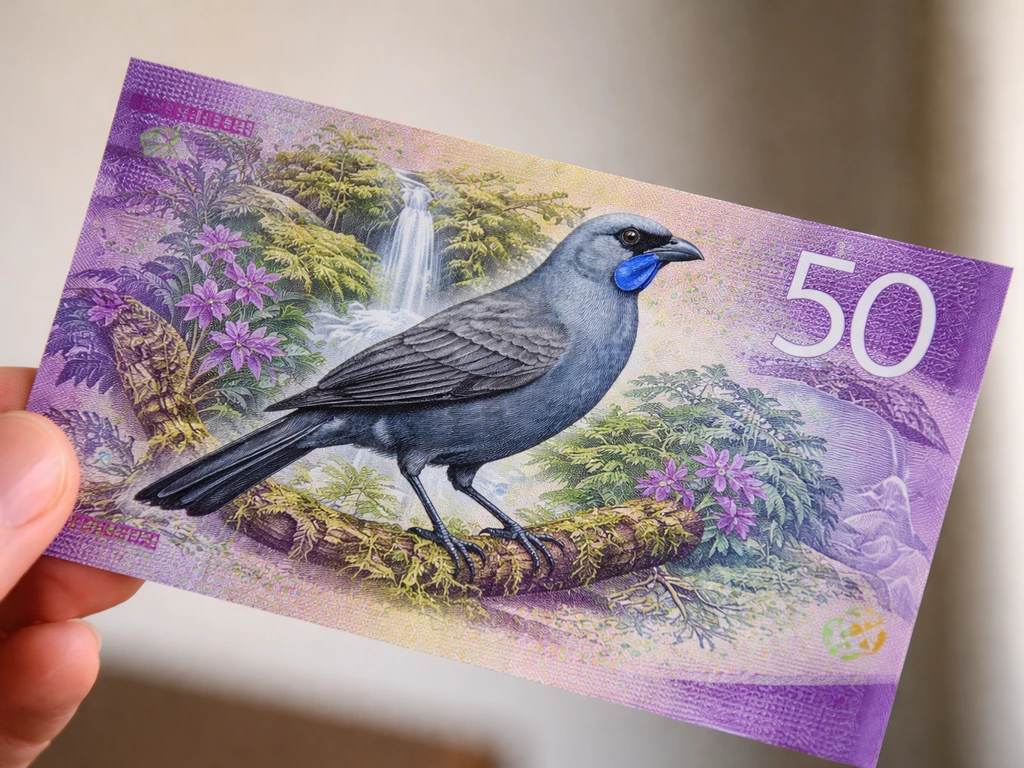
The bird on the back of the New Zealand $50 note is the kōkako, a bluish-grey native forest bird with sky-blue wattles and a distinctive black face mask. This has been the case across Series 5, 6, and 7 of the note, so whether you're holding an older purple $50 or the brighter current version, the kōkako is your bird.
What Bird Is on the NZ $50 Note? Identify the Species

Marcus Chen
14 Jun 2026
Which $50 note are you holding?
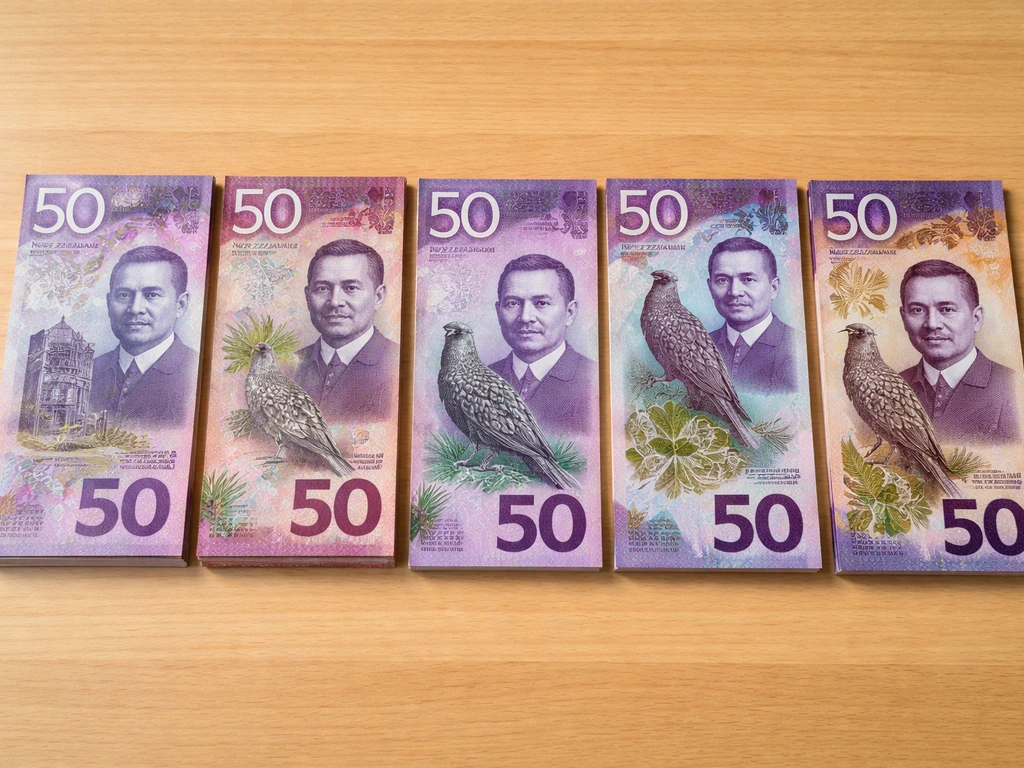
New Zealand's $50 banknote has gone through several design series, but the core imagery has stayed consistent since 1999. That year, Series 5 introduced Sir Āpirana Ngata on the front and locked in the kōkako on the back. Series 6 followed with polymer plastic and enhanced security features, and Series 7 (the current version) entered circulation from May 2016. The RBNZ describes Series 7 as looking 'brighter and clearer' than Series 6, with a larger, higher-contrast denomination number and improved colour vibrancy.
The easiest way to tell which series you have: Series 7 notes look noticeably more vivid in the purple-blue range, the '50' denomination print is larger and bolder, and the holographic window on the front is more complex. Older Series 5 and 6 notes are still legal tender and share the same bird, so for the core question of what bird you're looking at, the answer is the same across all three. If you're wondering what bird is on the NZ 5 dollar note, the answer depends on the specific design series what bird you're looking at.
| Series | In Circulation From | Polymer or Paper | Kōkako Present on Back? | Key Visual Difference |
|---|---|---|---|---|
| Series 5 | 1999 | Polymer | Yes | Original design, less vibrant colours |
| Series 6 | Mid-2000s upgrade | Polymer | Yes | Updated security features, similar look to Series 5 |
| Series 7 | May 2016 | Polymer | Yes | Brighter colours, larger '50' print, advanced hologram |
The bird on the NZ$50 note: the kōkako
The kōkako (also called the blue-wattled crow) is an endemic New Zealand forest bird belonging to the wattlebird family, a group found nowhere else on Earth. On the $50 note's back, it appears alongside imagery of Pureora Forest Park in the central North Island, which is home to one of the largest remaining kōkako populations in the country. The note also features the striking sky-blue mushroom entoloma hochstetteri, making the back a small celebration of New Zealand's unique native ecosystem.
WWF New Zealand refers to each of the five NZ banknotes as 'banknote birds,' and the kōkako is specifically tied to the purple $50. The Reserve Bank's own description is straightforward: Sir Āpirana Ngata on the front, kōkako (blue wattled crow) on the back.
How to confirm it yourself using visual clues
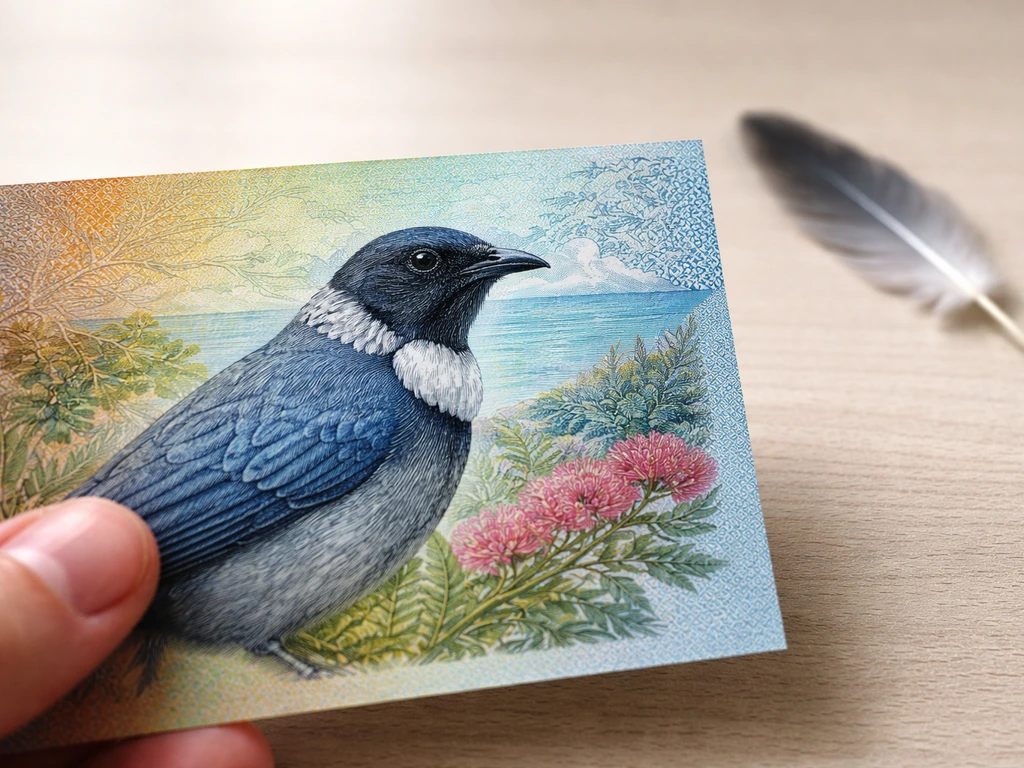
If you want to verify the bird on the note in your hand, here's what to look for on the back of a $50:
- Body colour: The kōkako has a bluish-grey body, not brown or speckled. It's a fairly large, plump bird silhouette.
- Face mask: There's a distinctive black mask covering the face area, which is one of the kōkako's most recognisable features.
- Wattles: Look for small sky-blue fleshy lobes at the base of the beak. These are the blue wattles the bird is named for.
- Forest background: The bird is set against a Pureora Forest Park scene, so you'll see native forest imagery behind it.
- Mushroom: The vivid sky-blue entoloma hochstetteri mushroom also appears on the back, which is unique to the $50.
On Series 7 notes, there's also a holographic window on the front. Hold the note up to the light and look through it, and you'll see a silhouette of the bird, a map of New Zealand, and a 3D value feature. Tilt the note and a bright shining bar rolls across the bird silhouette, and the window colours shift. This is both a counterfeit check and a quick way to confirm you're looking at the right denomination.
The Reserve Bank's 'Look, Feel and Tilt' verification method covers four main security features on Series 7 notes: the holographic window, a colour-changing bird silhouette, a puzzle number (on the left side front and back, which combines into the value when held to light), and raised ink you can feel on the denomination text and the words 'Reserve Bank of New Zealand Te Pūtea Matua' on the front.
What the kōkako means as a New Zealand symbol
The kōkako carries deep cultural weight in New Zealand, even without holding an official 'national bird' title. New Zealand doesn't have a single legislated national bird with formal status in the way it has national symbols like the silver fern, though the kiwi is widely used as an informal national emblem. The kōkako's place on the $50 note reflects something slightly different: it's a conservation symbol. NZBirds.com describes the kōkako as an elusive forest bird with a distinctive call and notes its remaining populations, which helps explain why the species is used in conservation-focused narratives place on the $50 note reflects something slightly different: it's a conservation symbol..
The kōkako is an elusive, endangered forest bird known for its haunting, organ-like call. The Department of Conservation (DOC) classifies it as endemic to New Zealand, meaning it evolved here and exists nowhere else. Its presence on the $50 note aligns with New Zealand's broader national identity around protecting rare native wildlife. The choice of Pureora Forest Park as the backdrop reinforces this: the park is a conservation success story, where kōkako populations have been actively managed and have recovered from near-collapse.
The pairing of Sir Āpirana Ngata on the front with the kōkako on the back is also meaningful. Ngata was a Māori statesman, scholar, and leader who championed Māori land rights, arts, and culture. The kōkako is referenced in Māori tradition and waiata (song), and its haunting call has made it a bird of cultural significance in that context. The $50 note brings together a Māori leader and a bird embedded in both Māori cultural memory and New Zealand's conservation identity.
The history behind the $50 note design and the kōkako's place in it
New Zealand's $50 denomination was introduced in December 1983 as part of the fourth banknote series. The specific design featuring Sir Āpirana Ngata and the kōkako arrived with Series 5 in 1999, when the Reserve Bank also switched from paper to polymer plastic notes. That shift brought significant security upgrades and locked in the current design theme: a notable New Zealander on the front, a native bird and natural setting on the back.
The philosophy behind the bird-on-back design was intentional. Each denomination was assigned a distinct native bird, creating a set of five notes that together represent New Zealand's unique biodiversity. The kōkako was selected for the $50 specifically. Other notes each have their own bird: the hoiho (yellow-eyed penguin) on the $5, the kārearea (New Zealand falcon) on the $20, and so on across the range. If you're wondering about the bird on the $5 note, that one is the hoiho, or yellow-eyed penguin. This system means each note tells a slightly different conservation story.
Series 7, released in May 2016, was framed by the RBNZ as a major anti-counterfeiting milestone. Central Banking reports the RBNZ launched the remaining NZ$20, NZ$50, and NZ$100 notes in the Series 7 release with circulation from mid-May 2016 Series 7, released in May 2016. The kōkako imagery was retained, but the printing was upgraded to be brighter and clearer, the denomination numeral was made larger, and new layered security features were added including the enhanced holographic window and the colour-changing bird silhouette. Series 6 notes remained in circulation alongside Series 7, which is why you might encounter both.
Common confusion points and quick checks
The most common mix-up is confusing the kōkako on the $50 with birds on other NZ notes. Here's a quick reference so you can rule out the wrong denomination:
| Note | Bird on Back | Quick Visual ID |
|---|---|---|
| $5 | Hoiho (yellow-eyed penguin) | Upright penguin, yellow eye stripe, coastal scene |
| $10 | Whio (blue duck) | Blue-grey duck, river scene |
| $20 | Kārearea (NZ falcon) | Brown raptor in flight, strong wings, fierce look |
| $50 | Kōkako (blue-wattled crow) | Bluish-grey body, black face mask, blue wattles, forest scene |
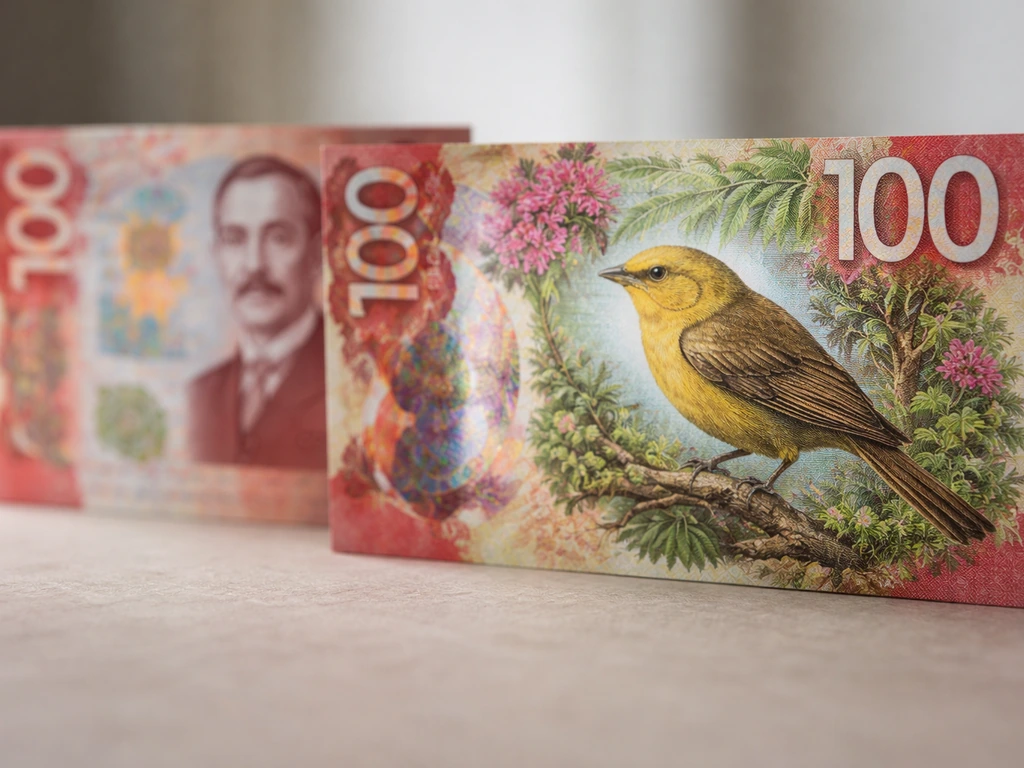
| $100 | Mohua (yellowhead) | Small yellow-headed bird, forest backdrop |
Another confusion point involves older denominations that no longer circulate. The rifleman (NZ's smallest bird) appeared on a former $2 banknote, and the kōtuku (white heron) appeared on $2 coins. If you're also wondering what bird appears on the $2 coin, that's the one mentioned separately from the $50 note birds what bird is on the $2 coin. Neither of these is the $50 note bird. If someone mentions the kōtuku or rifleman in the context of the $50, they're thinking of a different denomination or a discontinued note.
If you're unsure whether your $50 is Series 6 or Series 7, the simplest check is to compare the size and boldness of the '50' denomination number. Series 7 has it noticeably larger with stronger colour contrast. You can also check the Reserve Bank's 'Explore banknote features' page directly, which has side-by-side comparison guidance. For the bird identification question itself though, it doesn't matter which series you have: both show the kōkako on the back.
If you're exploring which birds feature across New Zealand and other countries' currency or national emblems, the NZ banknote set is a good starting point because each denomination pairs a national figure with a native bird in a deliberate, consistent way. The loon is the national bird of Canada, so it often comes up in discussions of Canadian bird symbols the loon the national bird of Canada. The Canadian $1 dollar bill and $5 coin also feature specific birds, so it helps to know which one matches those designs Canadian dollar bird. The kōkako on the $50 is one of the more striking examples, and the conservation context behind it gives the note a story worth knowing beyond just identifying the image.
FAQ
What bird is on the back of the NZ $50 note, even if it is an older series?
It is still the kōkako (blue-wattled crow) on the back across Series 5, 6, and 7. The series mainly changes how the note looks and which security features are used, not the bird choice.
Does the kōkako look the same on every $50 note I find in circulation?
The bird artwork is broadly consistent, but the colour intensity and print sharpness differ between series. Series 7 notes typically look more vivid, so the sky-blue wattles and the face mask can appear more high-contrast than on Series 5 or 6.
How can I confirm I am holding the NZ $50 note and not a different denomination with a similar bird scene?
Use two checks together: first, find the large “50” on the note, then verify the front holographic window by holding it up to the light. On Series 7, the hologram produces a bird silhouette and a shifting colour effect when you tilt the note.
If my $50 is Series 7, what specific security details should I expect to see besides the hologram?
You should also be able to feel raised ink on the denomination text and the Reserve Bank of New Zealand Te Pūtea Matua wording on the front. There is also a puzzle number feature that comes together when you hold the note to the light.
What should I look for on the back if I just want to identify the bird visually?
Look for the kōkako’s distinctive black face mask and sky-blue wattles on a bluish-grey bird. The scene behind it shows a forest park setting (Pureora Forest Park), which helps distinguish it from other note images.
Is the kōkako the bird on the NZ $50 note or the $50 coin?
The kōkako is on the back of the $50 banknote, not a coin. If you are checking currency by looking at coins, be aware that different birds appear on different coin denominations.
Why do people sometimes mention the kōtuku or rifleman when they talk about NZ bird notes?
Those birds belong to other denominations. The kōtuku is associated with a different currency item, and the rifleman was on a former $2 banknote. They are not the $50 banknote bird.
Is the kōkako on the $50 note meant as New Zealand’s official national bird?
No. The kōkako is used as a conservation symbol on the $50 note rather than as a formal, legislated national bird. Kiwi imagery is often used informally as a national emblem, but the $50 focuses on protecting a rare native species.
Where is the bird depicted as living in the $50 note design?
The bird is shown in imagery tied to Pureora Forest Park in the central North Island. That park theme supports the conservation story, because it is associated with managed kōkako recovery.
Do counterfeit checks and bird identification conflict, or can I safely do both?
You can do both, but keep it simple: start by identifying the bird features (mask and wattles), then confirm denomination with the Series 7 “look, feel and tilt” method. Avoid handling the note repeatedly under very low lighting, since security effects are harder to see consistently.
Next Article
What Bird Is on the NZ $100 Note? Identify It Fast
Identify the bird on NZ’s $100 note, plus exact look points, variant dates, and quick verification checklist.