Greece's national bird: the Little Owl
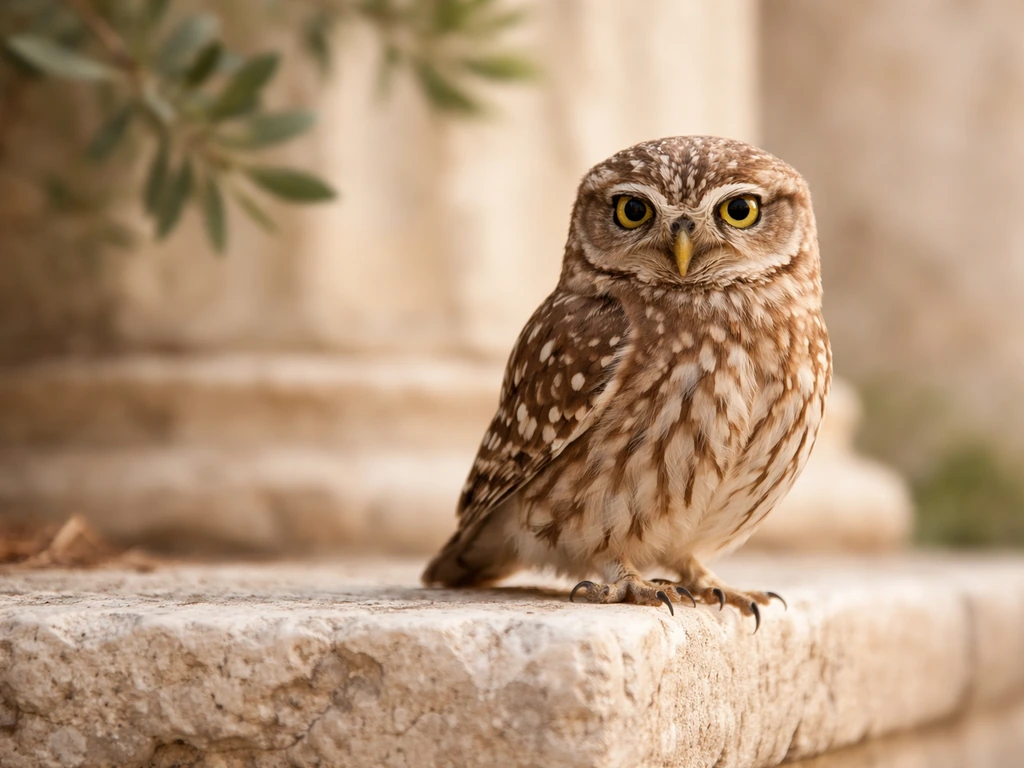
Greece's national bird is the Little Owl (Athene noctua). This small, compact owl is the species most consistently named in reference sources as Greece's avian symbol, and it carries a cultural weight that stretches back thousands of years. If you've seen the bird before, you'll recognize it: roughly 20 to 27 cm tall, streaked brown-and-white plumage, piercing yellow eyes, and a flat-topped head that gives it an almost stern expression.
One important caveat worth knowing upfront: there is no clearly documented Greek government decree or legal proclamation that formally names the Little Owl as the national bird. The claim appears widely in reference listings, including on Wikipedia's 'National colours and symbols of Greece' page, but that same page carries a 'citation needed' flag on the national bird entry. So while the Little Owl is the recognized and widely accepted answer to the question, its official status is more a matter of cultural convention than a signed-and-sealed government declaration.
Why the Little Owl? The historical background
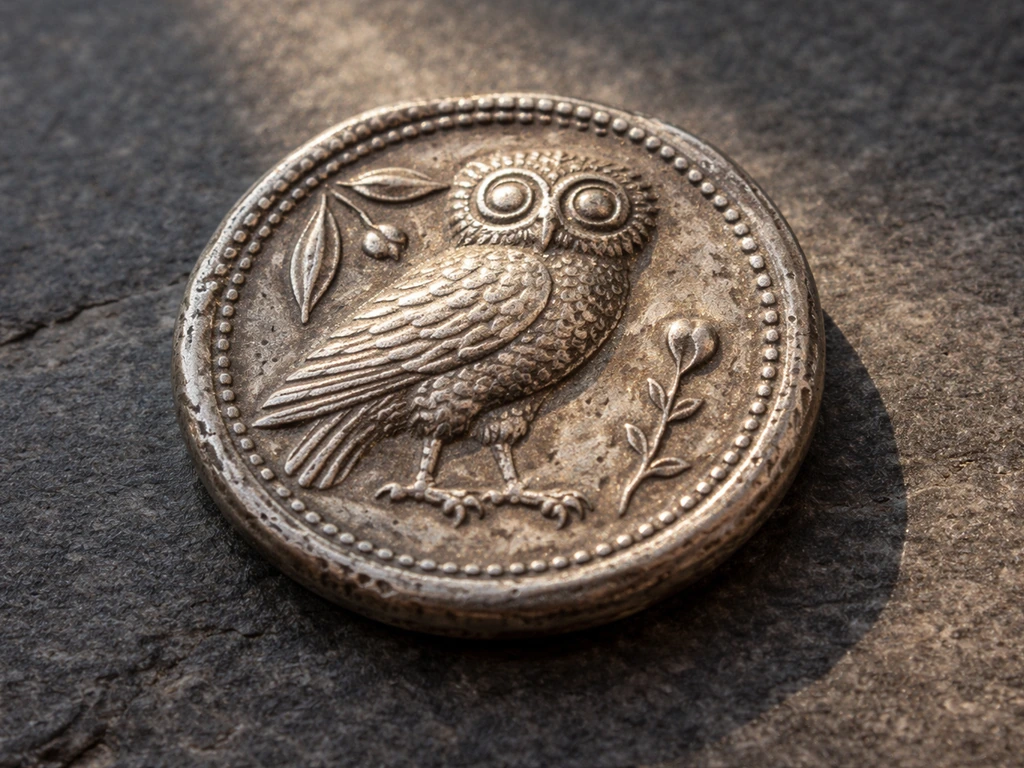
The connection between the Little Owl and Greece is not a modern invention. It goes back to ancient Athens, where the bird was considered sacred to Athena, the goddess of wisdom, craft, and warfare. Athena was the patron deity of the city, and her association with the Little Owl was so strong that the bird was stamped onto Athenian silver coins, called tetradrachms, from around the 5th century BCE. Those coins became the most widely circulated currency of the ancient Mediterranean world.
The phrase 'taking owls to Athens' became a Greek proverb, roughly equivalent to the English 'carrying coals to Newcastle,' meaning to bring something to a place already overflowing with it. That tells you how abundant and symbolically central the owl was to Athenian identity. When modern Greece sought to build a national identity after independence in 1821, it naturally drew from its ancient heritage, and the owl was already embedded in that cultural DNA.
The species name Athene noctua is itself a nod to this history. Linnaeus named the genus Athene directly after the goddess, cementing the scientific link between the bird and its classical roots. So unlike some national birds chosen through a formal committee process, the Little Owl's role as a Greek symbol evolved organically over millennia before anyone thought to put it on an official list.
What the Little Owl symbolizes for Greece
The core symbolism is wisdom, and that idea runs deep. In ancient Greek thought, the owl's ability to see in the dark was interpreted as insight, the capacity to perceive truth where others see only darkness. Paired with Athena, the goddess of reason and knowledge, the bird became a shorthand for intellectual clarity and good judgment.
There is also a democratic dimension to the symbol. The Athenian tetradrachm bearing the owl's image was minted during the height of Athenian democracy, roughly 480 to 404 BCE. So the owl is indirectly tied to the birth of democratic governance, a connection modern Greece is understandably proud of. When Greece joined the eurozone in 2002, it chose to feature the Athenian owl on its 1-euro coin, a deliberate callback to the ancient tetradrachm and a reminder of where Western civilization's democratic ideals were first formalized.
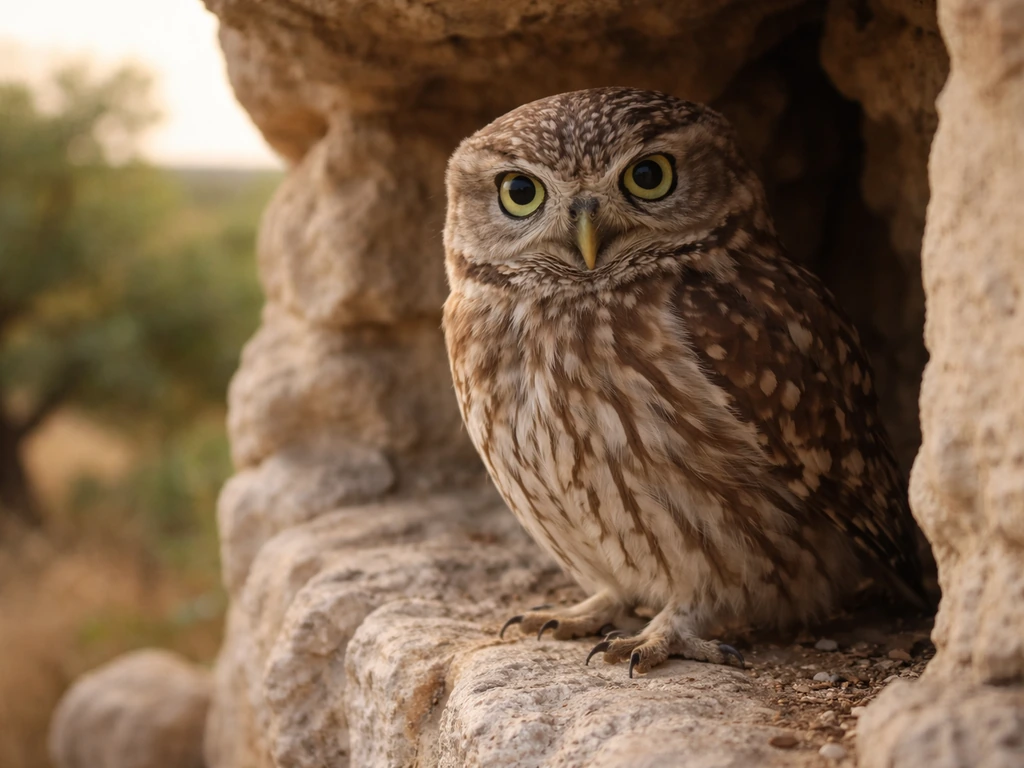
Beyond politics and philosophy, the Little Owl is also a practical presence in the Greek countryside. It nests in olive groves, rocky outcrops, and old stone buildings, which means it is genuinely part of the everyday Greek landscape, not just a mythological abstraction. That physical presence reinforces the symbol in a grounded, tangible way.
Key facts and memorable details about the Little Owl
| Attribute | Detail |
|---|
| Scientific name | Athene noctua |
| Size | 20 to 27 cm (roughly 8 to 10.5 inches) |
| Weight | Around 150 to 200 grams |
| Habitat in Greece | Olive groves, farmland, rocky hillsides, ruins |
| Diet | Insects, earthworms, small rodents, lizards |
| Activity pattern | Crepuscular and nocturnal (most active at dusk and night) |
| Lifespan (wild) | Up to 16 years |
| Conservation status | Least Concern (IUCN) |
One story that tends to stick with people: during the Battle of Salamis in 480 BCE, when the Greeks defeated the Persian fleet, an owl reportedly flew over the Greek ships before the battle. Sailors interpreted this as a direct sign of Athena's blessing. Whether or not the story is historically accurate, it was recorded and repeated widely in antiquity, which shows how powerfully the bird was woven into Greek ideas about fate, divine favor, and military courage.
The Little Owl is also notably bold for a small bird. Unlike many nocturnal species, it is frequently spotted during daylight hours, often sitting upright on a fence post or low branch, watching the world go by. Ancient Greeks observed this behavior and interpreted it as the bird being unafraid to confront what others avoid, another reason it fit so well with Athena's domain of clear-eyed wisdom.
How the Little Owl shows up in Greece today
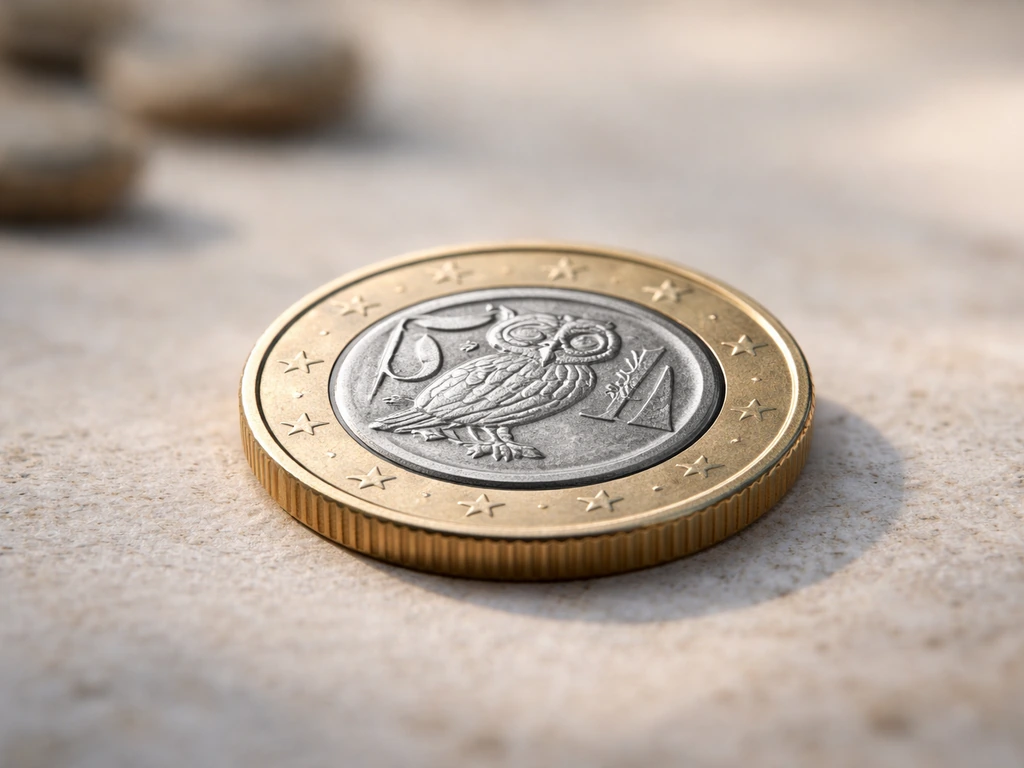
The most visible modern reference is the Greek 1-euro coin. Every euro-area country designs its own side of the coin, and Greece went with a direct reproduction of the ancient Athenian owl. Allnumis notes that the owl design used on Greece's 1-euro coin was copied from an ancient Athenian 4-drachma coin dating to the 5th century BC blank" rel="noopener noreferrer">the direct reproduction of the ancient Athenian owl. European Numismatics also describes the Greek 1-euro design as featuring an blank" rel="noopener noreferrer">owl image copied from an ancient Athenian coin, noting it appears on an ancient Athenian 4-drachma coin. This design has been on every Greek euro since the currency launched in 2002, putting the owl in the wallets of millions of people across Europe.
You'll also find the owl imagery throughout Greek tourism and cultural exports: on museum merchandise at the Acropolis Museum, in jewelry shops selling reproductions of the ancient tetradrachm, and as a common motif in Greek ceramics and decorative arts. The Greek Ministry of Education has used owl imagery in literacy and educational campaigns, leaning directly into the wisdom symbolism.
In wildlife and birdwatching contexts, the Little Owl is one of the birds most reliably found by visitors to Greece, especially in rural areas and around ancient sites. Birdwatching tours in regions like the Peloponnese and Thessaly regularly highlight it as a species with both natural and cultural significance. If you're visiting Greece and want to see one, dawn and dusk around open farmland or old stone walls give you the best chance.
Clearing up common confusion about Greece's national bird
A few birds come up regularly when people guess Greece's national symbol before looking it up. The Phoenix is the most dramatic wrong answer, partly because Greek mythology is rich with bird imagery. The Phoenix was a mythological creature, not a real species, so it doesn't qualify as a national bird in any practical sense. The eagle (specifically the golden eagle or white-tailed eagle) is another common guess because eagles appear on ancient Greek coins and art, but the owl consistently beats it in national-symbol listings for Greece.
Some people also confuse Greece's national bird with Turkey's, since the two countries share a complex historical relationship and a similar geography. Turkey's national bird is the redwing (Turdus iliacus), which is a completely different species with a completely different symbolic tradition. Turkey's national bird is the redwing, a completely different species from Greece's Little Owl.
Nearby countries like Albania, Hungary, Romania, and Austria each have their own distinct national bird choices, some of which are eagles or other raptors, which may be why eagle guesses for Greece are so common among people thinking regionally. Romania has its own distinct national bird, too what is the national bird of romania. Nearby countries like Austria each have their own distinct national bird choices, so you can also ask what is the national bird of austria.
If you're wondering about Albania, its national bird is the subject of its own distinct symbol story. If you're also curious about Hungary's national bird, that's a different species with its own story and symbolism.
The other confusion worth clearing up is about formality. When people ask 'what is Greece's official national bird,' the honest answer is that the Little Owl is the widely recognized and culturally authoritative answer, but Greece has not published a formal government proclamation the way some countries have. A related discussion on an r/AncientCoins thread also shows collectors debating authenticity and variations for Athena owl coin types in practical terms [widely recognized and culturally authoritative answer](https://www. reddit.
com/r/AncientCoins/comments/14a6snm). If you're also wondering what is Italy's national bird, the most commonly cited choice is closely tied to local tradition and official symbolism. This is not unusual. Many nations' national symbols emerged through tradition and popular consensus rather than legislation.
If you are wondering about another country, the national bird of Iran is the hoopoe what is the national bird of iran. Italy's national bird, the Italian Sparrow, is a good parallel: it reflects a specific cultural identity without a heavy bureaucratic paper trail behind it. If you are comparing how other countries choose symbols, the answer to why is the italian sparrow the national bird of italy follows a similar mix of tradition and widely repeated claims.
Quick answers to common questions
- What is the national bird of Greece? The Little Owl (Athene noctua), linked to the goddess Athena and ancient Athenian culture.
- Is it officially designated by the Greek government? Not through a known formal decree, but it is the universally recognized national bird in reference sources and cultural practice.
- Why was the owl chosen? Its 2,500-year association with Athena, goddess of wisdom, and its appearance on ancient Athenian coins made it the natural choice.
- Where can I see the Little Owl today? On the Greek 1-euro coin, in Athens museums, and in the wild across Greek farmland and rural areas.
- Could the eagle or Phoenix be Greece's national bird? No. The Phoenix is mythological, not a real bird. Eagles appear in Greek culture but are not the recognized national bird.
- Is the Little Owl endangered? No. It is listed as Least Concern by the IUCN, though local populations can be affected by habitat loss and pesticide use.