
The Italian sparrow (Passer italiae, described by Vieillot in 1817) is unofficially considered the national bird of Italy. There is no formal government decree behind this, it has never been enshrined in Italian law the way a national anthem or flag is, but the species has earned that symbolic status through a combination of endemism, cultural familiarity, and deliberate promotion by Italian ornithologists and birdwatching communities going back more than a century.
Why Is the Italian Sparrow the National Bird of Italy?

Marcus Chen
2 Jun 2026
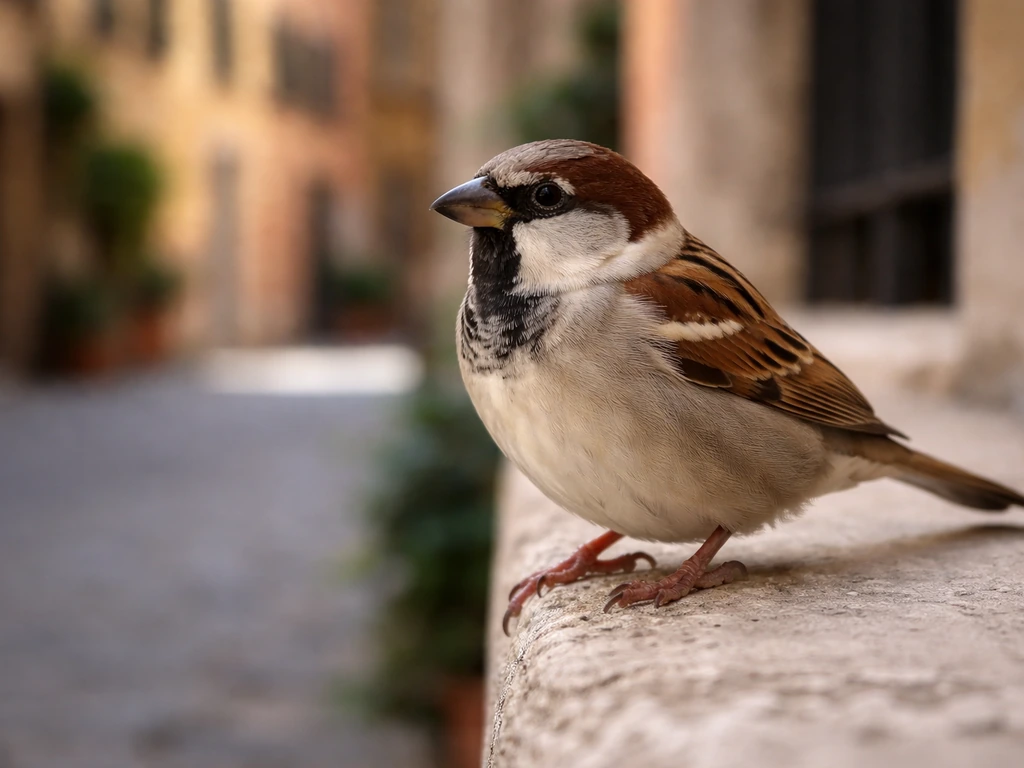
What Italy's national bird actually is and where the 'Italian sparrow' label comes from
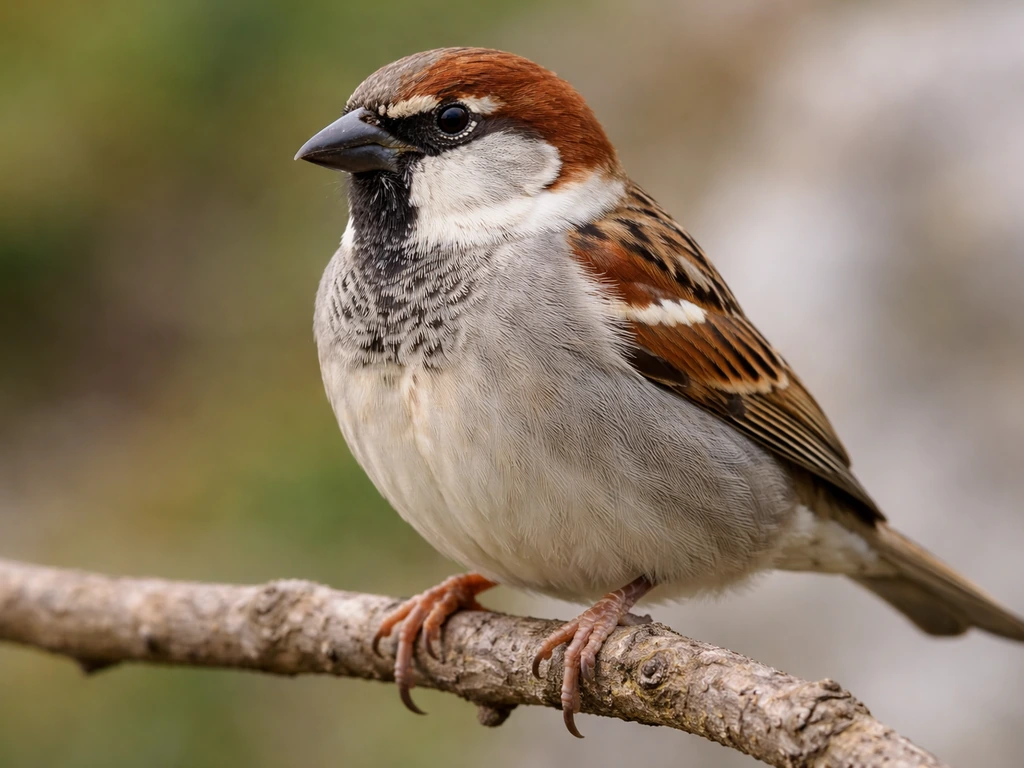
The bird in question is Passer italiae, known in Italian as 'passero italiano' or 'passera d'Italia.' The name itself does a lot of the work: 'italiae' literally means 'of Italy,' and the species is largely restricted to the Italian Peninsula and some surrounding areas, making it one of the very few bird species that can genuinely be called Italian in a biogeographic sense. Italy's conservation body LIPU explicitly classifies it as an 'endemic species of our country' (specie endemica del nostro Paese), which is a strong scientific basis for national symbolism.
The species was formally described and named by the French ornithologist Louis Jean Pierre Vieillot in 1817, and its scientific authority (Vieillot, 1817) is consistent across major taxonomy databases including GBIF and the IOC world bird list. So when you see 'Italian sparrow' in any reliable source, it refers specifically to this taxon, not to Italian sparrows in a loose colloquial sense.
Historical and cultural reasons for choosing this bird
The clearest historical anchor for the Italian sparrow's national symbolism is the ornithological magazine 'Avicula,' published in Italy from 1897 to 1907. That publication adopted a Latin motto, 'Passer italiae, parvus sed omnino italicus', which translates roughly as 'the Italian sparrow, small but entirely Italian.' That phrase is a deliberate statement of national identity wrapped around a bird. It was coined at a moment when Italy was still a young, unified nation (unification had only been completed in 1870), and Italian intellectuals and scientists were actively building a sense of shared national culture and heritage.
Decades later, the EBN (European Birdwatching Network's Italian membership) ran a process to identify a national bird for Italy and arrived at the Italian sparrow, partly drawing on that same 'Avicula' tradition. This gave the unofficial designation an institutional endorsement, even if it remained outside any government framework. The bird's selection wasn't arbitrary, it was a deliberate choice rooted in endemism, cultural proximity, and a long ornithological tradition.
Italian sparrow symbolism in Italian identity, folklore, and everyday life
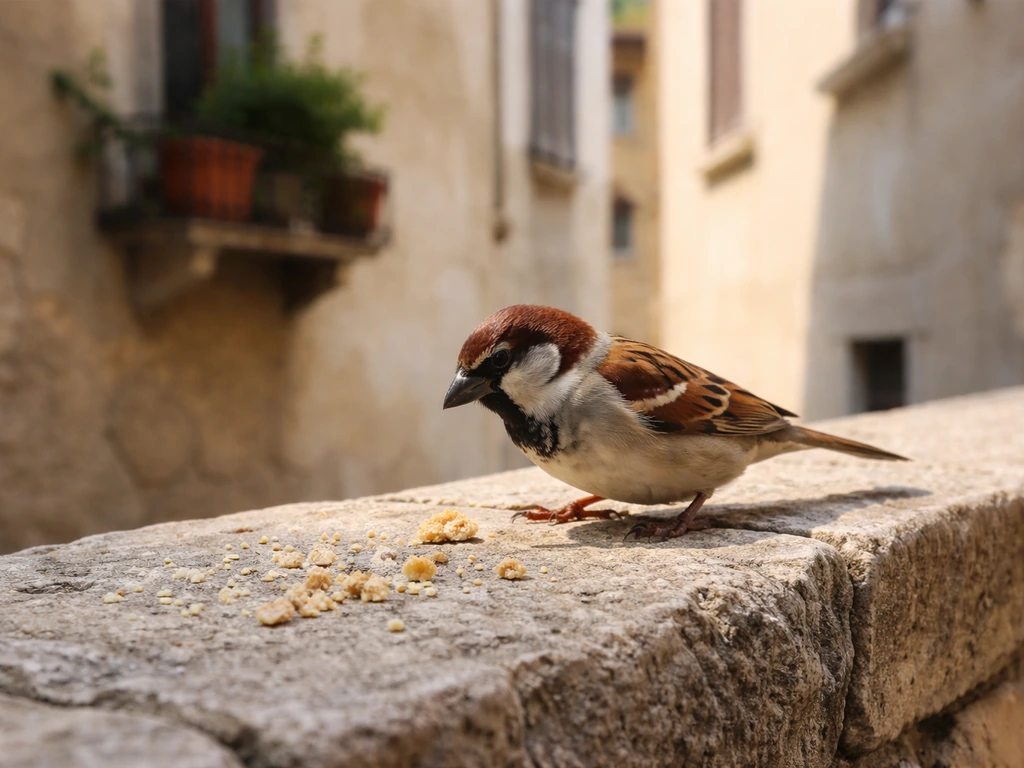
Part of what makes the Italian sparrow such a natural national symbol is how ordinary and present it is. Italian Wikipedia's species page describes it as 'strongly dependent on humans' and notes it 'frequents permanent inhabited centers and cultivated countryside.' In other words, this is the bird that hops around your café table in Rome, nests in the eaves of Milanese buildings, and picks at crumbs in Neapolitan piazzas. BAM (Birds in Milan) records it as a historically common urban species in Milan. That kind of everyday visibility matters enormously for national symbolism, it connects the bird not to remote wilderness but to the lived spaces of Italian life.
In Italian, 'passero' and its variants have deep roots in common speech. The word appears in proverbs, poetry, and folk sayings across Italian regions. While the Italian sparrow specifically doesn't carry the weight of a specific founding myth or legend the way some national birds do (think of the eagle in Roman iconography, which is a separate symbol entirely), it carries something arguably more intimate: it's the bird of the street, the village, the backyard. That ordinariness is the symbolism.
LIPU also documents a concerning urban decline in Italian sparrow populations, linked to changes in building construction (fewer nesting sites), pesticide use, and the reduction of weedy urban edges. This has added a conservation dimension to the symbolism, the bird has become a way to talk about what is being lost in modern Italian cities, which deepens its cultural meaning beyond simple pride.
The nation-building context behind national bird selections
Italy's relationship with the Italian sparrow fits a broader pattern: national bird selections are rarely purely scientific. They tend to happen during moments of national identity formation or cultural consolidation. Italy unified in 1861–1870, and by the 1890s, when 'Avicula' was publishing its sparrow-celebrating motto, Italian intellectuals were very consciously trying to define what 'Italian' meant in cultural and natural terms. Choosing an endemic, universally recognizable bird as a national emblem was part of that project.
This parallels what happened in neighboring countries. Greece, Turkey, Albania, Austria, Romania, Hungary, and Iran all have national birds that reflect specific moments of national consciousness and cultural values, sometimes a powerful predator to project strength, sometimes a migratory species tied to seasonal rhythms, sometimes an endemic species to assert geographic uniqueness. Hungary's national bird is the common kestrel (kezdő nyelven sólyom névvel is ismert) what is the national bird of hungary. For example, Iran has its own national-bird choice that reflects its cultural and national identity national bird of Iran. If you are curious about Romania specifically, Romania’s national bird is a different species chosen for its own national symbolism and regional ties Greece, Turkey, Albania, Austria, Romania, Hungary, and Iran. If you are wondering about another country’s picks, Austria has its own national bird as well. Greece, Turkey, Albania, Austria, Romania, Hungary, and Iran all have national birds, including a distinct national bird for Albania Albania's national bird. Greece’s national bird is the common nightingale what is the national bird of greece. If you're wondering the same for Turkey, its national bird is the roosting eagle rather than a sparrow. Italy's choice of a small, endemic, human-associated sparrow says something distinct: it prioritizes familiarity and belonging over grandeur.
It's also worth noting that Italy has a very strong tradition of ornithology and birdwatching culture, with organizations like LIPU playing a role roughly analogous to the RSPB in the UK. That scientific and civil-society tradition helped give the Italian sparrow's national-bird status real credibility even without a government mandate.
Traits that make the Italian sparrow a good fit for national symbolism
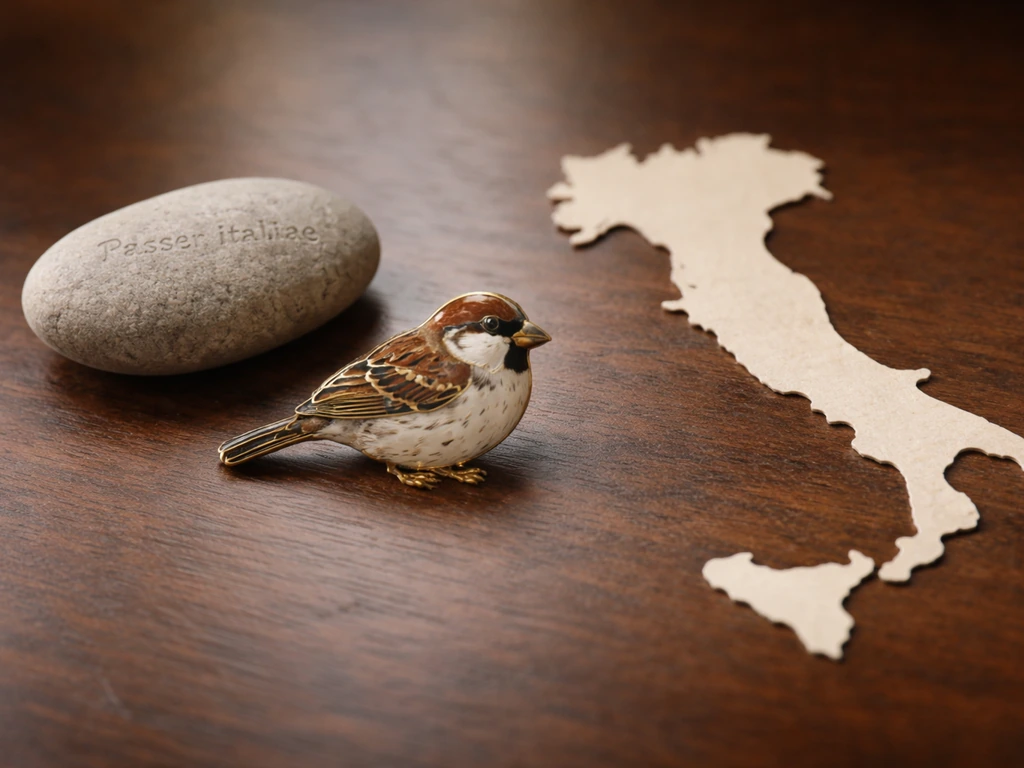
- Endemism: Passer italiae is found primarily in Italy, giving it genuine geographic exclusivity as a national symbol.
- Scientific naming: The species is literally named after Italy in its scientific name (italiae), a rare and explicit link between taxonomy and national identity.
- Ubiquity: It lives in cities, towns, and cultivated countryside throughout the peninsula, making it visible and familiar to virtually all Italians.
- Human association: Its strong dependence on human settlements means it has co-evolved alongside Italian civilization for millennia.
- Resilience narrative: Declining populations have turned the bird into a conservation symbol, adding urgency and emotional weight to its status.
- Ornithological tradition: The 'Avicula' motto and later birdwatching community promotion give it a documented intellectual and institutional history.
Common myths and confusion around the Italian sparrow
Myth 1: It's officially Italy's national bird
This is the most common misunderstanding. Passer italiae is unofficially considered Italy's national bird, there is no government decree, no official proclamation, and no legal designation. The status comes from ornithological tradition, birdwatching community consensus, and cultural familiarity, not from Italian state institutions. If you need an authoritative citation for a school paper or formal document, the honest answer is that Italy does not have an officially designated national bird in the way it has an officially designated national anthem.
Myth 2: 'Italian sparrow' just means any sparrow found in Italy
It doesn't. The Italian name 'passero' is used loosely for several sparrow-like birds, and Treccani's encyclopedia documents that Italian speakers use the word for multiple sparrow taxa including blank" rel="noopener noreferrer">Passer domesticus (the house sparrow) and various local forms. The Italian sparrow as a national symbol refers specifically to Passer italiae, a distinct taxon with its own scientific name, distribution, and characteristics. Confusing it with the house sparrow or other 'passeri' is a genuine and common error.
Myth 3: It's just a subspecies of the house sparrow
The taxonomy here has genuinely shifted over time and this is a legitimate source of confusion. Older classifications treated Passer italiae as Passer domesticus italiae, essentially a subspecies of the common house sparrow. More recent molecular research, including a 2011 paper in Molecular Ecology, supports treating it as a stable hybrid-origin entity and a distinct species in its own right, which is how most current authorities classify it. That scientific validation matters for its symbolic status: calling it Italy's national bird is more defensible when it's recognized as a species endemic to Italy rather than just a regional variant of a cosmopolitan bird.
Myth 4: The eagle is Italy's 'real' national bird
Italy's coat of arms features a white five-pointed star, not an eagle, and while the eagle is deeply embedded in Italian historical symbolism (Roman legions carried eagle standards, the Italian Republic used an eagle emblem at various points in heraldry), it is not designated as Italy's national bird. The eagle carries imperial and military associations; the Italian sparrow carries civilian and cultural ones. They occupy different symbolic spaces.
How to verify what you've read and go deeper

If you want to check the facts yourself, the most reliable starting points are LIPU's species page for Passer italiae (which confirms the endemism claim and provides ecology data), the GBIF taxon record (which pins down the scientific name and authority), and Italian Wikipedia's Passer italiae article (which covers the taxonomic debate and the 'Avicula' magazine history in useful detail). Treccani's 'Passero' entry is excellent for understanding why the common name 'Italian sparrow' can be confusing in Italian contexts. For the cultural and conservation angle, LIPU's broader work on urban bird decline in Italy tells you why this bird's symbolic status has gained emotional urgency in recent years.
For anyone building a broader picture of national bird symbolism across the region, it's worth comparing Italy's choice with those of its neighbors. Greece, Turkey, Albania, Austria, Romania, and Hungary each made different calls about what their national bird should represent, and comparing those choices reveals a lot about how different cultures frame their relationship with the natural world. Italy's quiet, urban sparrow is a distinctly different kind of national statement than the powerful birds of prey chosen by many of its neighbors.
FAQ
Is the Italian sparrow an official national bird of Italy by law?
No. Italy does not currently have a law or formal government instrument that designates any species as an official national bird. If you need something for an essay or official document, you should phrase it as an unofficial symbol and, if required, cite conservation and taxonomy organizations rather than treating it as state law.
How can I be sure I’m looking at Passer italiae and not a different sparrow?
The “Italian sparrow” refers specifically to Passer italiae, not the house sparrow (Passer domesticus). In everyday Italian speech, passero can cover multiple sparrow-like birds, so confirming the scientific name is the safest way to avoid mixing species.
Is the Italian sparrow truly endemic, or just associated with Italy?
It’s accurate to call it endemic in the sense that its breeding range is centered on the Italian Peninsula and nearby areas, but “endemic” is sometimes used loosely in popular writing. For strict work, rely on species range statements from conservation and biodiversity databases, which show the actual distribution rather than just national association.
Why do some websites disagree on whether Italy has a national bird?
Because the status is unofficial, you may see regional or historical references that disagree on wording. If you encounter “national bird” claims in blogs or local pages, treat them as cultural tradition, then verify the taxon identity and the history through ornithological and conservation sources.
Did Passer italiae used to be classified differently, and does that affect the “national bird” claim?
Taxonomy can change over time. Older references treated Passer italiae as a form related to the house sparrow, but more recent genetic evidence supports species-level recognition for Passer italiae in most modern authorities, which strengthens the argument for a distinct “Italian” bird symbol.
What’s the best wording to use in English or Italian so readers don’t confuse it with the house sparrow?
A good rule is to use the bird’s common name carefully in Italian contexts, because passero is a general term. When you write in English, including the scientific name Passer italiae on first mention helps readers avoid assuming you mean the house sparrow.
How does conservation for the Italian sparrow relate to its national-symbol status?
The bird’s everyday presence is part of the symbolism, but the conservation angle is equally important in current public messaging. If you are explaining “why it matters,” connect the cultural familiarity to habitat pressures, such as loss of suitable nesting spots in built environments.
If I want to verify the claim myself, what quick checklist should I follow?
You can do a quick fact-check with three layers: (1) confirm the scientific taxon name for “Italian sparrow,” (2) verify endemism or range statements from conservation/biodiversity records, and (3) look for historical ornithology mentions that explain how the symbol emerged without government endorsement.
Next Article
What Is the National Bird of Albania? Meaning and Facts
Find Albania’s national bird, the eagle, plus its symbolism, history, and how to recognize it in the wild.